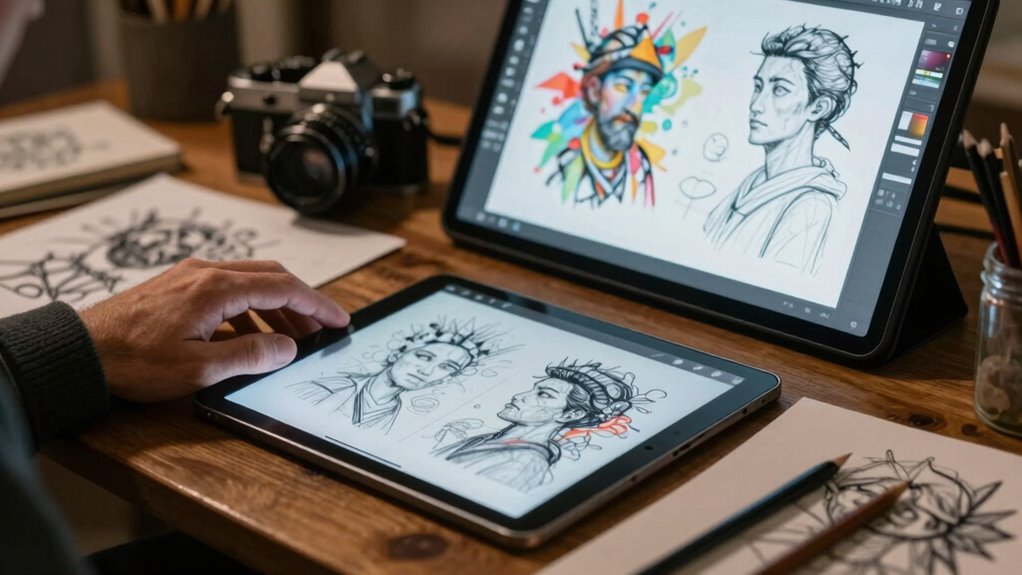
To navigate AI art ethics, you need to decide who owns your work, how much influence you retain, and what boundaries you set around datasets and training methods. Clarify your stance on originality and remain transparent about your creative input. Understanding legal and ethical implications helps protect your artistic integrity. If you move forward with purpose, you’ll find clearer ways to maintain authenticity and responsibility in your AI-driven creative journey.

Get the latest gadgets delivered free — and shop member deals
- Fast, free delivery on millions of items
- Access to Prime Big Deal Days deals on October 6–7
- Prime Video, Amazon Music and more included
Key Takeaways
- Clarify the extent of personal input and control in AI art to establish ownership and ethical boundaries.
- Decide on dataset transparency and ethical sourcing to address originality and moral considerations.
- Define the role of human creativity versus AI output to maintain artistic integrity and authenticity.
- Consider legal implications and advocate for clear copyright frameworks for AI-generated works.
- Reflect on societal impact and set ethical standards that promote responsible, intentional AI art creation.
Have you ever wondered whether AI-generated art challenges our traditional notions of creativity and originality? It’s a question that’s becoming more urgent as technology advances. When AI creates a piece of art, it blurs the lines between human ingenuity and machine output, raising important questions about copyright concerns and creative ownership. You might find yourself asking: who truly owns this work—the artist who trained the AI, the programmer who designed it, or the machine itself? These are critical issues that demand your attention because they impact not only legal rights but also how you define artistic value.
Copyright concerns come to the forefront in AI art because traditional copyright law assumes a human creator. When an AI produces a piece, it challenges this assumption. Is it fair to grant copyright to an algorithm? Or should the person who set the parameters or provided the input be considered the rightful owner? You need to consider that, under current laws, works created solely by AI might not qualify for copyright protection unless a human element is clearly involved. This creates a gray area where rights could either be unprotected or ambiguously assigned, potentially leading to disputes. As an artist or creator, you should think carefully about how to protect your work and clarify ownership rights in this new landscape.
Creative ownership also becomes complicated because AI tools are often trained on vast datasets that include existing artworks. When an AI generates new images or music, it’s effectively remixing and reinterpreting those inputs. This raises ethical questions about originality and whether the work is genuinely new or merely derivative. If you’re using AI, you need to decide how much control you want to retain over the final piece. Are you simply an operator, or do you see yourself as the primary creator? Establishing clear boundaries about your role in the process helps define your creative ownership. It’s essential to document your contributions and decisions to ensure your rights are protected and your artistic identity remains intact.
Ultimately, these issues aren’t just technical; they’re deeply personal and philosophical. You must decide how much you’re willing to accept AI’s influence in your work and how you want to navigate the legal and ethical landscape. As AI art continues to evolve, your choices about copyright concerns and creative ownership will shape how society perceives artistic value and originality. By staying informed and intentional, you can ensure your work reflects your vision while respecting the complexities introduced by this new era of art creation. Considering the role of datasets and how they influence AI-generated content can help you better understand the ethical boundaries involved.
As an affiliate, we earn on qualifying purchases.
Frequently Asked Questions
How Can Artists Protect Their Intellectual Property in Ai-Generated Art?
To safeguard your intellectual property in AI-generated art, you should address copyright concerns by registering your work whenever possible. Use licensing strategies to specify how others can use your creations, clearly defining permissions and restrictions. Keep detailed records of your creative process and the prompts used. By taking these steps, you guarantee your rights are protected and you maintain control over your art’s use and distribution.
What Are the Environmental Impacts of Training Large AI Models for Art?
You might think AI training is harmless, but it substantially impacts the environment through high energy consumption. To promote sustainable training, opt for models that use less energy or leverage renewable resources. By choosing energy-efficient techniques, you reduce your carbon footprint and help protect the planet. Remember, small choices in how you train AI models can lead to big environmental benefits, making your art practice more eco-friendly and responsible.
How Do We Ensure Diverse Representation in AI Art Datasets?
To guarantee diverse representation in AI art datasets, you should prioritize dataset diversity by actively sourcing images from different cultures, genders, and backgrounds. Implement bias mitigation techniques, like balanced sampling and algorithmic adjustments, to prevent overrepresentation of dominant groups. Regularly review and update your datasets to reflect evolving societal norms, fostering inclusivity and reducing bias in AI-generated art.
What Role Should Art Institutions Play in AI Art Ethics?
Your art institution should take the lead in shaping AI art ethics, acting like a lighthouse guiding responsible practices. You need to implement robust museum oversight and develop clear policies that address AI’s unique challenges. By doing so, you guarantee ethical standards are upheld, artists’ voices are protected, and the art community moves forward with integrity. Your proactive stance can prevent chaos and set the gold standard for AI art responsibility.
How Can Artists Collaborate Ethically With AI Technologies?
You can foster authentic collaboration with AI technologies by setting clear ethical boundaries upfront. Be transparent about your use of AI, ensuring your audience understands where human creativity ends and machine input begins. Engage in open dialogue with others, sharing your intentions and concerns. This approach helps maintain integrity, respects artistic values, and promotes responsible innovation, allowing you to integrate AI ethically while preserving the authenticity of your work.
As an affiliate, we earn on qualifying purchases.
Conclusion
Ultimately, you hold the brush that shapes the future of AI art. Don’t let the noise drown out your voice—stand firm and decide what kind of creative landscape you want to build. Like a lighthouse guiding ships through stormy waters, your choices illuminate ethical paths amid the chaos. Embrace your power to steer this revolution with clarity and conviction, ensuring that art’s true essence isn’t lost in the fog of controversy.
AI art dataset transparency software
As an affiliate, we earn on qualifying purchases.
As an affiliate, we earn on qualifying purchases.
copyright management for AI-generated art
As an affiliate, we earn on qualifying purchases.
As an affiliate, we earn on qualifying purchases.
Halloween Picks
halloween
As an affiliate, we earn on qualifying purchases.