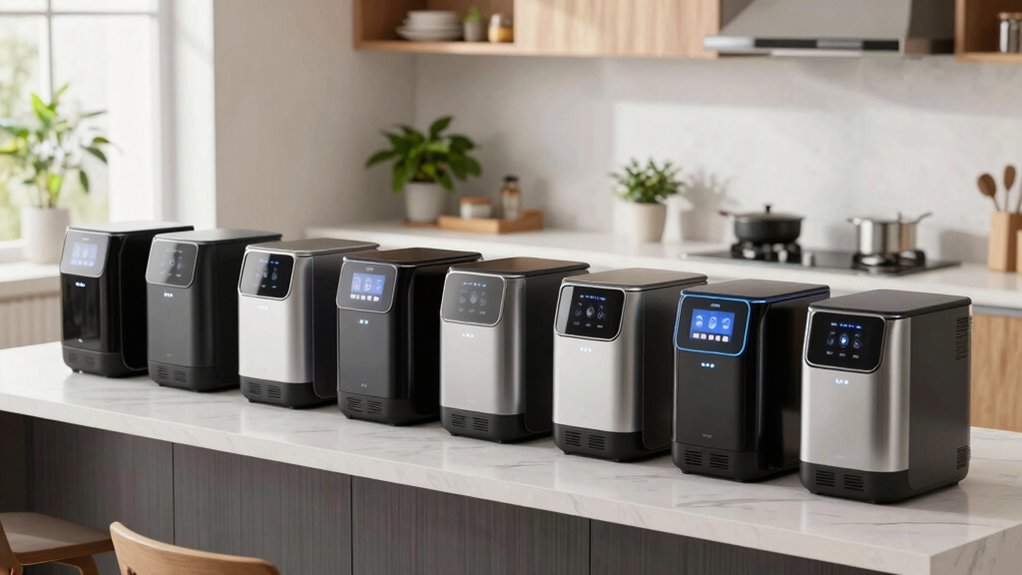

An electric composter for a kitchen can reduce the volume of food scraps and make indoor waste handling more convenient, but these machines vary in capacity, footprint, odor control, and upkeep. I would start with the Reencle Prime for its larger 14L capacity, while the Food Cycler Eco 5 stands out as a 5L alternative and the Airthereal R500-V suits kitchens that favor a smaller 2.5L unit with a visible cover. The main tradeoff is between a compact countertop footprint and fewer emptying cycles, with maintenance and the nature of the output also shaping the choice. Some models are marketed as composters, though processing scraps does not necessarily produce finished garden compost. Read on for the full comparison and a guide to choosing a machine that fits your kitchen and routine.

Get the latest gadgets delivered free with Prime
- Fast, free delivery on millions of items
- Prime Video, Amazon Music and more included
- Member-only deals all year
Complete the kit



Key Takeaways
- Capacity is the clearest dividing line: the Reencle Prime and GEME Terra 2 each list 14L, while several Ouaken, Saluna, and BAOSHISHAN options cluster around 4L and the Airthereal R500 models list 2.5L.
- The Food Cycler Eco 5 offers a middle ground: its listed 5L capacity is larger than the compact Airthereal units without moving into the footprint category implied by the 14L models.
- Visual access is a distinct feature, not a capacity upgrade: the Airthereal R500-V and Saluna 4L add a visible window, which may help users check contents but does not by itself indicate faster or more complete processing.
- Filter claims need context: listed carbon-filter life, dual-filter design, and odor-control wording differ across models; replacement availability and ongoing upkeep matter as much as the initial feature list.
- “Composter” does not guarantee finished compost: these products are also described as food recyclers or composter-bin alternatives, so buyers should check what the processed output is and how their local garden or waste program accepts it.


| electric composting machine for kitchen | Capacity | Model | Noise level | Dimensions |
|---|---|---|---|---|
| Ouaken 4L Electric Kitchen Com | 4 L | J6001A | Below 40 dBA | — |
| Ouaken OK-255 Electric Kitchen | 5.5 L | OK-255 | Below 45 dBA | — |
| Airthereal R500-V Electric Com | 2.5 L | — | — | 12.5 × 10 × 12.5 in |
| 1 Gallon Electric Composter wi | 1 gallon | FWD-301 | 28 dB | — |
| Reencle Prime Electric Compost | 14 L | — | As low as 28 dB | — |
| Food Cycler Eco 5 Award-Winnin | 5 liters | — | — | 10.3 x 13.8 x 13.8 inches |
| GEME Terra 2 14L Kitchen Elect | 14 liters | — | — | — |
| Ouaken 4L Electric Countertop | 4 liters | JF6001A | Below 40 dBA | — |
| Saluna 4L Electric Kitchen Com | 4 liters | FC-385W | — | 13.2 x 11 x 13.3 inches |
| Airthereal R500 Electric Kitch | 2.5 liters | — | — | 12.5 x 10 x 12.5 inches |
| Assark 3L Electric Kitchen Com | 3 L | HQD-260C | Below 40 dB | — |
| BAOSHISHAN 4L Electric Kitchen | 4 L | FWD-201 | — | 13 × 10 × 13 in |
| Soliddis 4.2L Indoor Electric | 4.2 L | CY03RG-C | Below 45 dB | 12.9 × 12.6 × 10.6 in |
| Ouaken 2.5L Indoor Electric Co | 2.5 L | JF6011A | Below 40 dB | 11.6 × 9.4 × 12 in |
| CGOLDENWALL Electric Kitchen C | 1.2 gallons (4.2 L) | CGO-SP08 | Below 40 dB | 12.8 × 10.4 × 13.3 in |
More Details on Our Top Picks
Ouaken 4L Electric Kitchen Composter
The Ouaken 4L is my most balanced pick for a kitchen that needs useful capacity without moving up to a larger, more involved machine. Its heat-drying and grinding cycle can reduce scraps by up to 90%, while the Crush, Ferment, and Clean modes cover everyday processing and cleanup. Compared with the Airthereal R500-V, it holds more and offers a detachable, dishwasher-safe bucket, but it lacks that model’s viewing window and stated three-year warranty. The reported noise level below 40 dBA suits kitchens where a louder appliance would be distracting. One operating habit matters: the bucket should be emptied before each cycle, since leftover material can clump and may cause blade or fan problems. Reprocessing scraps can also add cycle time and power use.
Pros:- 4-liter capacity offers more room than the 2.5-liter Airthereal R500-V.
- Crush, Ferment, and Clean modes support processing and routine maintenance.
- Detachable bucket is dishwasher-safe.
- Reported operating noise is below 40 dBA.
Cons:- Manufacturer recommends emptying the bucket before every cycle to reduce clumping and protect the fan or blades.
- Treating the same material repeatedly can extend operation and increase power use.
Best for: Households seeking a versatile 4-liter countertop machine with a removable bucket that can go in the dishwasher.
Not ideal for: Buyers who want to load scraps across multiple cycles without emptying the bucket, or who prioritize a transparent lid for monitoring.
- Capacity:4 L
- Model:J6001A
- Modes:Crush, Ferment, Clean
- Noise level:Below 40 dBA
- Waste reduction:Up to 90%
- Carbon filter life:Up to 5 months
- Bucket:Detachable and dishwasher-safe
- Color:White
Our verdict“Choose the Ouaken 4L if you want a quiet, versatile countertop composter with an easy-to-clean bucket and can empty it between cycles.”
Ouaken OK-255 Electric Kitchen Composter, 5.5 L
When a 4-liter bin feels restrictive, the Ouaken OK-255’s 5.5-liter capacity gives daily scraps more room before the next cycle. Its five modes—Standard, Quick, Crush, Clean, and Store—make it more adaptable than the Ouaken 4L, which has three modes, and the transparent flip-top lid helps with everyday access and maintenance. Heat drying and grinding can reduce food-waste volume by up to 90%; an activated-carbon filter and moisture collection tray address two practical kitchen concerns. The tradeoff is a reported noise level below 45 dBA, higher than the smaller Ouaken’s below-40-dBA figure, and the filter is recommended for replacement about every five months. This is a capacity-and-flexibility choice, not the best fit for shoppers prioritizing the quietest stated operation.
Pros:- 5.5-liter capacity exceeds the Ouaken 4L and Airthereal R500-V.
- Five modes offer more cycle and storage options than the three-mode Ouaken 4L.
- Transparent flip-top lid supports convenient access and maintenance.
- Activated-carbon filtration and a moisture collection tray help manage odors and liquid.
Cons:- Noise is specified below 45 dBA, rather than the Ouaken 4L’s below-40-dBA figure.
- Filter replacement is recommended approximately every five months.
Best for: Households that generate enough food scraps to benefit from a larger countertop capacity and want dedicated quick, storage, and cleaning modes.
Not ideal for: Noise-sensitive households that prefer the lower stated operating level of the Ouaken 4L, or kitchens where countertop space is scarce.
- Capacity:5.5 L
- Model:OK-255
- Modes:Standard, Quick, Crush, Clean, Store
- Noise level:Below 45 dBA
- Food-waste volume reduction:Up to 90%
- Odor control:Activated-carbon filter
- Recommended filter replacement:Approximately every 5 months
- Non-stick coating hardness:9H
Our verdict“Pick the OK-255 if you need more capacity and mode choices than the Ouaken 4L provides and can accommodate its larger countertop footprint.”
Airthereal R500-V Electric Composter, Visual Glass Cover, 2.5L, Gray
The Airthereal R500-V is the lineup’s clearest choice for someone who wants to see what is happening inside the machine: its transparent glass cover lets you monitor the cycle without opening the lid. The 2.5-liter bucket is more compact than the 4-liter Ouaken models, making it a better match for lighter scrap volumes, though larger households may need to empty it more often. Its SHARKSDEN tri-blade system turns scraps into dry material in a stated two to five hours, with waste volume reduction of up to 90%. A biodegradable carbon filter helps limit odors, but the product description notes that some smell can still be noticeable during operation. Unlike the Ouaken 4L, it also lists a three-year warranty. The small capacity is the main compromise for buyers who value visibility and a compact footprint.
Pros:- Transparent glass cover allows cycle monitoring without opening the unit.
- Stated processing time is 2–5 hours, with up to 90% waste-volume reduction.
- SHARKSDEN tri-blade system is designed to grind food scraps.
- Lists a three-year warranty.
Cons:- 2.5-liter capacity is smaller than either Ouaken model here and can mean more frequent emptying.
- Some odor may still be noticeable during processing.
- Requires a stable countertop space and an electrical connection.
Best for: One- or two-person households that produce modest amounts of scraps and want to watch the process through a transparent cover.
Not ideal for: Larger households that need more than 2.5 liters of capacity or buyers who require odor control with no noticeable smell during a cycle.
- Capacity:2.5 L
- Dimensions:12.5 × 10 × 12.5 in
- Color:Gray
- Bucket material:Cast aluminum
- Cover:Transparent glass
- Processing time:2–5 hours
- Waste-volume reduction:Up to 90%
- Warranty:3 years
Our verdict“Choose the R500-V if visibility and a compact 2.5-liter format matter more than the larger capacity of the Ouaken models.”
1 Gallon Electric Composter with Smart Touch Screen, Whisper-Quiet & Rapid Composting, 0.5 kWh Energy-Efficient, Odorless Kitchen Bin with Carbon Filter (2000h), 2 Composting Modes, Self-Cleaning
For a kitchen where appliance noise is a deciding factor, the KEEPEEZ FWD-301 has the lowest stated sound level in this group at 28 dB. Its one-gallon capacity sits between the compact Airthereal R500-V’s 2.5 liters and the larger Ouaken OK-255’s 5.5 liters, giving it a middle-ground format for moderate scrap volumes. The product description lists two composting modes, a touchscreen display, child safety lock, and self-cleaning function, while the three-layer activated-carbon filter is specified at 760 g. A cycle is described as taking two to ten hours and using 0.5 kWh. Compared with the Ouaken OK-255, it has fewer modes and less listed capacity, but its quieter operating figure and safety features may suit shared living spaces. The one-gallon limit can mean frequent emptying for larger families.
Pros:- Specified noise level of 28 dB is lower than the stated levels for both Ouaken models.
- Touch LED display and child safety lock add convenient controls and a safety feature.
- Three-layer activated-carbon filter is specified at 760 g.
- Self-cleaning function reduces routine bucket-cleaning work.
Cons:- One-gallon capacity may require frequent emptying in larger households.
- Two composting modes offer fewer options than the five-mode Ouaken OK-255.
Best for: Noise-sensitive households with moderate daily food scraps that want touchscreen controls, a child lock, and self-cleaning.
Not ideal for: Larger families seeking the higher stated capacity and five mode options of the Ouaken OK-255.
- Brand:KEEPEEZ
- Model:FWD-301
- Capacity:1 gallon
- Power per cycle:0.5 kWh
- Noise level:28 dB
- Filter:3-layer activated carbon, 760 g
- Composting modes:2
- Warranty:3 years
Our verdict“Choose the KEEPEEZ if a quiet cycle and kitchen-friendly controls matter more than the larger load capacity and mode selection of the Ouaken OK-255.”
Reencle Prime Electric Composter, 14L, Silver
The Reencle Prime stands apart from the smaller countertop-style machines here with a 14-liter capacity and a stated ability to process up to 2.2 pounds of scraps. Its microbial-decomposition approach differs from the heat-drying and grinding cycles described for the Ouaken OK-255 and Airthereal R500-V, making it the option to compare when you want an indoor system built around ongoing compost processing rather than just reducing scraps to dry material. A three-layer filter helps manage odors, and its noise level is listed as low as 28 dB—matching the KEEPEEZ figure while offering much more capacity. The drawback is timing: processing can take anywhere from two to 24 hours, so it is less predictable than the R500-V’s stated two-to-five-hour cycle. It also comes with a starter pack and shovel, though the larger format needs more room.
Pros:- 14-liter capacity and stated handling of up to 2.2 pounds of scraps offer substantially more room than the other listed models.
- Microbial decomposition provides an alternative to the heat-drying and grinding approach used by the Ouaken OK-255.
- Three-layer filtration helps control odors.
- Includes a carbon filter, compost starter pack, and shovel.
Cons:- Processing time varies from 2 to 24 hours.
- Its 14-liter format needs more space than the compact Airthereal R500-V and one-gallon KEEPEEZ.
Best for: Households generating substantial food scraps that want a high-capacity indoor composter and are comfortable with variable processing times.
Not ideal for: Small kitchens with limited floor or counter space, or buyers who want a short, predictable cycle like the Airthereal R500-V’s stated 2–5 hours.
- Capacity:14 L
- Food-waste capacity:Up to 2.2 lb
- Processing time:2–24 hours
- Noise level:As low as 28 dB
- Processing method:Microbial decomposition
- Filter system:Three-layer
- Included accessories:Carbon filter, compost starter pack, shovel
- Color:Silver
Our verdict“Choose the Reencle Prime if your household needs substantially more capacity than the smaller electric composters offer and can accept variable processing times.”
Food Cycler Eco 5 Award-Winning Kitchen Food Recycler – Indoor Composter Bin Alternative, Electric Countertop Food Disposer with Odorless 5L Indoor Food Waste Bin, Grey
The Food Cycler Eco 5 makes the most sense for kitchens that want a larger batch size without moving to a floor-standing unit. Its 5-liter removable bucket holds more scraps than the 4-liter Ouaken and Saluna, so households can wait longer between emptying. One-touch operation keeps the routine simple, while a refillable carbon filter helps limit odors indoors. Its tradeoff is pace: cycles can take several hours, so it is not the pick for someone expecting quick turnaround after every meal. The filter also needs periodic replacement. Compared with the smaller Airthereal R500, this model gives up compactness in favor of capacity; compared with the GEME Terra 2, it offers a familiar batch-based countertop approach rather than continuous feeding.
Pros:- 5-liter bucket accommodates larger batches than the 4-liter Ouaken and Saluna
- Removable bucket makes loading and emptying more manageable
- Carbon filter helps control kitchen odors
- One-touch operation keeps daily use simple
Cons:- Processing cycles can take several hours
- Refillable carbon filter requires periodic replacement
- At 13.6 kg, it is a heavy countertop appliance to move
Best for: Households that produce steady kitchen scraps and want a roomy removable bucket with straightforward one-touch operation.
Not ideal for: People who need continuous feeding or a fast cycle after each meal; the batch process can take several hours and the filter needs upkeep.
- Capacity:5 liters
- Dimensions:10.3 x 13.8 x 13.8 inches
- Weight:13.6 kg
- Color:Gray
- Material:Plastic
- Included components:Bucket and lid, carbon refill, food recycler, refillable filter
- Warranty:3-year limited
Our verdict“Choose the Eco 5 if you want a larger batch-style countertop recycler and can wait through longer cycles.”
GEME Terra 2 14L Kitchen Electric Composter
Unlike the batch-based Food Cycler Eco 5, the GEME Terra 2 is designed for continuous feeding, making it better suited to kitchens that add scraps throughout the day. Its 14-liter capacity and stated daily handling of up to 2 kg give it a much larger working volume than the 4- and 5-liter countertop choices here. The kick-open lid also helps when hands are full, and its permanent catalytic filter avoids routine filter replacements. The tradeoff is its larger footprint and reliance on microbial processing, which may not suit buyers looking for a compact appliance that simply dries and grinds a batch. The stated 6–8 hour processing time and waste reduction are manufacturer claims, not guarantees. Compared with the Eco 5, Terra 2 prioritizes ongoing input and volume over a smaller, simpler batch routine.
Pros:- Continuous-feed design accepts scraps without waiting for a batch to finish
- 14-liter capacity and stated daily capacity suit higher waste volumes
- Permanent catalytic filter does not require routine replacement
- Kick-open lid and sensors support hands-free use and monitoring
Cons:- Larger capacity may require more kitchen space than compact batch models
- The 6–8 hour processing time and up-to-95% reduction are product claims
- Microbial processing is less suited to buyers who want a simple drying-and-grinding cycle
Best for: High-scrap households that want continuous feeding, hands-free lid access, and room for food waste as it accumulates.
Not ideal for: Small kitchens or buyers seeking a compact batch appliance; its 14-liter capacity and microbial system are a different, larger-scale setup.
- Capacity:14 liters
- Daily capacity:Up to 2 kg (4.4 lb)
- Processing time:6–8 hours (claimed)
- Waste reduction:Up to 95% (claimed)
- Feeding method:Continuous feed
- Filter:Permanent catalytic filter
- Lid:Kick-open
- Monitoring:Humidity, temperature, and weight sensors
Our verdict“Pick the Terra 2 if your priority is continuous feeding and high capacity rather than a compact batch-style machine.”
Ouaken 4L Electric Countertop Composter
The Ouaken 4L stands out for buyers who want a defined batch cycle rather than the Eco 5’s several-hour wait: its stated process takes about three hours. Three modes—Crush, Ferment, and Clean—give it more operating flexibility than the one-touch Food Cycler Eco 5, while a detachable, dishwasher-safe bucket reduces cleanup effort. Its noise rating is listed below 40 dBA, which may suit kitchens where an appliance runs near living areas. The tradeoffs are its smaller 4-liter capacity and a carbon filter that may need replacement after about five months. Compared with the 2.5-liter Airthereal R500, it offers more batch room and a shorter stated cycle; compared with Saluna’s 4-liter model, Ouaken provides a listed processing time and noise figure.
Pros:- About three-hour stated processing time is quicker than the Eco 5’s several-hour cycles
- Three modes include crushing, fermenting, and cleaning
- Detachable bucket is dishwasher safe
- Listed noise level is below 40 dBA
Cons:- 4-liter capacity is smaller than the Food Cycler Eco 5 and much smaller than the GEME Terra 2
- Carbon filter may need replacement after about five months
- Processing still takes about three hours rather than producing material immediately
Best for: People who want a 4-liter batch appliance with a stated three-hour cycle, multiple modes, and easier bucket cleanup.
Not ideal for: Large households that regularly produce more scraps than a 4-liter batch can hold, or buyers who do not want periodic filter replacement.
- Capacity:4 liters
- Model:JF6001A
- Waste reduction:Up to 90% (claimed)
- Processing time:About 3 hours
- Noise level:Below 40 dBA
- Modes:Crush, Ferment, Clean
- Carbon filter life:Up to 5 months
- Bucket:Detachable and dishwasher safe
Our verdict“Choose the Ouaken if a shorter stated batch cycle and dishwasher-safe bucket matter more than maximum capacity.”
Saluna 4L Electric Kitchen Composter with Visible Window
The Saluna 4L is a practical match for buyers who care about cleanup and odor control more than a published cycle duration. Its removable dishwasher-safe bucket and one-touch auto-cleaning reduce the effort after processing, while dual activated carbon filters offer a different odor-control setup from the single-filter Ouaken and Food Cycler Eco 5. Three modes and an LED display add more control than the Eco 5’s one-touch approach. The main limitation is uncertainty: the product details do not state how long a cycle takes, making it harder to plan around than the Ouaken’s roughly three-hour cycle or Airthereal’s four-hour run. Its 4-liter capacity also keeps it firmly in the smaller-batch class, well below the GEME Terra 2’s 14 liters.
Pros:- Removable dishwasher-safe bucket simplifies cleanup
- One-touch auto-cleaning reduces hands-on maintenance
- Dual activated carbon filters help manage odors
- Three modes and an LED display provide more controls than the Eco 5
Cons:- Product details do not specify cycle time
- 4-liter capacity limits batch size compared with the Eco 5 and GEME Terra 2
- The listed features do not provide a stated noise level
Best for: Apartment cooks and small households who prioritize easy bucket washing, auto-cleaning, and dual-filter odor control.
Not ideal for: Buyers who need a known cycle duration or regularly fill larger batches; cycle timing is unspecified and capacity is 4 liters.
- Capacity:4 liters
- Dimensions:13.2 x 11 x 13.3 inches
- Color:White
- Materials:Metal and stainless steel
- Modes:3
- Cleaning:One-touch auto-cleaning; removable dishwasher-safe bucket
- Odor control:Dual activated carbon filters
- Model:FC-385W
Our verdict“Pick the Saluna if easy cleanup and dual-filter odor control outweigh the need for a confirmed cycle time.”
Airthereal R500 Electric Kitchen Composter, 2.5 L, Gray
The Airthereal R500 is the compact choice in this group, with a 2.5-liter aluminum bucket that takes up less working capacity than the 4-liter Ouaken and Saluna. Its stated four-hour cycle turns scraps into dry powder fertilizer, and a tri-blade system handles the grinding stage. The single-button control keeps operation simple, while the dishwasher-safe bucket makes cleanup less fiddly. The price of its smaller footprint is fewer scraps per batch, so it is a weaker fit for households that would benefit from the Eco 5’s 5-liter bucket or GEME Terra 2’s continuous feed. The full cycle also takes four hours, and the product notes possible grinding noise. Its biodegradable carbon filter helps control odor but adds another consumable to maintain.
Pros:- Compact 2.5-liter capacity suits smaller kitchens and lower waste volumes
- Tri-blade system processes scraps into dry powder in a stated four-hour cycle
- Cast-aluminum bucket is dishwasher safe
- Single-button operation is straightforward
Cons:- Smallest capacity among these five picks limits batch size
- Four-hour cycle is not a rapid turnaround
- Grinding may create noise, and the carbon filter is a consumable
Best for: One- or two-person households with limited counter space that prefer simple controls and a dishwasher-safe metal bucket.
Not ideal for: Families or frequent cooks who generate large amounts of scraps; the 2.5-liter capacity means smaller batches than the Eco 5, Ouaken, or Saluna.
- Capacity:2.5 liters
- Dimensions:12.5 x 10 x 12.5 inches
- Weight:16.8 pounds
- Color:Gray
- Material:Aluminum
- Processing time:4 hours
- Bucket:Dishwasher safe
- Warranty:1 year
Our verdict“Choose the R500 if counter space and a simple, compact setup matter more than processing larger batches.”
Assark 3L Electric Kitchen Compost Bin – Smart Countertop Composter with Odorless Carbon Filter
The Assark 3L suits kitchens where a low-noise appliance and minimal tending matter more than batch size. Its under-40 dB operation is quieter than the Soliddis, rated below 45 dB, while three modes let you choose between quick processing, storage, and a deeper cycle. The stated 4–6-hour cycle and automatic pause/resume make it a practical fit for routine scraps without constant attention. Auto-cleaning also reduces the work after a run, though it does not remove the need to maintain the bin and replace its carbon filter. At 3 liters, it holds less than the 4.2-liter Soliddis and CGOLDENWALL, so households that produce a steady volume of scraps may need to empty it more often. Its strongest case is quiet convenience, not capacity.
Pros:- Three modes offer quick processing, storage, and deeper treatment options.
- Rated below 40 dB, quieter than the Soliddis’s below-45 dB rating.
- Automatic pause/resume and auto-clean functions reduce routine handling.
- Stated 4–6-hour processing cycle can reduce the wait for everyday scraps.
Cons:- The 3-liter capacity is smaller than the Soliddis and CGOLDENWALL, which each hold 4.2 liters.
- The activated-carbon filter needs periodic replacement.
- Deep mode may take longer than the quick cycle.
Best for: Apartment cooks and small households who want quiet, automated countertop processing and do not generate large batches of scraps.
Not ideal for: Families or frequent home cooks who need a larger batch capacity or want to avoid periodic carbon-filter replacement.
- Capacity:3 L
- Model:HQD-260C
- Noise level:Below 40 dB
- Modes:Quick, Storage, Deep
- Cycle time:4–6 hours
- Filter:Activated carbon; stated to last up to 3 months
- Warranty:12-month limited warranty
Our verdict“Choose the Assark if quiet, low-effort operation matters more to you than the larger capacity offered by the Soliddis or CGOLDENWALL.”
BAOSHISHAN 4L Electric Kitchen Food Recycler
The BAOSHISHAN is a straightforward pick for cooks who want to load a countertop recycler and let its sensors adjust the run. Its one-touch operation and moisture and temperature sensing set it apart from the Ouaken 2.5L, which emphasizes compact size and separate modes rather than automatic cycle adjustment. The BAOSHISHAN’s 4-liter bucket also offers more room than the Ouaken, while its dishwasher-safe construction gives cleanup a clear advantage over models that rely on a self-clean function alone. Cycle time ranges from 2 to 6 hours, so this is not a fast, fixed-duration appliance every time; the actual run adjusts to the contents. The dimensions are substantial for a countertop machine, and the product data gives little detail beyond its core functions. It makes the most sense for buyers who value simple controls and easy bucket washing.
Pros:- One-touch controls and moisture and temperature sensors adjust the cycle to the contents.
- The 4-liter capacity exceeds the Ouaken 2.5L’s capacity.
- Dishwasher-safe bucket makes direct cleanup easier.
- Designed to reduce food waste volume by up to 90%.
Cons:- The cycle can take 2–6 hours rather than following a single set duration.
- At 13 × 10 × 13 inches, it may take up meaningful counter space.
- The supplied details do not specify a noise rating or filter replacement interval.
Best for: Busy cooks who want a one-touch recycler with a dishwasher-safe bucket and enough capacity for regular household scraps.
Not ideal for: People with limited counter space or buyers who need a predictable short cycle instead of an automatically adjusted 2–6-hour run.
- Capacity:4 L
- Model:FWD-201
- Cycle time:2–6 hours
- Waste volume reduction:Up to 90%
- Blade material:Aluminum alloy
- Odor control:Integrated carbon filtration system
- Bucket:Dishwasher safe
- Dimensions:13 × 10 × 13 in
- Warranty:1 year
Our verdict“Pick the BAOSHISHAN if easy bucket cleanup and sensor-adjusted one-touch operation matter more than a compact footprint or fixed cycle time.”
Soliddis 4.2L Indoor Electric Food Waste Composter
Among these five machines, the Soliddis is one of the clearest choices for households that want more room per batch: its 4.2-liter capacity matches the CGOLDENWALL and exceeds the 3-liter Assark and 2.5-liter Ouaken. It crushes and dries scraps into dry pre-composting material in hours, a useful distinction for buyers who understand that processed output is not necessarily finished garden compost. A 900 ml activated-carbon filter, below-45 dB operation, and self-cleaning function round out the everyday convenience features. Compared with the quieter Assark, the Soliddis has a higher stated noise ceiling; compared with the CGOLDENWALL, its supplied information does not give a waste-reduction percentage or a second filter. Starting requires a long press, and the filter has a stated replacement point of about 600 operating hours.
Pros:- The 4.2-liter capacity accommodates larger batches than the Assark or Ouaken 2.5L.
- Self-cleaning function can reduce manual cleanup.
- Processes scraps into dry material in hours.
- A 900 ml activated-carbon filter is included for odor control.
Cons:- Its below-45 dB rating is higher than the Assark and Ouaken’s below-40 dB ratings.
- Starting requires a long press rather than a quick tap.
- Filter replacement is specified after approximately 600 hours of operation.
Best for: Families and regular home cooks who want a 4.2-liter batch capacity and can use dry, pre-composted material as a next step.
Not ideal for: Buyers who want a below-40 dB rating, a one-touch start, or a stated high waste-reduction percentage.
- Capacity:4.2 L
- Model:CY03RG-C
- Noise level:Below 45 dB
- Carbon filter capacity:900 ml
- Dimensions:12.9 × 12.6 × 10.6 in
- Weight:14.3 lb
- Material:Aluminum
- Filter replacement interval:Approximately 600 operating hours
Our verdict“Choose the Soliddis for larger daily batches and self-cleaning, provided its long-press start and pre-compost output suit your routine.”
Ouaken 2.5L Indoor Electric Composter
The Ouaken is the space-conscious option here: at 11.6 × 9.4 × 12 inches and 11 pounds, it is easier to accommodate than the 4-liter BAOSHISHAN, though its smaller 2.5-liter capacity means more frequent batches. Its below-40 dB operation makes it a quieter choice than the Soliddis, and Crush, Ferment, and Clean modes give it a different emphasis from the Assark’s Quick, Storage, and Deep settings. The detachable blade assembly and removable bucket are practical details for people who want access to the parts that collect food residue. The machine is described as reducing waste volume by up to 90% through drying and grinding, but its output is still processed material, not necessarily finished compost. Its filter life is stated as up to five months, and small households are more likely to appreciate this compact tradeoff than larger ones.
Pros:- Compact dimensions and 11-pound weight suit kitchens with limited counter space.
- Below-40 dB operation is quieter by rating than the Soliddis.
- Removable bucket and detachable blade assembly make cleaning access easier.
- Three modes cover crushing, fermenting, and cleaning.
Cons:- The 2.5-liter capacity is the smallest among these five products.
- Carbon filter replacement is needed after up to five months, depending on use.
- Processed scraps may need further treatment before use as finished compost.
Best for: Apartment residents, couples, or solo cooks who need a smaller countertop footprint and produce modest amounts of food scraps.
Not ideal for: Families or batch-focused cooks who would rather have the Soliddis or CGOLDENWALL’s 4.2-liter capacity.
- Capacity:2.5 L
- Model:JF6011A
- Dimensions:11.6 × 9.4 × 12 in
- Weight:11 lb
- Noise level:Below 40 dB
- Modes:Crush, Ferment, Clean
- Waste volume reduction:Up to 90%
- Carbon filter life:Up to 5 months
Our verdict“Choose the Ouaken if counter space and easy access for cleaning outweigh the smaller batch size.”
CGOLDENWALL Electric Kitchen Composter, 1.2-Gallon, with Dual Carbon Filters
The CGOLDENWALL combines a 4.2-liter capacity with two activated-carbon filters, making it a strong fit for kitchens that process larger loads but still want odor-control hardware built in. Its capacity matches the Soliddis and exceeds the Assark and Ouaken, while its below-40 dB rating is quieter by specification than the Soliddis’s below-45 dB rating. Automatic sensors adjust processing, reducing the need to manage each run, and the product states waste reduction of up to 90–95%. The tradeoff is what happens after processing: the description says further fermentation may be needed before the scraps become fertilizer. Its 15.8-pound weight and roughly 13-inch height also make it a substantial countertop appliance, unlike the lighter, more compact Ouaken. Buyers should pick it for capacity and dual filtration, not for a promise of finished compost straight from the cycle.
Pros:- The 4.2-liter capacity matches the larger Soliddis and exceeds the Assark and Ouaken.
- Two activated-carbon filters provide a dual-filter odor-control setup.
- Automatic sensors adjust processing without requiring constant input.
- Rated below 40 dB and specified to reduce waste volume by up to 90–95%.
Cons:- Further fermentation may be needed before processed scraps become fertilizer.
- At 15.8 pounds, it is heavier than the Ouaken 2.5L.
- Its 12.8 × 10.4 × 13.3-inch body requires a substantial countertop footprint.
Best for: Households producing larger scrap batches that want automatic processing, dual carbon filters, and a quiet-by-rating countertop appliance.
Not ideal for: Buyers seeking a lightweight compact unit or finished fertilizer without an additional fermentation step.
- Capacity:1.2 gallons (4.2 L)
- Model:CGO-SP08
- Dimensions:12.8 × 10.4 × 13.3 in
- Weight:15.8 lb
- Filters:2 activated-carbon filters
- Noise level:Below 40 dB
- Waste reduction:Up to 90–95%
- Composting modes:2
- Material:Plastic
Our verdict“Choose the CGOLDENWALL if you need a larger batch size and dual filtration, and are comfortable fermenting the output further when needed.”

How We Picked
I ranked these 15 electric kitchen food-waste machines by how clearly their stated features address daily indoor use: listed capacity, likely countertop fit, odor-control details, maintenance features, and ease of understanding what the machine does. I gave more weight to specific, decision-useful information than broad claims such as “rapid,” “odorless,” or “award-winning.” A model with a larger stated capacity can suit a busy household, but size alone does not make it a better kitchen choice if counter or storage space is limited.
The order reflects use-case fit and the strength of the available product details, not a claim that every unit has been independently tested. Models with distinct, practical differentiators—such as the Reencle Prime and GEME Terra 2’s 14L capacity, the Food Cycler Eco 5’s 5L size, or the Airthereal R500-V’s visible cover—are easier to place against a real need. Similar-capacity models remain lower where the listed information provides fewer distinguishing details. I also treat food-waste processing and finished compost as separate outcomes, since buyers should verify the intended use of the output before choosing.
Factors to Consider When Choosing Electric Composting Machine For Kitchens
Before choosing an electric composter, I would match the machine to the household’s scrap volume and kitchen routine rather than buying by capacity or feature count alone. These four checks can help prevent a unit from becoming an awkward countertop appliance.
Match Capacity to Your Scrap Routine
Capacity affects how often you may need to load, process, and empty the machine, but the listed volume does not tell you exactly how much food waste fits in a typical cycle. Think about how many people cook at home, how often you prepare fresh food, and whether you want to store scraps between cycles. A larger unit such as a 14L model may suit heavier household use, but it can claim more counter or floor space. A 2.5L machine may be easier to place in a compact kitchen yet require more frequent attention. Avoid choosing the biggest capacity automatically; a unit that obstructs prep space can be less useful than a smaller one that fits your routine. Check the manufacturer’s guidance on loading levels and cycle frequency before comparing capacities.
Check the Real Countertop Footprint
Capacity is only one part of kitchen fit: height, lid clearance, ventilation needs, and access to the removable container can determine whether a machine works in its intended spot. Measure the full space, including room to open the lid and lift out any bucket or processing chamber. A compact listing such as the Airthereal R500’s 2.5L capacity may sound convenient, but confirm its actual dimensions rather than inferring them from volume. Also check the distance to outlets and whether the appliance needs an open area around it. One common mistake is measuring only the counter surface while overlooking upper cabinets. If counter space is scarce, consider where the unit will live between cycles before settling on a capacity.
Understand What the Output Can and Cannot Do
Electric kitchen machines may dry, grind, or otherwise process scraps, but those actions do not automatically create mature compost ready for every garden. Before buying, read the maker’s description of the finished material and follow its instructions for disposal, curing, or soil use. Check whether your intended destination—home garden, municipal organics program, or regular waste collection—accepts that material. Do not assume a product described as an “indoor composter” produces the same result as a traditional outdoor compost pile. This distinction matters most if your main goal is to feed plants rather than reduce the volume of kitchen scraps. Choosing based on the desired end use can prevent disappointment after the machine arrives.
Compare Odor Control and Filter Upkeep
Carbon filters can help manage smells, but a filter’s presence is not a promise that every load will be odor-free. Look for clear information about filter replacement, availability, and the maker’s stated service life, such as the listed 2000-hour filter claim on one model. Consider whether filters are easy to access and whether the unit needs routine cleaning around the lid or chamber. Wet, strongly scented scraps and infrequent cleaning can affect odor regardless of a product’s marketing language. A dual-filter design may appeal to odor-sensitive households, but it also makes replacement details worth checking. Before purchase, look for an ongoing maintenance plan rather than focusing only on the included filter.
Prioritize Maintenance You Will Actually Do
Self-cleaning claims and removable parts can reduce effort, but they do not mean the machine requires no care. Review which components are dishwasher-safe, what needs hand washing, and whether residue can collect around blades, seals, or vents. If you cook daily, a simple emptying and cleaning routine may matter more than a touchscreen or multiple processing modes. Buyers sometimes focus on cycle speed and overlook the time needed to clean the container after use. Check the warranty and replacement-part information too, especially for filters and wear components. The best maintenance setup is the one you are likely to keep up with during a busy week.
Pay for Features That Solve Your Specific Problem
A visible window, touch controls, extra capacity, or added filters can be useful when each addresses a real kitchen need. A window may let you check contents without opening the lid, while a larger capacity can reduce how often a household handles scraps. Smart controls matter less if a straightforward cycle and clear status indicator are all you need. Do not treat multiple modes or quiet-operation wording as proof of better results; look for specific operating details and noise information from the manufacturer. For a first-time buyer, a simpler machine with understandable care instructions may be a better fit than one with more controls. Spend extra attention on footprint, filter replacement, and output handling before adding convenience features to your shortlist.
Frequently Asked Questions
Does an electric kitchen composter make finished compost?
Not necessarily. Products in this roundup are described variously as composters, food recyclers, and food-waste-bin alternatives, and those labels do not establish that the output is finished compost. Check each manufacturer’s instructions for how to handle the processed material and whether it needs further curing or another disposal route. If you plan to use it in a garden, confirm that the stated output is suitable for that purpose and follow any mixing guidance. If your priority is reducing scrap volume rather than producing garden-ready compost, a food recycler may still meet your needs.
Is a 14L machine always a better choice than a 2.5L or 4L model?
No. A larger listed capacity may reduce how often you need to load or empty a machine, but it can take up more room and may be excessive for a small household. Compact models such as the 2.5L Airthereal options may fit a tighter kitchen, while several 4L choices offer a middle-size alternative. Compare the capacity with your actual weekly scraps and the available counter or storage space. Also check whether the maker’s capacity refers to the chamber volume or a typical amount of food waste per cycle.
How much should I rely on carbon-filter and odorless claims?
Treat odor-control claims as useful features, not a guarantee that smells will never occur. Filter design and stated service life can help you compare models, but the result also depends on the food loaded, how often the unit runs, and whether it is cleaned as directed. Check how to replace the filter and whether compatible replacements are available before buying. If odor sensitivity is a major concern, avoid leaving scraps in the machine longer than the maker recommends. A clear maintenance routine is a better sign of practical odor control than a broad “odorless” label alone.
Can I leave an electric composter on the counter all the time?
That depends on the unit’s dimensions, ventilation instructions, and your kitchen layout. Measure its footprint and height, then allow room to open the lid and remove the container without moving other appliances. Check the operating and placement guidance from the manufacturer, including any clearance requirements. A compact-capacity model may be easier to accommodate, but volume alone does not confirm its external dimensions. If your counter is crowded, plan a storage spot near a suitable outlet before making a choice.
What should I check before buying if I want to use the output in my garden?
Start by identifying exactly what the machine produces and whether the manufacturer says it can go directly into soil. Some units reduce or dry food scraps without making mature compost, so their output may need further processing. Check the product’s instructions for curing, dilution, or mixing, and confirm that the materials you plan to add are permitted. If you depend on a municipal organics program, ask whether it accepts processed food waste from home appliances. Choosing around the final use of the output is more reliable than choosing by the word “composter” on a product listing.
Conclusion
For a household that wants the most room for scraps, I would start with the Reencle Prime as the best overall pick in this lineup, with the GEME Terra 2 as another 14L option to compare. The Food Cycler Eco 5 is my best value-style fit for buyers seeking a listed 5L capacity without moving to a 14L unit; compare its upkeep and footprint before deciding. For a premium-oriented buyer, the larger-capacity Reencle Prime is the clearest choice here, though buyers should confirm its space and care requirements. For beginners, I would favor a straightforward 4L model such as the Ouaken 4L and prioritize clear instructions and replacement-filter details. For a compact kitchen, look at the Airthereal R500-V; for buyers who want a visible cover, compare it with the Saluna 4L. Whichever model you choose, verify the output’s intended use and the ongoing filter and cleaning routine before purchase.
Halloween Picks
halloween
As an affiliate, we earn on qualifying purchases.