
You can see how artists use scientific imagery as both material and metaphor to craft powerful visual stories. They manipulate colors, forms, and textures from microscopic cells, stars, or satellite images to evoke emotions or highlight themes like interconnectedness and complexity. By blending physical materials with digital techniques, they encourage tactile engagement and provoke thoughtful reflection on science’s beauty and ethics. Keep exploring to discover how these creative approaches deepen understanding and inspire new ways of seeing the world.
Key Takeaways
- Artists manipulate colors, forms, and textures of scientific visuals to evoke emotional and conceptual responses.
- Scientific imagery is stylized or distorted to communicate complex ideas through metaphor and abstraction.
- Physical materials like microscope slides and satellite images are integrated to create multisensory, tangible artworks.
- Visual techniques serve as metaphors, symbolizing themes like consciousness, interconnectedness, or environmental issues.
- Collaboration with scientists provides access to detailed visuals that inspire innovative artistic interpretations.
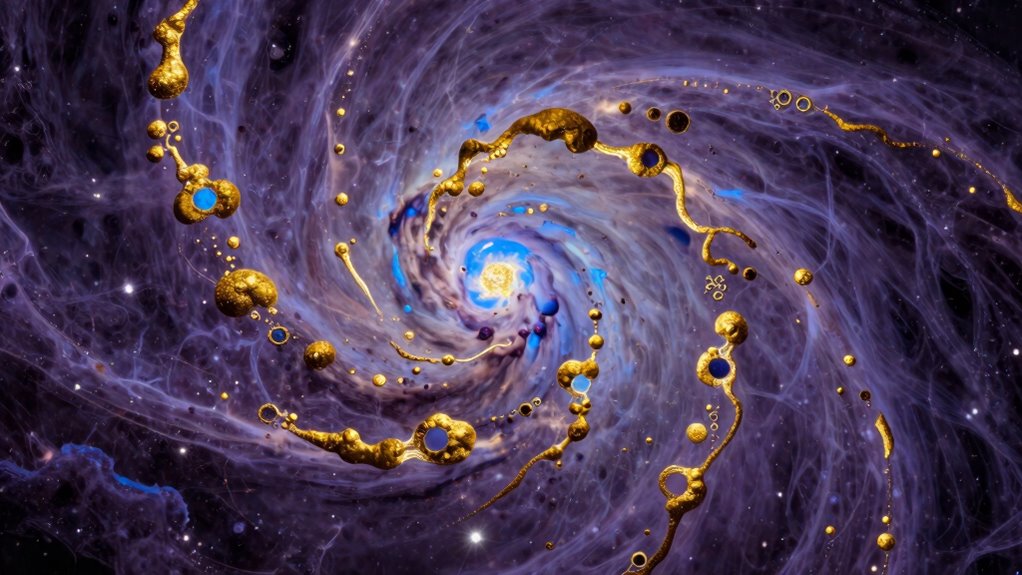
Scientists often provide detailed images that inspire new artistic interpretations and methods, enriching the creative process.
Scientific imagery has become a powerful source of inspiration for artists, blurring the lines between art and science. When you explore this intersection, you discover how interdisciplinary collaboration fuels innovative projects. Artists team up with scientists to access detailed images—microscopic cells, astronomical phenomena, or complex data visualizations—that might otherwise remain inaccessible. This partnership helps you see scientific data through a new lens, transforming raw images into compelling visual narratives. By working across disciplines, you can incorporate authentic scientific visuals into your art, ensuring accuracy while pushing creative boundaries.
Exploring science through art reveals new perspectives, blending authentic visuals with creative innovation to inspire deeper understanding.
You also learn to apply visual representation techniques that enhance the impact of scientific imagery. Instead of simply reproducing raw data, you manipulate colors, forms, and textures to evoke emotion or provoke thought. For example, you might amplify certain hues to highlight biological structures or distort scales to emphasize cosmic vastness. These techniques allow you to abstract scientific visuals, turning them into metaphors that explore themes like complexity, interconnectedness, or the unknown. As you experiment with layering, transparency, and digital manipulation, you create artworks that communicate scientific concepts in ways both accessible and profound.
Using scientific imagery as material enables you to challenge traditional notions of artistic media. You might incorporate actual microscope slides, satellite images, or data streams directly into your work, bridging the physical and digital worlds. This approach invites viewers to engage with science not just as information but as a tactile experience. *Furthermore*, it encourages you to think critically about the role of science in society, prompting questions about technology, ethics, and the environment through your art.
Visual representation techniques serve as tools for metaphorical storytelling. By stylizing or distorting scientific visuals, you craft narratives that resonate on emotional or philosophical levels. For instance, a distorted image of a neuron could symbolize human consciousness or the fragility of mental health. These methods help you communicate complex scientific ideas in a way that’s visually striking and conceptually layered. The fusion of interdisciplinary collaboration and innovative visualization not only deepens your artistic practice but also broadens your audience’s understanding of science’s beauty and significance.
Ultimately, your work with scientific imagery becomes more than just an aesthetic pursuit. It transforms into a dialogue—between disciplines, between science and society, and within your own creative process—making science’s intricate visuals accessible, meaningful, and inspiring. Additionally, exploring scientific visualization techniques can elevate your artwork by making complex data more engaging and comprehensible for viewers.
As an affiliate, we earn on qualifying purchases.
Frequently Asked Questions
How Do Artists Choose Specific Scientific Images for Their Work?
You choose specific scientific images based on their visual selection and symbolism significance. You look for images that resonate emotionally or conceptually, aligning with your message. You consider how the imagery’s forms, patterns, or symbols evoke certain ideas or feelings. By analyzing their visual impact and deeper meaning, you select images that enhance your artwork’s narrative, making the scientific visuals both meaningful and compelling within your artistic expression.
What Ethical Considerations Arise From Using Scientific Imagery?
You face ethical dilemmas when using scientific imagery, especially around authenticity concerns. Exaggeration can make your work seem more impactful, but it risks misrepresenting scientific facts or undermining trust. You must consider if your use preserves the original data and avoids sensationalism. Balancing artistic expression with responsibility ensures your work remains truthful, avoids deception, and honors the integrity of scientific discovery.
How Does Scientific Accuracy Influence Artistic Interpretation?
Scientific accuracy shapes your artistic interpretation by balancing abstract symbolism with visual authenticity. When you prioritize precision, your work resonates more deeply, conveying credible scientific concepts through imagery. Conversely, embracing abstraction allows you to evoke emotion and metaphor, even if the visuals aren’t entirely accurate. Your choice influences how viewers connect with your piece—either appreciating its authenticity or exploring its symbolic, interpretive layers.
Can Scientific Imagery Enhance Emotional Impact in Art?
Yes, scientific imagery can profoundly enhance emotional resonance in your art by adding powerful visual symbolism. When you incorporate precise scientific visuals, you evoke curiosity and awe, allowing viewers to connect emotionally with complex concepts. This fusion of science and art deepens engagement, making abstract ideas more tangible. By using scientific imagery thoughtfully, you create a layered, emotionally compelling experience that invites viewers to explore both the scientific and human elements within your work.
How Do Viewers Typically Interpret Scientific Metaphors in Art?
You see scientific metaphors in art as allegories, inviting you to explore symbolic resonance and interpretive diversity. You might interpret a DNA strand as a symbol of identity or a galaxy as a metaphor for infinity, depending on your perspective. Viewers often bring personal experiences and knowledge, making their interpretations unique. This layered approach enriches your understanding, transforming scientific imagery from mere representation into a profound, multi-faceted dialogue.
As an affiliate, we earn on qualifying purchases.
Conclusion
You see, when you incorporate scientific imagery into your art, you’re not just creating visuals—you’re bridging worlds. It’s like the old saying goes, “A picture is worth a thousand words,” but with science, those words become a universal language. By using these images as material and metaphor, you connect viewers to the wonder of discovery and the beauty of the unknown. Embrace the science, and let your art speak volumes beyond words.
As an affiliate, we earn on qualifying purchases.
digital art software for scientific visualization
As an affiliate, we earn on qualifying purchases.
As an affiliate, we earn on qualifying purchases.