

📊 Full opportunity report: China: The Visible Hand on ThorstenMeyerAI.com — validation score, market gap, and execution plan.
TL;DR
China is implementing a centralized, state-led approach to technological development, prioritizing strategic sectors like AI and robotics. This method involves direct government ownership and planning, contrasting with market-driven models. The development underscores China’s aim to accelerate innovation and maintain global competitiveness.
China is intensifying its use of direct government control to steer its technological and industrial development, especially in artificial intelligence and robotics, through the implementation of its 15th Five-Year Plan. This strategic approach marks a departure from market-driven models. This approach marks a strategic departure from market-driven models, emphasizing state ownership and planning to achieve national objectives.
The Chinese government actively directs its AI and robotics sectors via national plans, notably the 15th Five-Year Plan covering 2026 to 2030. Key initiatives like ‘AI+’ and ‘Robot+’ mobilize provincial and municipal governments to align local targets with central priorities.
Major state-owned enterprises (SOEs) and private firms such as Baidu and Alibaba play a significant role, with the state owning a substantial share of capital and providing funding and regulatory support. For more on China’s AI development, see China Sphere Capability Gap. While private companies lead technological breakthroughs, the state’s role is primarily to fund, diffuse, and own innovations rather than invent them directly.
China’s strategy leverages its large industrial base and existing supply chains, focusing on physical AI applications like humanoid robots and smart manufacturing, aiming to solidify its global leadership in these areas. However, social safety nets remain limited, with the hukou system excluding many rural migrants from urban welfare programs.
The Visible Hand
Where the US bets on the market’s invisible hand, China bets on the visible one: the party-state directs the transition by plan — owns the capital, names the strategic tracks — strong where the state acts, thin where the individual stands.
Independent commentary, produced with AI assistance under human editorial oversight. The views are the author’s own and may change. This is analysis, not policy, economic, investment, or legal advice. Descriptions of “common prosperity,” dibao, the hukou system, the 15th Five-Year Plan, “AI+”/”Robot+,” DeepSeek, and China’s robotics and state-ownership landscape reflect publicly reported information as of mid-2026 and may change; figures are indicative and several are contested estimates. This phase maps differing approaches and endorses none; characterizations of contested political, economic, and labor arrangements are factual and analytical, present competing views, not a verdict, and are not partisan. Country, program, and company names are referenced for analysis and imply no affiliation.
Implications of China’s State-Led Technological Strategy
This approach demonstrates China’s commitment to rapid, centralized industrial development, potentially providing it with a competitive edge over market-driven democracies. It also raises questions about the balance of power between the state and individuals, especially regarding social safety and inequality.
The model’s success could influence global technology geopolitics, challenging Western reliance on market forces and highlighting the effectiveness of state-directed innovation. However, it also underscores risks related to social inequality and limited individual protections, which could impact long-term stability.

AI Vision & Voice Interaction Robot for Arduino Scratch Python Programming 17DOF Humanoid Robot Large AI Model STEM Project Education Voice Command Walking Dancing Self-Stand Up, Tonybot Standard kit
- Humanoid Robot with ESP32: Smooth performance with 17 servos and app control
- Multimodal AI Models: Includes language, voice, and vision capabilities (Ultimate Kit only)
- AI Vision & Voice Interaction: Face recognition, tracking, line following, and voice control
As an affiliate, we earn on qualifying purchases.
As an affiliate, we earn on qualifying purchases.
Background of China’s Top-Down Innovation Model
China’s economic strategy has historically combined state ownership with market reforms, but in recent years, it has shifted toward a more direct, plan-based approach. The 15th Five-Year Plan emphasizes AI, robotics, and supply chain security, with the state mobilizing capital through ownership and regulation.
Previous initiatives like the ‘Made in China 2025’ plan and the ‘AI+’ campaign laid the groundwork for this strategy, with the government directing resources toward strategic sectors and fostering a close collaboration between public and private sectors. This approach aims to accelerate China’s technological self-sufficiency amid global competition and US restrictions on hardware access.
While private firms are leading innovations, the state’s role remains pivotal in funding and regulation, especially in controlling social stability and national security concerns.
“China’s government actively directs its AI and robotics sectors via national plans, notably the 15th Five-Year Plan covering 2026 to 2030.”
— Thorsten Meyer

RCTCBRZVTW CM5 IO Board Expansion Board Verification Board IO Interface Board
- Long-term stable operation: Supports prolonged stable use
- Durable design: Robust and easy to maintain
- Simple installation: Easy to set up and operate
As an affiliate, we earn on qualifying purchases.
As an affiliate, we earn on qualifying purchases.
It remains uncertain how sustainable the social safety nets will be given the emphasis on technological and security priorities over welfare. The extent to which social inequality and migrant exclusion will influence stability is still developing, and the long-term effectiveness of this model is yet to be proven.
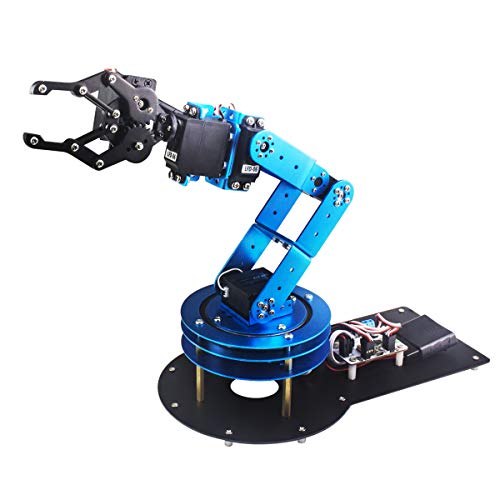
LewanSoul Robotic Arm Kit 6DOF Programming Robot Arm with 5 Servo, Handle, Mechanical Claw and More, PC Software APP Control with Tutorial
- Creative Robotics Platform: 6DOF desktop robot with 6 servos
- Remote Control & Programming: Supports grasping, object transport, custom actions
- Anti-stall Protection: Equipped with 3 anti-blocking servos and gear clutches
As an affiliate, we earn on qualifying purchases.
As an affiliate, we earn on qualifying purchases.
Next Steps in China’s Strategic Tech Policy
China is expected to continue implementing its Five-Year Plan, with increased investment in AI and robotics. Monitoring how provincial and local governments adapt central directives will be crucial. Additionally, observing the private sector’s response and innovation output will provide insights into the model’s effectiveness and resilience.

New Generation Artificial Intelligence-Driven Diagnosis and Maintenance Techniques: Advanced Machine Learning Models, Methods and Applications (Smart Sensors, Measurement and Instrumentation, 46)
As an affiliate, we earn on qualifying purchases.
As an affiliate, we earn on qualifying purchases.
Key Questions
What is the main difference between China’s approach and Western market models?
China’s approach relies on direct government planning, ownership, and control, whereas Western models favor market-driven innovation with less direct state intervention.
How does the state influence private tech companies in China?
The state provides funding, sets strategic priorities, and regulates sectors, guiding private companies to align with national goals while allowing them to lead technological breakthroughs.
What are the potential risks of China’s top-down model?
Risks include increased social inequality, limited protections for displaced workers, and potential over-reliance on state control, which could affect innovation flexibility and social stability.
Will this strategy give China a lasting advantage in AI and robotics?
It positions China strongly for rapid development and deployment, but long-term leadership depends on how well social and innovation challenges are managed amid global competition.
Source: ThorstenMeyerAI.com