
📊 Full opportunity report: Private AI Prompt Workspace For Sensitive Teams on IdeaNavigator AI — validation score, market gap, and execution plan.
Open a free Amazon Business account
Business pricing, bulk buying and tax-exempt orders.
Create a free accountAs an affiliate, we earn on qualifying purchases.
TL;DR
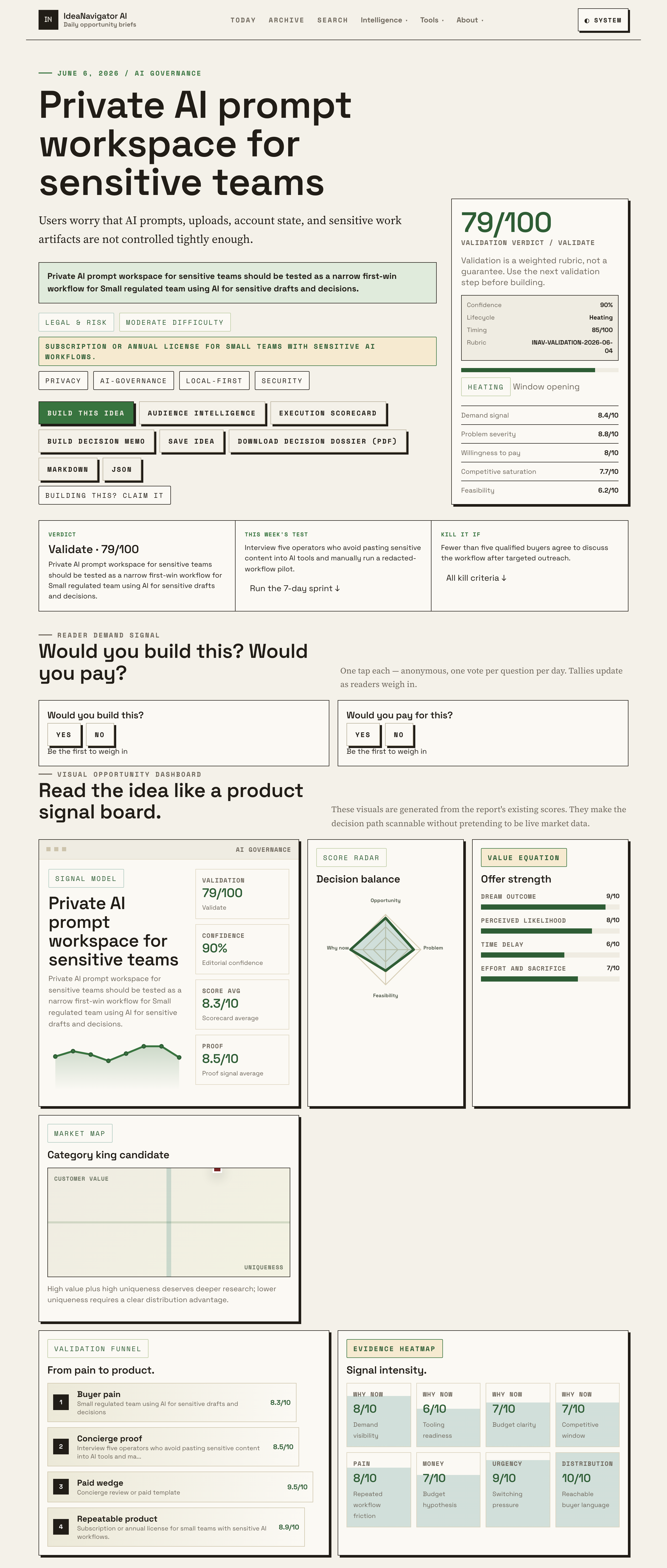
IdeaNavigator AI is piloting a private, local-first AI prompt workspace aimed at small regulated teams. The tool focuses on data control, redaction, and audit features to address privacy concerns. Its success could influence enterprise AI governance practices.
IdeaNavigator AI is testing a private, local-first AI prompt workspace designed specifically for small, regulated teams managing sensitive information. This development aims to address concerns about data control, privacy, and auditability in AI workflows, which are increasingly critical as organizations adopt AI for sensitive decision-making.
The new workspace offers features such as redaction checklists, source notes, review status tracking, and exportable audit logs. It is intended to be used as a narrow, targeted workflow for teams that need to handle sensitive drafts and decisions securely. The initial testing involves interviews with five operators who currently avoid pasting sensitive content into AI tools or manually run redacted workflows, highlighting the market need for such a solution.
According to an anonymous researcher associated with IdeaNavigator AI, the platform aims to provide a local-first architecture that keeps all data on-premises or within controlled environments, reducing reliance on cloud storage and minimizing data exposure risks. Revenue will be generated through subscription or annual licensing tailored for small teams with strict data governance requirements.
Implications for Sensitive Data Handling in AI
This development is significant because it addresses a growing concern among regulated teams about data privacy, compliance, and auditability when using AI tools. As organizations increasingly incorporate AI into sensitive workflows, the need for secure, controlled environments becomes more urgent. Successful testing could set a precedent for enterprise-grade AI governance solutions, influencing how sensitive data workflows are managed across industries.
As an affiliate, we earn on qualifying purchases.
Rising Need for Data-Controlled AI Workspaces
As AI adoption accelerates in sectors like finance, healthcare, and legal services, teams face challenges in maintaining data privacy and compliance with regulations such as GDPR and HIPAA. Currently, many organizations manually redact or restrict sensitive data before using AI, which is inefficient and prone to error. There is a clear market gap for tools that enable secure, auditable AI workflows without sacrificing productivity.
This initiative by IdeaNavigator AI follows broader industry trends emphasizing AI governance, data sovereignty, and local processing solutions, especially for small teams that cannot afford large-scale infrastructure investments.
“The new workspace aims to provide a secure environment for sensitive workflows, reducing the risk of data leaks and ensuring compliance.”
— an anonymous researcher
As an affiliate, we earn on qualifying purchases.
Unconfirmed Aspects of the Workspace’s Deployment
Details about the full feature set, user interface, and scalability of the workspace remain unconfirmed. It is also unclear when the platform will be generally available beyond the pilot phase, or how it will be integrated with existing AI tools and workflows. The effectiveness of the redaction and audit features in real-world scenarios is still to be validated through ongoing testing.
As an affiliate, we earn on qualifying purchases.
Next Steps for Validation and Broader Adoption
IdeaNavigator AI plans to complete pilot interviews with additional small teams and gather feedback on usability and security. If successful, the company will refine the platform and prepare for a wider rollout, potentially including more advanced features like automated redaction and compliance reporting. Monitoring the pilot results will be key to understanding its impact on sensitive AI workflows.
As an affiliate, we earn on qualifying purchases.
Key Questions
When will the private AI prompt workspace be available to the public?
There is no confirmed release date yet. The platform is currently in testing with selected pilot users, and broader availability will depend on pilot outcomes and further development.
How does the workspace improve data security compared to existing AI tools?
It offers a local-first architecture that keeps all sensitive data on-premises or within controlled environments, reducing exposure risks associated with cloud storage and third-party access.
Will the platform support integrations with popular AI models and tools?
Specific integration plans are still under development, but the focus is on creating a secure, self-contained environment that can work with various AI workflows while maintaining strict data control.
Is this solution suitable for large organizations?
Currently, the focus is on small, regulated teams. Larger organizations may require more extensive infrastructure and customization, which are not the immediate targets for this initial pilot.
What are the costs associated with this workspace?
Pricing will likely be based on subscription or annual licensing models tailored for small teams, but specific figures have not yet been announced.
Source: IdeaNavigator AI
Flea & tick season Picks
flea and tick prevention
As an affiliate, we earn on qualifying purchases.






![IKEA Made A Mod For Skyrim [Video]](https://cornfordandcross.com/wp-content/uploads/2026/09/ikea-made-a-mod-for-skyrim-video-featured-260x140.jpg)