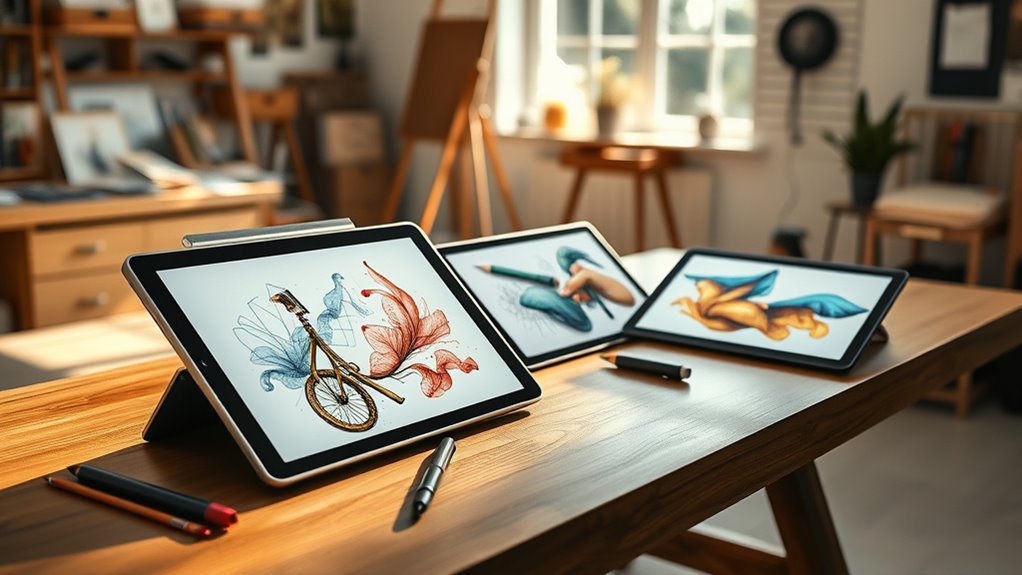

For a premium drawing tablet for art studios, I’d start with the XPPen Artist Pro 19 Gen2 as the best overall choice: its large 4K canvas and included shortcut keyboard suit demanding desktop workflows. The Wacom MovinkPad Pro 14 stands out for artists who want an OLED screen and a standalone Android setup, while the XP-Pen Artist Pro 24 Gen 2 4K is a better fit for a permanent, spacious studio station. The main tradeoffs are screen size versus desk space, standalone portability versus computer-based performance, and display quality versus workflow controls. Continue reading for the full comparison, ranking logic, and guidance on matching a tablet to your studio needs.

Get the latest gadgets delivered free with Prime
- Fast, free delivery on millions of items
- Prime Video, Amazon Music and more included
- Member-only deals all year
Complete the kit



Key Takeaways
- The Artist Pro 19 Gen2 balances a large 4K screen with included shortcut controls, making it a strong all-around studio workstation.
- Standalone models such as the MovinkPad Pro 14 and Magic Drawing Pad reduce dependence on a computer, but their portable format serves a different role from a large desktop display.
- The Artist Pro 24 Gen 2 4K prioritizes canvas area and resolution, while the 165Hz 24-inch model emphasizes a different display experience; choose based on your workflow rather than size alone.
- Several 16-inch options offer distinct compromises: QHD resolution, 2.5K detail, or a more basic screen-tablet setup can matter more than the shared size category.
- A screenless Wacom Intuos Pro Large can be a serious studio tool for artists who value desk ergonomics and direct hand-to-screen viewing is not part of their preferred workflow.
| Wacom MovinkPad Pro 14 Android Tablet with OLED Display and Pro Pen 3 |  | Best Standalone Premium Pick | Operating system: Android 15 | Processor: Snapdragon 8s Gen 3 | Memory: 12GB RAM | VIEW ON AMAZON | See Our Full Breakdown |
| XPPen Artist Pro 19 Gen2 Drawing Tablet with Screen, 18.4″ 4K UHD Display, Dual Stylus, ACK05 Wireless Shortcut Keyboard |  | Best Large 4K Studio Canvas | Screen size: 18.4 inches | Resolution: 4K UHD, 3840 × 2160 | Color gamut: 99.8% sRGB, 96% Adobe RGB, 98% Display P3 | VIEW ON AMAZON | See Our Full Breakdown |
| HUION Kamvas 16 (Gen 3) QHD Drawing Tablet with Screen |  | Best Balanced QHD Pen Display | Screen size: 15.8 inches | Resolution: 2560 × 1440, QHD | Pen pressure: 16,384 levels | VIEW ON AMAZON | See Our Full Breakdown |
| XPPen Artist Ultra 16 4K OLED Touchscreen Drawing Tablet |  | Best OLED Color and Touch Controls | Screen size: 15.6 inches | Resolution: 3840 × 2160, 4K UHD | Display technology: OLED | VIEW ON AMAZON | See Our Full Breakdown |
| HUION Kamvas Pro 16 V2 Drawing Tablet with Screen |  | Best Slim, Practical Studio Display | Screen size: 15.6 inches | Color coverage: 120% sRGB (99% sRGB + 99% Rec.709) | Pen: PW600A, battery-free | VIEW ON AMAZON | See Our Full Breakdown |
| XPPen Artist Pro 16 Gen2 2.5K Drawing Tablet with Screen |  | Best Overall for Color-Focused Studio Work | Display: 16 inches, 2560 × 1600 QHD | Aspect ratio: 16:10 | Stylus: X3 Pro battery-free | VIEW ON AMAZON | See Our Full Breakdown |
| Wacom Intuos Pro Large Bluetooth Drawing Tablet with Pro Pen 3 |  | Best for Screen-Free Studio Workflows | Active area: 14.8 × 9.9 inches (377 × 253 mm) | Aspect ratio: 16:9 | Pen: Pro Pen 3 | VIEW ON AMAZON | See Our Full Breakdown |
| XPPen Artist 16 (3rd Gen) Drawing Tablet with 15.4-Inch Display |  | Best for Shortcut-Driven Workflows | Display: 15.4-inch FHD | Stylus pressure levels: 16,384 | Initial activation force: 2 g | VIEW ON AMAZON | See Our Full Breakdown |
| Huion Kamvas 16 (Gen 3) 2.5K QHD Drawing Tablet with PenTech 4.0 |  | Best for Color-Accurate Detail Work | Screen: 15.8 inches, 2560 × 1440 (2.5K QHD) | Pixel density: 186 PPI | Color gamut: 99% sRGB, 90% Adobe RGB, 99% Rec.709 | VIEW ON AMAZON | See Our Full Breakdown |
| Huion Kamvas Slate 11 Standalone Drawing Tablet (10.95″) |  | Best for Portable, Computer-Free Sketching | Screen: 10.95 inches, 1920 × 1200 FHD+ | Refresh rate: 90 Hz | Color gamut: 99% sRGB | VIEW ON AMAZON | See Our Full Breakdown |
| XP-Pen Artist Pro 24 Gen 2 23.8″ 165Hz Drawing Tablet with Screen and 16K Key Dial |  | Best for Smooth, Color-Critical Studio Work | Screen size: 23.8 inches | Resolution: 2560 × 1440 (2.5K QHD) | Refresh rate: 165Hz | VIEW ON AMAZON | See Our Full Breakdown |
| XPPen Magic Drawing Pad 12.2-Inch Standalone Tablet with 16K Pressure Levels, X3 Pro Slim Stylus, Tilt Support, Paper-Like Screen, 8GB RAM + 256GB Storage |  | Best Standalone Studio Companion | Screen size and aspect ratio: 12.2 inches; 3:2 | Resolution: 2160 × 1440 | Color gamut: 97% sRGB | VIEW ON AMAZON | See Our Full Breakdown |
| HUION KAMVAS Pad 12 Standalone Drawing Tablet |  | Best for a High-Refresh Portable Canvas | Screen size: 12.2 inches | Resolution: 2K+; 236 PPI | Refresh rate: 90Hz | VIEW ON AMAZON | See Our Full Breakdown |
| XPPen Artist Pro 22 Gen 2 2.5K Drawing Display |  | Best for a Balanced Studio Desk | Display size: 21.5 inches | Resolution and pixel density: 2560 × 1440; 137 PPI | Color coverage: 99% Adobe RGB, 99% sRGB, 94% Display P3 | VIEW ON AMAZON | See Our Full Breakdown |
| XPPen Artist Pro 24 Gen 2 23.8-Inch 4K Drawing Display |  | Best Premium 4K Studio Display | Display size: 23.8 inches | Resolution: 3840 × 2160 (4K UHD) | Color gamut: 99% Adobe RGB, 99% sRGB, 98% P3 | VIEW ON AMAZON | See Our Full Breakdown |
| premium drawing tablet for art studio | Connectivity | Color gamut | Resolution |
|---|---|---|---|
| Wacom MovinkPad Pro 14 Android | Bluetooth, Wi-Fi, USB-C | — | — |
| XPPen Artist Pro 19 Gen2 Drawi | Dual USB-C, HDMI input, Bluetooth 5.0 | 99.8% sRGB, 96% Adobe RGB, 98% Display P3 | 4K UHD, 3840 × 2160 |
| HUION Kamvas 16 | USB-C, USB 3.1 Gen 1, DP1.2 | 99% sRGB, 90% Adobe RGB | 2560 × 1440, QHD |
| XPPen Artist Ultra 16 4K OLED | Dual USB-C, HDMI | 99% Adobe RGB, 99% sRGB, 98% Display P3 | 3840 × 2160, 4K UHD |
| HUION Kamvas Pro 16 V2 Drawing | — | — | 5080 LPI |
| XPPen Artist Pro 16 Gen2 2.5K | Requires connection to a computer; 3-in-1 cable included | — | — |
| Wacom Intuos Pro Large Bluetoo | — | — | — |
| XPPen Artist 16 | USB-C to USB-C or included 3-in-1 cable | 99% sRGB, 98% Adobe RGB, 97% Display P3 | — |
| Huion Kamvas 16 | USB-C supporting USB 3.1 Gen 1 and DP 1.2; 3-in-1 cable included | 99% sRGB, 90% Adobe RGB, 99% Rec.709 | — |
| Huion Kamvas Slate 11 Standalo | — | 99% sRGB | — |
| XP-Pen Artist Pro 24 Gen 2 23. | USB-C, DisplayPort, HDMI | 99% Adobe RGB, 99% sRGB, 94% DCI-P3 | 2560 × 1440 (2.5K QHD) |
| XPPen Magic Drawing Pad 12.2-I | — | 97% sRGB | 2160 × 1440 |
| HUION KAMVAS Pad 12 Standalone | — | 99% sRGB | 2K+; 236 PPI |
| XPPen Artist Pro 22 Gen 2 2.5K | USB-C, HDMI | — | — |
| XPPen Artist Pro 24 Gen 2 23.8 | USB-C, DisplayPort, HDMI | 99% Adobe RGB, 99% sRGB, 98% P3 | 3840 × 2160 (4K UHD) |
More Details on Our Top Picks
Wacom MovinkPad Pro 14 Android Tablet with OLED Display and Pro Pen 3
The MovinkPad Pro 14 is the clearest choice here for studio artists who want to sketch or paint away from a computer. Its Android 15 all-in-one design and 14-inch 3K OLED screen make it more mobile than the desk-bound XPPen Artist Ultra 16, while the battery-free Pro Pen 3 avoids charging interruptions. The textured, anti-glare surface supports a more controlled drawing feel, and the microSD slot gives artists room to carry larger project libraries. Its 12GB of RAM and Snapdragon 8s Gen 3 processor suit creative apps, though this is not a replacement for every desktop workflow. The key compromise is compatibility: it cannot operate as a pen display with Windows ARM-based systems or Intel Macs, so artists tied to those setups should choose a conventional connected display instead.
Pros:- Runs Android 15 as a standalone creative tablet, with no computer required for drawing
- 14-inch 3K OLED display pairs high resolution with anti-glare textured glass
- Battery-free Pro Pen 3 supports 8,192 pressure levels
- 12GB RAM, 256GB storage, and microSD expansion support app and project storage
Cons:- Pen display mode does not support Windows ARM-based systems or Intel Macs
- The 14-inch workspace is smaller than the connected 15.6- and 18.4-inch displays in this lineup
- Android app workflows may not replace desktop software for every studio task
Best for: Studio artists who want a portable, self-contained drawing device for sketching and app-based illustration without keeping a computer connected.
Not ideal for: Artists whose workflow depends on using the tablet as a pen display with a Windows ARM-based system or Intel Mac, or who need a larger drawing surface.
- Operating system:Android 15
- Processor:Snapdragon 8s Gen 3
- Memory:12GB RAM
- Storage:256GB, expandable via microSD
- Display:14-inch OLED, 2880 × 1800
- Pen:Wacom Pro Pen 3, battery-free, 8,192 pressure levels
- Connectivity:Bluetooth, Wi-Fi, USB-C
- Weight:0.73 kg
- Warranty:2 years
Our verdict“Choose the MovinkPad Pro 14 if portability and standalone drawing matter more than desktop pen-display compatibility or a large canvas.”
XPPen Artist Pro 19 Gen2 Drawing Tablet with Screen, 18.4″ 4K UHD Display, Dual Stylus, ACK05 Wireless Shortcut Keyboard
For artists who want room for detailed compositions and reference material beside the canvas, the Artist Pro 19 Gen2 makes a strong studio-focused case. Its 18.4-inch 4K display gives it more working area than the 15.6-inch HUION Kamvas Pro 16 V2, while broad color coverage supports work where color separation matters. The etched glass adds drawing texture, and the included dual styluses and ACK05 wireless keyboard with a physical dial offer useful ways to manage tools without crowding the screen with menus. This is a connected pen display, not a standalone tablet, and its size calls for a substantial desk footprint. Setup can also be less tidy than a portable all-in-one because it relies on the supplied cables and power adapter. Choose it for a fixed studio station, not an easy carry-around setup.
Pros:- 18.4-inch 4K UHD screen offers more drawing area than the 15.6-inch HUION Kamvas Pro 16 V2
- Calman-verified color coverage includes 99.8% sRGB, 96% Adobe RGB, and 98% Display P3
- Etched glass provides anti-glare texture for a more tactile drawing surface
- Includes two styluses and a wireless shortcut keyboard with a physical dial
Cons:- Large footprint may crowd smaller studio desks
- Requires a computer and specific cables and power adapter for setup
- Less suited to mobile drawing than the standalone Wacom MovinkPad Pro 14
Best for: Illustrators and design teams building a dedicated desk setup who value a large 4K canvas, broad color coverage, and physical workflow controls.
Not ideal for: Artists with limited desk space, frequent travel needs, or a preference for a standalone tablet that works without a computer.
- Screen size:18.4 inches
- Resolution:4K UHD, 3840 × 2160
- Color gamut:99.8% sRGB, 96% Adobe RGB, 98% Display P3
- Color depth:1.07 billion colors
- Pen pressure:16,384 levels
- Tilt support:60°
- Connectivity:Dual USB-C, HDMI input, Bluetooth 5.0
- Compatibility:Windows 7+, macOS 10.13+, ChromeOS 88+, Android, Linux
- Included accessories:Two styluses, ACK05 wireless shortcut keyboard, pen case, cables, power adapter, glove, cleaning cloth
Our verdict“Pick the Artist Pro 19 Gen2 for a permanent studio desk where its roomy 4K canvas and included controls justify the larger setup.”
HUION Kamvas 16 (Gen 3) QHD Drawing Tablet with Screen
The Kamvas 16 (Gen 3) is a balanced pick for artists who want a sharper, more textured screen without moving up to a large 4K display. Its 15.8-inch QHD canvas sits between the compact HUION Kamvas Pro 16 V2 and the larger XPPen Artist Pro 19 Gen2, offering useful workspace while remaining more manageable on a studio desk. Nano-etched glass and full lamination aim to make strokes feel direct and reduce the visual gap beneath the pen; dual dials also give frequent controls a physical home. Its 16,384 pressure levels and stated color coverage suit detailed illustration work. Unlike the Wacom MovinkPad Pro 14, though, the Kamvas needs a connected computer or compatible Android device. Android use has additional USB and DisplayPort requirements, and the one-year warranty is shorter than the Wacom’s.
Pros:- 15.8-inch QHD resolution balances workspace and desk footprint
- Nano-etched, fully laminated glass provides texture and helps keep the pen-to-cursor view direct
- PenTech 4.0 supports 16,384 pressure levels and tilt
- Dual dial controllers and customizable shortcut keys support hands-on workflow control
Cons:- Requires a connected computer or compatible Android device
- Android connectivity depends on USB 3.1 Gen 1 and DP1.2 support
- One-year warranty is shorter than the two-year coverage listed for the Wacom MovinkPad Pro 14
Best for: Digital illustrators seeking a mid-size QHD pen display with textured glass and physical dial controls for a computer-based studio workflow.
Not ideal for: Artists who need a standalone device, prefer a larger 4K work area, or want uncomplicated Android connectivity without checking port support.
- Screen size:15.8 inches
- Resolution:2560 × 1440, QHD
- Pen pressure:16,384 levels
- Color gamut:99% sRGB, 90% Adobe RGB
- Pen technology:PenTech 4.0 with tilt support
- Screen surface:Nano-etched canvas glass with full lamination
- Connectivity:USB-C, USB 3.1 Gen 1, DP1.2
- Compatibility:Windows 10+, macOS 10.12+, Android, Linux (Ubuntu 20.04 LTS)
- Warranty:1 year
Our verdict“Choose the Kamvas 16 (Gen 3) for a textured, mid-size QHD studio display if you already have a compatible computer and do not need standalone operation.”
XPPen Artist Ultra 16 4K OLED Touchscreen Drawing Tablet
The Artist Ultra 16 is the standout for studio artists who want an OLED image and direct touch interaction in a connected pen display. Its 15.6-inch 4K OLED panel combines 99% Adobe RGB coverage with a high stated contrast ratio, giving it a different emphasis from the larger, etched-glass XPPen Artist Pro 19 Gen2: this model prioritizes OLED contrast and gesture control over extra screen area. Multi-point touch and customizable touch zones can speed up navigation, while the included ACK05 remote and two styluses add alternatives to on-screen menus. The tradeoff is that this is not an all-in-one device; it needs a computer or compatible host. Touch support is also limited on older operating systems, so artists should check their host version before choosing it over the more straightforward HUION Kamvas 16 (Gen 3).
Pros:- 4K OLED panel combines 99% Adobe RGB coverage with a 100,000:1 contrast ratio
- Multi-point touch and customizable touch zones add gesture-based control
- Two 16,384-level styluses and an ACK05 shortcut remote are included
- Compatibility spans Windows, macOS, Android, ChromeOS, and Linux
Cons:- Requires a connected computer or other compatible host to function
- Touch support requires Windows 10+ or Ubuntu 20.04+
- Its 15.6-inch canvas is smaller than the 18.4-inch XPPen Artist Pro 19 Gen2
Best for: Professional illustrators and image-makers with a compatible computer who want OLED contrast, 4K detail, and touchscreen gestures in a compact studio display.
Not ideal for: Artists seeking a standalone tablet, a larger drawing surface, or reliable touch features on an older operating system.
- Screen size:15.6 inches
- Resolution:3840 × 2160, 4K UHD
- Display technology:OLED
- Color gamut:99% Adobe RGB, 99% sRGB, 98% Display P3
- Color depth:10-bit, 1.07 billion colors
- Contrast ratio:100,000:1
- Pen pressure and tilt:16,384 levels; 60° tilt support
- Touch support:Multi-point touch
- Connectivity:Dual USB-C, HDMI
Our verdict“Choose the Artist Ultra 16 if OLED contrast and touch gestures matter more to your studio workflow than standalone use or a larger canvas.”
HUION Kamvas Pro 16 V2 Drawing Tablet with Screen
The Kamvas Pro 16 V2 suits artists who want a conventional pen display that is easier to fit into a working studio than the 18.4-inch XPPen Artist Pro 19 Gen2. Its slim 15.6-inch build, adjustable stand, and 2.65-pound listed weight make it the more practical choice for a smaller desk or a setup that is occasionally moved. The full-laminated, textured screen and PW600A battery-free pen support direct, natural drawing, while Express Keys and a Smart Touch Bar put common actions within reach. Its stated 120% sRGB coverage is a different color specification from the Adobe RGB and Display P3 figures supplied for the XPPen Artist Ultra 16, so those numbers should not be treated as a direct comparison. This HUION requires a computer, has no touch input, and uses a 3-in-1 cable rather than offering standalone operation.
Pros:- Slim 2.65-pound design is easier to place or move than the larger XPPen Artist Pro 19 Gen2
- Full-laminated anti-glare screen has a paper-like texture
- Battery-free PW600A pen supports 16,384 pressure levels
- Adjustable stand, Express Keys, Smart Touch Bar, and recessed Type-C port support a practical desk setup
Cons:- Requires a connected computer and is not a standalone drawing tablet
- No touchscreen functionality
- A 3-in-1 cable is part of the connection setup, limiting the simplicity of a one-cable arrangement
Best for: Studio artists with a computer-based workflow who want a relatively light 15.6-inch pen display, adjustable stand, and hardware shortcuts.
Not ideal for: Artists who need an all-in-one tablet, touchscreen gestures, or a 4K OLED panel with stated Adobe RGB and Display P3 coverage.
- Screen size:15.6 inches
- Color coverage:120% sRGB (99% sRGB + 99% Rec.709)
- Pen:PW600A, battery-free
- Pen pressure:16,384 levels
- Resolution:5080 LPI
- Weight:2.65 lbs
- Thickness:0.453 inches
- Stand angles:14.5°–45°
- Compatibility:Windows 7+, macOS 10.12+, Linux (Ubuntu 20.04 LTS)
Our verdict“Pick the Kamvas Pro 16 V2 if you want a lighter, shortcut-equipped pen display for a computer-based studio and can do without touch or standalone use.”
XPPen Artist Pro 16 Gen2 2.5K Drawing Tablet with Screen
For a computer-based studio setup, I’d put the Artist Pro 16 Gen2 near the front of the shortlist: its 16-inch, 2.5K laminated display offers more workspace detail than the FHD XPPen Artist 16 (3rd Gen), while its anti-glare etched glass helps keep reflections down under studio lighting. The 99% sRGB coverage and stated color accuracy make it a stronger fit for color-conscious illustration than a basic pen display. Its X3 Pro stylus has 16,384 pressure levels, and the included stand, remote, and wrist rest make the desk setup more complete out of the box. The tradeoff is that this is a computer-dependent display, not a portable standalone tablet; artists who need a higher-resolution panel in a similar footprint may also compare it with the Huion Kamvas 16 (Gen 3).
Pros:- 2.5K resolution on a 16-inch screen gives detailed working space.
- Full lamination and etched glass reduce the visible gap and screen glare.
- X3 Pro battery-free stylus supports 16,384 pressure levels.
- Includes a foldable stand, wireless shortcut remote, and wrist rest.
Cons:- Requires a connected computer or compatible device to function.
- 16 inches may feel restrictive for artists who want a broad canvas and room for palettes.
Best for: Studio illustrators who want a 16-inch, high-resolution pen display with broad sRGB coverage and useful included desk accessories.
Not ideal for: Artists who need to draw without a computer, or anyone prioritizing a larger work surface over a compact studio footprint.
- Display:16 inches, 2560 × 1600 QHD
- Aspect ratio:16:10
- Stylus:X3 Pro battery-free
- Pressure levels:16,384
- Color coverage:99% sRGB
- Color accuracy:△E < 2.2
- Connectivity:Requires connection to a computer; 3-in-1 cable included
- Included accessories:Foldable stand, wireless shortcut remote, wrist rest
Our verdict“Choose the Artist Pro 16 Gen2 for a well-equipped, color-focused 2.5K studio display, but skip it if you need a standalone tablet or a larger drawing area.”
Wacom Intuos Pro Large Bluetooth Drawing Tablet with Pro Pen 3
The Intuos Pro Large is the outlier in this group: it has no built-in display, so you draw on the tablet while watching your computer monitor. That separation can suit artists who already rely on a calibrated studio monitor and prefer a clear, uninterrupted view of their work. Its large active area, 10 customizable ExpressKeys, and two mechanical dials give it a more control-focused workflow than the screen-based XPPen Artist Pro 16 Gen2. The Pro Pen 3 adds tilt support and 8,192 pressure levels, while USB and Bluetooth let the tablet fit either a fixed desk or a more flexible setup. The compromise is the hand-eye adjustment required for screenless drawing, and it lacks the direct-on-screen feel and color panel built into the Huion Kamvas 16 (Gen 3).
Pros:- Large 14.8 × 9.9-inch active area supports broad gestures and detailed work.
- Ten customizable ExpressKeys and two mechanical dials put frequent controls close at hand.
- Pro Pen 3 supports 8,192 pressure levels and tilt.
- USB and Bluetooth connectivity suit both wired desks and flexible setups.
Cons:- No built-in screen; drawing requires looking at a separate display.
- The large active area takes substantial desk space compared with smaller pen tablets.
- Its workflow is less direct than drawing on the screen of the XPPen Artist 16 (3rd Gen).
Best for: Experienced digital artists with a separate monitor who value customizable controls, a large active area, and a screen-free desk setup.
Not ideal for: Artists who want to draw directly on the image, or beginners who may find screenless hand-eye coordination less intuitive.
- Active area:14.8 × 9.9 inches (377 × 253 mm)
- Aspect ratio:16:9
- Pen:Pro Pen 3
- Pressure levels:8,192
- Tilt support:Yes
- ExpressKeys:10 customizable
- Mechanical dials:2
- Connectivity and body:USB and Bluetooth; magnesium body
Our verdict“Pick the Intuos Pro Large if you prefer a screen-free workflow and extensive physical controls; choose a pen display if direct on-screen drawing matters more.”
XPPen Artist 16 (3rd Gen) Drawing Tablet with 15.4-Inch Display
The Artist 16 (3rd Gen) is the more control-oriented choice for artists who would rather keep common actions on the tablet than reach for a keyboard. Its two scroll wheels and eight customizable keys make brush sizing, zooming, and other repeated adjustments easier to place within reach. The 15.4-inch screen is fully laminated and uses anti-glare etched glass, while the magnetic stylus offers 16,384 pressure levels and a low 2 g activation force for light marks. Its FHD resolution is the main distinction from the 2.5K XPPen Artist Pro 16 Gen2 and Huion Kamvas 16 (Gen 3): it gives up pixel density for a workflow built around hands-on controls. The broad stated gamut is appealing, but this remains a computer-connected display, and setup depends on a suitable USB-C connection or the included 3-in-1 cable.
Pros:- Two scroll wheels and eight customizable keys support hands-on workflow adjustments.
- Fully laminated etched glass helps reduce glare and pen-to-cursor separation.
- Stylus supports 16,384 pressure levels with a 2 g initial activation force.
- Broad stated coverage across sRGB, Adobe RGB, and Display P3.
Cons:- FHD resolution is lower than the 2.5K panels on the XPPen Artist Pro 16 Gen2 and Huion Kamvas 16 (Gen 3).
- Requires a computer connection rather than working as a standalone tablet.
- Connection may require the included 3-in-1 cable if the device lacks a compatible USB-C port.
Best for: Illustrators who want a direct-drawing display with customizable controls and a light-touch pen, and who do not require 2.5K resolution.
Not ideal for: Artists who need finer screen detail for dense interface layouts or who want a standalone tablet independent of a computer.
- Display:15.4-inch FHD
- Stylus pressure levels:16,384
- Initial activation force:2 g
- Color gamut:99% sRGB, 98% Adobe RGB, 97% Display P3
- Controls:2 scroll wheels and 8 customizable shortcut keys
- Included stand:S20 foldable stand
- Connectivity:USB-C to USB-C or included 3-in-1 cable
- Compatibility:Windows, macOS, Android, ChromeOS, and Linux
Our verdict“Choose this Artist 16 for its convenient physical controls and low-force stylus, but favor a 2.5K alternative if screen detail is your studio priority.”
Huion Kamvas 16 (Gen 3) 2.5K QHD Drawing Tablet with PenTech 4.0
Among these mid-size pen displays, the Kamvas 16 (Gen 3) makes the strongest case for artists who care about both fine detail and color specifications. Its 15.8-inch 2.5K panel packs 186 PPI into a compact workspace, and the stated △E < 1.5 accuracy plus 99% sRGB and 90% Adobe RGB coverage give color-managed illustration work a clear advantage over the FHD XPPen Artist 16 (3rd Gen). PenTech 4.0 adds 16,384 pressure levels, ±60° tilt, and 2 g activation, while the nano-etched laminated glass aims for a less reflective, more paper-like surface. Dual dials and six silent keys offer quick adjustments, though fewer dedicated keys than the XPPen may appeal less to shortcut-heavy users. It also needs a computer or compatible device; USB-C must support the specified data and display standards for full operation.
Pros:- 2.5K resolution and 186 PPI deliver detailed imagery on a compact display.
- Stated △E < 1.5 accuracy and broad sRGB, Adobe RGB, and Rec.709 coverage suit color-focused work.
- PenTech 4.0 offers 16,384 pressure levels, ±60° tilt, and 2 g activation.
- Dual rotary dials and six silent press keys provide quick workflow controls.
Cons:- Requires a connected computer or compatible device; it is not standalone.
- Full USB-C functionality depends on support for USB 3.1 Gen 1 and DP 1.2.
- Its 15.8-inch workspace is smaller than large-format studio displays.
Best for: Color-conscious illustrators and concept artists who want a compact 2.5K display, detailed pen input, and physical dials.
Not ideal for: Artists seeking a standalone tablet, a larger drawing surface, or a simple USB-C setup without checking device compatibility.
- Screen:15.8 inches, 2560 × 1440 (2.5K QHD)
- Pixel density:186 PPI
- Color gamut:99% sRGB, 90% Adobe RGB, 99% Rec.709
- Color accuracy:△E < 1.5
- Pen:PenTech 4.0; 16,384 pressure levels; ±60° tilt
- Glass:Nano-etched laminated glass 2.0
- Controls:2 rotary dials and 6 silent press keys
- Connectivity:USB-C supporting USB 3.1 Gen 1 and DP 1.2; 3-in-1 cable included
Our verdict“Choose the Kamvas 16 (Gen 3) for a compact, color-focused 2.5K workspace, provided your computer or device supports its connection requirements.”
Huion Kamvas Slate 11 Standalone Drawing Tablet (10.95″)
The Kamvas Slate 11 takes a different route from the computer-dependent Artist Pro 16 Gen2 and Kamvas 16 (Gen 3): it is a standalone Android tablet, so artists can sketch without setting up a laptop and pen display. Its 10.95-inch FHD+ screen, 90 Hz refresh rate, and 99% sRGB coverage make it a convenient portable canvas, while the included H-Pencil supports 4,096 pressure levels and 60° tilt. That makes it the most self-contained option here, but not the strongest fit for a precision-focused studio desk: the screen is smaller and its pressure-level count is below the 16,384 offered by the XPPen and larger Huion displays. Android also limits access to desktop-only creative tools. The expandable storage and included case and glove help with mobile use, though intensive drawing can put a strain on the battery.
Pros:- Standalone Android operation removes the need for a separate computer.
- 90 Hz refresh rate supports smooth screen motion and pen interaction.
- Storage expands from 128 GB up to 1 TB.
- Includes an H-Pencil, extra nibs, leather case, and artist glove.
Cons:- Android app availability may exclude desktop-only creative software.
- The 10.95-inch screen is much smaller than the 15.8- and 16-inch pen displays in this roundup.
- Its 4,096 pressure levels are fewer than those on the XPPen Artist 16 (3rd Gen) and Huion Kamvas 16 (Gen 3).
- Battery life may be limited during intensive drawing sessions.
Best for: Artists who want a self-contained Android sketching tablet for studies, travel, and light creative work away from a computer.
Not ideal for: Studio artists whose workflow depends on desktop-only software, a large canvas, or high-end display pen specifications.
- Screen:10.95 inches, 1920 × 1200 FHD+
- Refresh rate:90 Hz
- Color gamut:99% sRGB
- Pen:H-Pencil; 4,096 pressure levels; 60° tilt
- Processor and memory:Octa-core CPU, 8 GB RAM
- Storage:128 GB, expandable to 1 TB
- Operating system:Android 14
- Battery:8,000 mAh
Our verdict“Pick the Kamvas Slate 11 for portable, computer-free sketching and light creative tasks, not as a replacement for a full-size desktop studio display.”
XP-Pen Artist Pro 24 Gen 2 23.8″ 165Hz Drawing Tablet with Screen and 16K Key Dial
The Artist Pro 24 Gen 2 is my pick for studios that want a large pen display with especially fluid on-screen motion. Its 165Hz refresh rate is a distinguishing advantage for animation and fast brushwork, while the 2.5K panel and ΔE<1 calibration support color-conscious illustration. Compared with the Artist Pro 24 Gen 2 4K Drawing Display, this version trades pixel density for a faster refresh rate; the 4K model is the clearer choice for inspecting fine detail, while this one favors responsive motion. Two battery-free styluses and a wireless shortcut keyboard give artists useful workflow options without relying on a touchscreen. The tradeoff is a fixed computer connection and a large footprint that suits a dedicated desk better than a shared or compact workspace.
Pros:- 165Hz refresh rate supports fluid cursor and stroke movement.
- ΔE<1 accuracy and broad Adobe RGB, sRGB, and P3 coverage suit color-focused work.
- Two battery-free styluses offer 16K pressure sensitivity and 60° tilt.
- Flexible stand options and a wireless shortcut keyboard support studio ergonomics.
Cons:- Requires a connected computer rather than running drawing software on its own.
- The 23.8-inch body needs substantial, dedicated desk space.
- Its 2.5K resolution offers less pixel detail than the lineup’s 4K 24-inch model.
Best for: Animation and illustration teams with a permanent studio desk who value smooth strokes, accurate color, and included workflow controls.
Not ideal for: Artists who need a portable or standalone device, or who prioritize 4K detail over refresh speed.
- Screen size:23.8 inches
- Resolution:2560 × 1440 (2.5K QHD)
- Refresh rate:165Hz
- Color gamut:99% Adobe RGB, 99% sRGB, 94% DCI-P3
- Color accuracy:ΔE < 1, Calman Verified
- Stylus pressure and tilt:16,384 pressure levels; 60° tilt
- Connectivity:USB-C, DisplayPort, HDMI
- Compatibility:Windows, macOS, Linux, ChromeOS, Android
Our verdict“Choose this 24-inch display if smooth animation and color accuracy matter more than 4K resolution or portability.”
XPPen Magic Drawing Pad 12.2-Inch Standalone Tablet with 16K Pressure Levels, X3 Pro Slim Stylus, Tilt Support, Paper-Like Screen, 8GB RAM + 256GB Storage
The XPPen Magic Drawing Pad is the practical choice for artists who want to sketch away from the workstation and continue working without a computer. Its Android 14 system, 12.2-inch 3:2 screen, and 599 g weight make it more portable than the connected Artist Pro 22 Gen 2, while 16K pressure sensitivity and tilt support preserve nuanced pen input. The paper-like surface and up-to-13-hour battery are useful for sketching sessions, travel, or a secondary studio station. Its 97% sRGB coverage is respectable for mobile art, but it does not match the broader Adobe RGB and P3 coverage of the desktop displays here. Storage expands by microSD, and there is no external display output, so artists who need a large calibrated canvas should choose a connected display instead.
Pros:- Runs drawing apps as a standalone Android tablet.
- 16K pressure sensitivity and 60° tilt support controlled pen strokes.
- Portable 599 g body and stated battery life of up to 13 hours suit work on the move.
- 256GB internal storage can be expanded to 1TB with a microSD card.
Cons:- 12.2-inch canvas is much smaller than the Artist Pro 22 and 24-inch displays.
- 97% sRGB coverage is narrower than the Adobe RGB and P3 coverage on the desktop models.
- No dedicated HDMI or external display output is listed.
Best for: Illustrators and students who want an Android drawing device for portable sketching, app-based work, and sessions away from a computer.
Not ideal for: Color-critical studio teams needing broad professional gamut coverage, a large canvas, or external-display workflows.
- Screen size and aspect ratio:12.2 inches; 3:2
- Resolution:2160 × 1440
- Color gamut:97% sRGB
- Pressure and tilt:16,384 pressure levels; 60° tilt
- Memory:8GB RAM
- Storage:256GB; expandable to 1TB via microSD
- Battery:8000mAh; up to 13 hours
- Weight and thickness:599 g; 6.9 mm
- Operating system:Android 14
Our verdict“Choose the Magic Drawing Pad as a portable, self-contained sketching station, not as a replacement for a large color-critical studio display.”
HUION KAMVAS Pad 12 Standalone Drawing Tablet
The HUION KAMVAS Pad 12 brings a 90Hz display and standalone Android workflow to a compact 12.2-inch format. That refresh rate gives it a smoother-feeling screen than a standard-rate portable tablet, while 2K+ resolution and 99% sRGB coverage make it a capable mobile canvas. Like the XPPen Magic Drawing Pad, it includes 8GB RAM, 256GB storage, expandable capacity, and 16K pen input; HUION’s stated advantage is the faster screen and Android 16. Neither replaces the larger workspace or wider color gamut of the Artist Pro 24 Gen 2. Its compact size is useful for sketching around a studio or away from one, but it constrains detailed multi-panel work. The nano-etched surface may also call for compatible nibs to get the intended feel.
Pros:- Standalone Android 16 operation supports drawing without a computer.
- 90Hz refresh rate and 2K+ resolution suit responsive sketching on a compact canvas.
- 16K pressure levels and PenTech 4.0 support expressive pen control.
- 256GB storage is expandable to 1TB.
Cons:- The 12.2-inch screen is restrictive for complex studio layouts and detailed work.
- Nano-etched glass may require specific nibs for the preferred surface feel.
- The supplied data does not specify battery runtime or color accuracy beyond gamut coverage.
Best for: Mobile illustrators who want a self-contained Android tablet with a faster-refresh screen and enough storage for drawing apps and projects.
Not ideal for: Artists who need a large working area, computer-connected studio software, or verified color accuracy beyond the stated sRGB coverage.
- Screen size:12.2 inches
- Resolution:2K+; 236 PPI
- Refresh rate:90Hz
- Color gamut:99% sRGB
- Pen input:16,384 pressure levels; PenTech 4.0
- Processor and memory:8-core processor; 8GB RAM
- Storage:256GB; expandable to 1TB
- Battery:8000mAh
- Operating system:Android 16
Our verdict“Pick the KAMVAS Pad 12 if you want a portable, standalone canvas with a 90Hz screen, and accept the limits of a small display.”
XPPen Artist Pro 22 Gen 2 2.5K Drawing Display
The Artist Pro 22 Gen 2 is a strong fit for artists who want a professional pen display without giving a full 24-inch model the whole desk. Its 21.5-inch 2.5K screen gives more room than either standalone 12.2-inch tablet, and its ΔE<1 rating with broad Adobe RGB, sRGB, and Display P3 coverage suits carefully managed color work. Compared with the Artist Pro 24 Gen 2 165Hz, it is smaller and does not list a high refresh rate, but it retains the same stated 16K pressure sensitivity and 60° tilt. The adjustable stand, VESA mounting, and 40-key wireless remote let studios tailor the setup. This is still a computer-connected display, not a mobile tablet, and the optional height-adjustable ACS15 stand is not included.
Pros:- 2.5K resolution and 21.5-inch display provide a spacious drawing area.
- ΔE<1 accuracy and broad Adobe RGB, sRGB, and Display P3 coverage support color-focused work.
- Wireless remote includes 40 customizable keys.
- Stand adjusts from 15° to 88° and the display supports VESA mounting.
Cons:- Requires a connected computer or compatible device.
- Resolution is 2.5K rather than the 4K offered by the Artist Pro 24 Gen 2 4K.
- The optional ACS15 height-adjustable stand is not included.
Best for: Studio illustrators who need a color-accurate, mid-large pen display and want flexible desk or VESA mounting without moving to a 23.8-inch model.
Not ideal for: Artists seeking a standalone tablet, 4K resolution, or a specifically high-refresh display for animation.
- Display size:21.5 inches
- Resolution and pixel density:2560 × 1440; 137 PPI
- Color coverage:99% Adobe RGB, 99% sRGB, 94% Display P3
- Color accuracy:ΔE < 1
- Brightness and contrast:250 cd/m² peak; 1000:1
- Stylus input:16,384 pressure levels; 60° tilt
- Stand and mounting:15°–88° adjustment; 100 × 100 mm VESA
- Shortcut remote:40 customizable keys; Bluetooth 5.0
- Connectivity:USB-C, HDMI
Our verdict“Choose this model for a color-capable, adjustable 21.5-inch studio display when 4K and standalone operation are not priorities.”
XPPen Artist Pro 24 Gen 2 23.8-Inch 4K Drawing Display
For a studio that wants a large, detailed canvas, the Artist Pro 24 Gen 2 4K is the premium pick in this group. Its 23.8-inch 4K UHD panel provides substantially more pixel detail than the 2.5K Artist Pro 24 Gen 2 165Hz, which favors faster screen updates instead. Broad gamut coverage, ΔE<1 calibration, and etched anti-glare glass make this version the more compelling choice for close inspection and color-focused production. Two 16K styluses, an adjustable stand, and a wireless remote round out a studio-oriented package. Like the Artist Pro 22 Gen 2, it needs a connected computer; unlike that smaller display, it claims more workspace and 4K resolution but also occupies more desk area. Its 300 cd/m² brightness is specified, though this remains a desk-bound setup rather than a portable drawing tablet.
Pros:- 23.8-inch 4K resolution supports fine detail and generous workspace.
- ΔE<1 calibration and 98% P3 coverage suit color-sensitive work.
- Etched anti-glare glass reduces reflections during long desk sessions.
- Includes two 16K, 60°-tilt styluses, a wireless remote, and an adjustable stand.
Cons:- Requires a connected computer or laptop.
- Large display needs substantial desk space and is not designed for portable use.
- The listed specifications do not state a high refresh rate like the 165Hz 2.5K alternative.
Best for: Professional illustrators and design studios that need a large 4K drawing canvas, broad color coverage, and a computer-based workflow.
Not ideal for: Artists with limited desk space or anyone who needs a standalone device; those prioritizing a 165Hz refresh rate should compare the 2.5K 24-inch version.
- Display size:23.8 inches
- Resolution:3840 × 2160 (4K UHD)
- Color gamut:99% Adobe RGB, 99% sRGB, 98% P3
- Color accuracy:ΔE < 1, Calman verified
- Brightness and contrast:300 cd/m²; 1000:1
- Stylus input:16,384 pressure levels; 60° tilt
- Color depth:8-bit + Hi-FRC; 1.07 billion colors
- Connectivity:USB-C, DisplayPort, HDMI
- Included accessories:Two styluses, wireless shortcut remote, adjustable stand, pen case, replacement nibs, cables, glove, cleaning cloth
Our verdict“Choose this 4K model when fine detail and a large, color-accurate canvas matter more than portability or the 165Hz refresh rate of its 2.5K sibling.”

How We Picked
I ranked these tablets around studio use rather than treating every model as a direct substitute. I weighed the drawing surface, resolution and display type, pen and touch workflow, shortcut controls, standalone capability, and how readily each format fits a shared or dedicated workspace. I also considered whether a model’s strengths solve a real studio need: a large screen can help with detailed work, while portability or a screenless design may improve flexibility and desk comfort.
The order favors products with a persuasive balance of drawing area, visual clarity, workflow support, and versatility for professional or serious creative work. A specialized option can rank well for its intended buyer without being the best fit for every studio. Screen tablets, standalone tablets, and pen tablets are compared by role, not by assuming that one category is universally superior; buyers should confirm computer compatibility, connectivity, and included accessories before choosing.
Factors to Consider When Choosing Premium Drawing Tablet For Art Studios
Studio tablet decisions are less about chasing the highest specification and more about avoiding a mismatch between the device and the way work moves through your space. I’d settle the setup, display, and collaboration questions before comparing pen features.
Choose Between a Display Tablet and a Screenless Pen Tablet
A display tablet lets you draw directly on the image, which can feel intuitive for sketching, paint work, and demonstrations. A screenless tablet separates hand movement from the monitor, a relationship that may take practice but can keep your posture and gaze more upright. In a studio, this is an ergonomic and workflow decision, not a measure of professional skill. Display models also occupy more desk space and may need more cable management. A screenless device can suit a workstation already built around a calibrated monitor or artists who prefer a larger external display. Avoid buying a screen model simply because it seems like the more advanced format; choose the interaction style you can sustain through long sessions.
Size the Active Canvas to Your Work and Desk
A larger drawing area gives room for broad gestures and keeps interface panels from crowding the artwork, but it also claims a fixed footprint. Measure the space with the stand, keyboard, and reference materials in place rather than checking the tablet dimensions alone. Smaller models can be easier to move between stations and may suit focused illustration or mobile work. Large displays make more sense when they will remain set up and the work regularly benefits from a broad canvas. Studios with shared desks should account for who needs access and how quickly the device can be stored. A common mistake is choosing by diagonal measurement without considering aspect ratio, stand position, or the distance from the artist’s eyes.
Match Resolution and Screen Type to the Work
Higher resolution can make interface details and fine lines appear sharper, especially across a large display. It does not automatically improve a finished illustration if the software, artwork scale, or viewing distance is the limiting factor. OLED can offer rich contrast, while other display types may suit buyers who prefer a different brightness or color workflow. Studios handling client deliverables should check color-management options and verify the display against their output process instead of relying on vividness alone. Think about whether the tablet is the main proofing screen or simply the drawing surface. Paying extra for display technology makes more sense when its visual characteristics support a real part of your work.
Treat Standalone Capability as a Workflow Choice
A standalone tablet can move between a studio, a meeting room, and a home workspace without requiring a computer at every stop. That convenience is valuable for sketching, annotation, and work that fits the tablet’s operating system and apps. A computer-connected pen display may be a better anchor for software-heavy production, large project files, and established desktop workflows. Before choosing standalone, check the apps you rely on, file handoff methods, storage needs, and how the device fits studio backup practices. Portability can add flexibility, but it does not guarantee that every desktop task will carry over unchanged. Studios may get more value from a hybrid setup than from asking one tablet to perform every role.
Plan for Controls, Connections, and Shared Use
Shortcut keys, dials, touch controls, and an external keyboard can reduce repeated menu trips, but only if they match the software and habits used in the studio. For a shared device, programmable controls may need a clear reset routine so one artist’s layout does not slow down the next. Check the connection requirements, available ports, cable reach, and whether the stand positions the screen comfortably. A tidy drawing surface can still create a cluttered station if the computer, power, and accessory cables are awkward to route. When several artists use one workstation, setup time and easy adjustments may matter more than a single-user feature set. Confirm what accessories come with the model before planning around them.
Spend for a Studio Need, Not a Spec-Sheet Trophy
Paying more is easiest to justify when the upgrade removes a daily constraint: too little drawing room, a display that does not suit color work, or a workflow that needs portable standalone use. A higher refresh rate or finer resolution may have less impact if the tablet is used mostly for static illustration or occasional annotation. Likewise, an advanced pen feature is useful only when the artist’s software and technique can take advantage of it. For a studio buying multiple devices, consistent setup and compatibility can be more valuable than giving every station the largest model. Decide which task costs time or comfort now, then spend toward that bottleneck. This approach helps prevent an expensive tablet from becoming an underused secondary screen.
Frequently Asked Questions
Should a studio choose a standalone drawing tablet or a computer-connected display?
Choose standalone when artists need to sketch or review work away from a fixed computer and the required apps run well on the tablet’s operating system. A connected display usually fits better when the studio depends on desktop software, established project storage, and a computer’s processing setup. These formats are not direct replacements: portable convenience and desktop workflow depth solve different problems. Before choosing standalone, check file transfer, app compatibility, storage, and backup habits. If the device will spend most of its time beside one workstation, a connected model may be the more practical studio tool.
Is a 24-inch drawing display worth choosing over a 16-inch model?
A 24-inch display can give detailed work more room and leave space for software panels without compressing the canvas. It can be a good fit for a dedicated station where the artist sits at a comfortable viewing distance. A 16-inch model is easier to fit on a crowded desk and may be simpler to move or share. Larger size alone does not guarantee a better drawing experience; resolution, stand ergonomics, and desk depth also affect usability. Choose the larger format when its extra working area will be used regularly, not just because it sounds more studio-grade.
Does a 4K drawing display matter more than OLED or a high refresh rate?
Those features serve different priorities, so the right choice depends on the work. 4K resolution can provide fine image detail across a large canvas, while OLED appeals to buyers who value its display characteristics. A high refresh rate may suit artists who care about responsive on-screen motion, but it is not automatically the deciding factor for illustration. For client-facing color work, also check color-management needs and the studio’s proofing process. Do not treat any one display specification as a substitute for checking the whole screen and workflow.
Can one premium tablet work for several artists in a shared studio?
It can, provided the device is easy to adjust and each artist’s preferred controls can be saved or restored. A large display may anchor a shared production station, while a portable standalone tablet can move between people and rooms. Shared use makes cable access, stand adjustment, screen cleaning, and account or file handoff more important than they are for a personal setup. Agree on shortcut layouts and storage conventions before the tablet becomes a central workstation. If artists use very different software or postures, separate devices may reduce setup friction.
When is a screenless pen tablet a better studio choice than a display tablet?
A screenless model can be the better choice when the studio already has a preferred monitor and the artist wants to draw without adding another large screen to the desk. It may also suit someone who values a more upright viewing position and is comfortable coordinating hand movement with the monitor. The main adjustment is learning to look at the display while drawing on a separate surface. For artists who strongly prefer direct hand-to-screen interaction, a pen display may feel more natural. The decision is about drawing habits and workspace design, not whether one device type is inherently more professional.
Conclusion
For a versatile studio workstation, I’d choose the XPPen Artist Pro 19 Gen2 as the best overall pick for its large 4K drawing area and included shortcut keyboard. My best value choice is the HUION Kamvas 16 (Gen 3) QHD for artists who want a capable screen tablet in a more manageable format. For a premium large-screen setup, the XPPen Artist Pro 24 Gen 2 4K is the clearest fit; for beginners who want a self-contained way to draw, the XPPen Magic Drawing Pad offers a portable standalone path. Artists who need OLED and standalone use should look at the Wacom MovinkPad Pro 14, while those who prefer a screenless, monitor-led workstation should consider the Wacom Intuos Pro Large. Match the tablet to the station and software first, then choose the screen size and features that solve your actual studio constraints.