
Visual Thinking Strategies (VTS) boosts art discussions by encouraging you to observe closely, ask open-ended questions, and explore multiple interpretations. It helps students develop critical thinking, build confidence in sharing ideas, and deepen their understanding of artwork’s details and stories. By fostering active dialogue and diverse viewpoints, VTS transforms how you engage with art—making conversations richer and more meaningful. Keep exploring to discover how these techniques can truly enhance your classroom experience.
Key Takeaways
- VTS promotes critical thinking and deep analysis through open-ended questions about artworks.
- It encourages diverse perspectives, fostering richer classroom discussions and shared insights.
- Structured observation techniques improve students’ visual literacy and descriptive vocabulary.
- Combining VTS with emotional support boosts confidence in articulating interpretations.
- Regular practice develops deliberate observation skills, enhancing overall art comprehension and discussion quality.

Visual Thinking Strategies (VTS) is a powerful method that helps you develop critical thinking and deepens your understanding through close observation of artworks. When you engage with VTS, you learn to look carefully, ask thoughtful questions, and consider different perspectives. This approach enhances your ability to interpret art by encouraging art interpretation that goes beyond surface details. Instead of simply labeling what you see, you analyze the elements, context, and emotional impact of each piece. Through this process, you sharpen your skills in critical observation, which allows you to notice subtle nuances and connections that might otherwise go unnoticed.
As you participate in VTS discussions, you become more attuned to visual details. You learn to articulate what you observe clearly and confidently, which helps you build a more nuanced understanding of artworks. The method emphasizes open-ended questions, such as “What’s going on in this picture?” or “What do you see that makes you say that?” These prompts invite you to dig deeper into the artwork, fostering a dialogue that promotes multiple interpretations. As you listen to others’ perspectives, you realize that art can have many valid meanings, depending on individual experiences and insights. This not only broadens your appreciation for different viewpoints but also enhances your critical observation skills, as you learn to compare, contrast, and evaluate various ideas.
VTS also trains you to look beyond the obvious. Instead of rushing to form a quick judgment, you examine the composition, colors, textures, and symbolism. This detailed examination helps you grasp the artist’s intent and the story behind the artwork. With consistent practice, you develop a habit of slow, deliberate observation that enriches your art interpretation. It’s about honing your ability to see what others might overlook, recognizing patterns, and understanding how visual elements work together to evoke emotion or meaning. Incorporating structured observation techniques can further deepen your engagement and skill development, especially when combined with emotional support strategies that foster confidence in sharing insights. Additionally, understanding visual literacy enhances your capacity to interpret complex artworks and communicate your ideas more effectively. Developing a visual vocabulary is essential for articulating your insights clearly and engaging meaningfully with art.
Furthermore, VTS encourages active participation and confidence in your insights. As you articulate your observations and listen to others, you strengthen your analytical thinking. You begin to see art not just as a static object but as a conversation starter—one that invites multiple interpretations and critical observations. This approach transforms classroom discussions into dynamic exchanges where your critical thinking skills grow alongside your appreciation for art. Ultimately, VTS empowers you to approach artworks with curiosity and confidence, making your art interpretation more insightful and your critical observation more precise.
Additionally, the practice of VTS can be supported by resources such as pediatric sleep specialists, which highlight the importance of establishing routines and environments conducive to better understanding and growth, paralleling how structured observation enhances art interpretation.
Frequently Asked Questions
How Can VTS Be Adapted for Younger Children?
You can adapt VTS for young learners by using simple, engaging visual prompts that capture their attention. Encourage them to share their thoughts by asking open-ended questions suited to their developmental level. Keep discussions short and lively, using familiar words and pictures. Incorporate hands-on activities, like drawing or storytelling, to help young children connect with the art. This approach boosts their confidence and nurtures early critical thinking skills.
What Are Common Challenges When Implementing VTS?
Struggling with student engagement and teacher preparation poses common challenges when implementing VTS. You might find it tricky to spark meaningful discussions or to equip teachers with effective facilitation skills. Time constraints can also hinder thorough preparation, making it hard to foster confident conversations. To overcome these hurdles, focus on training, build confidence, and create a supportive environment where students feel comfortable sharing their ideas, ensuring successful VTS integration.
How Does VTS Improve Critical Thinking Skills?
You’ll find that VTS improves your critical thinking skills by strengthening your analytical reasoning and perspective taking. As you engage in guided discussions about art, you learn to analyze visual details more deeply and consider multiple viewpoints. This process challenges you to question assumptions, develop reasoned arguments, and appreciate diverse perspectives, all of which are essential for sharpening your overall critical thinking abilities.
Can VTS Be Integrated With Digital Tools?
Sure, you can totally integrate VTS with digital tools—because who doesn’t love staring at virtual galleries on a tiny screen? Using digital tools, you can facilitate art discussions online, share images instantly, and even host virtual tours. This combination makes VTS more accessible and interactive, turning your classroom into a dynamic digital space. Embrace technology to deepen art understanding and keep students engaged, all from the comfort of their screens.
What Training Is Needed to Facilitate VTS Effectively?
To facilitate VTS effectively, you need strong facilitation skills and effective questioning techniques. You should undergo training that emphasizes active listening, guiding discussions without dominating, and encouraging diverse perspectives. Practice asking open-ended questions that promote critical thinking and reflection. Additionally, training should cover managing group dynamics and fostering a respectful environment. With these skills, you’ll confidently lead engaging art discussions that inspire students and deepen their understanding.
Conclusion
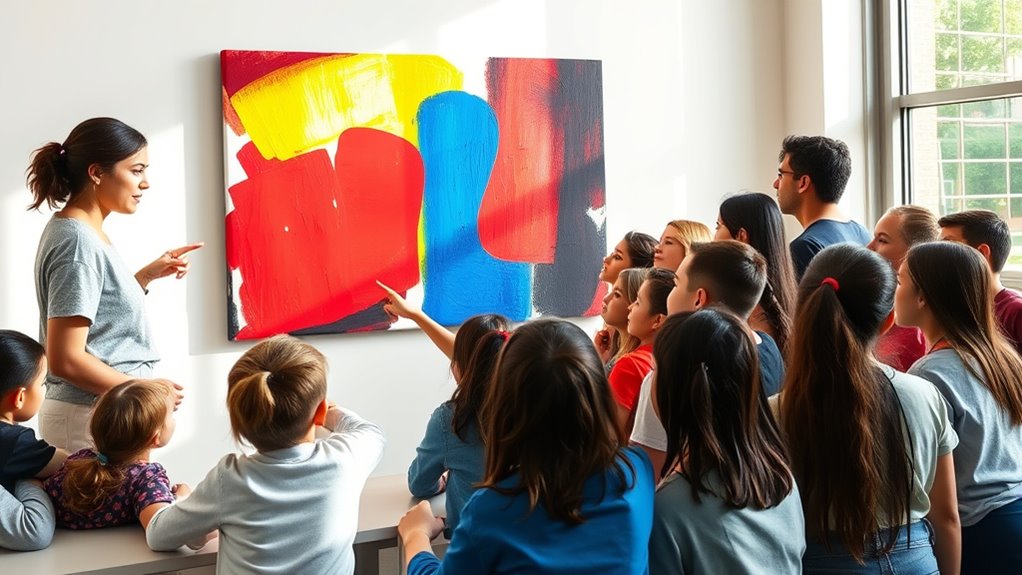
By embracing Visual Thinking Strategies, you open the door to vibrant classroom conversations, where students’ eyes light up like sparks of inspiration. Picture them gathering around a masterpiece, their minds weaving colors and stories into lively discussions. As you guide them through this journey, you’ll see ideas bloom like flowers in spring, fostering confidence and deeper understanding. With every shared perspective, the classroom transforms into a canvas of collective discovery and growth.