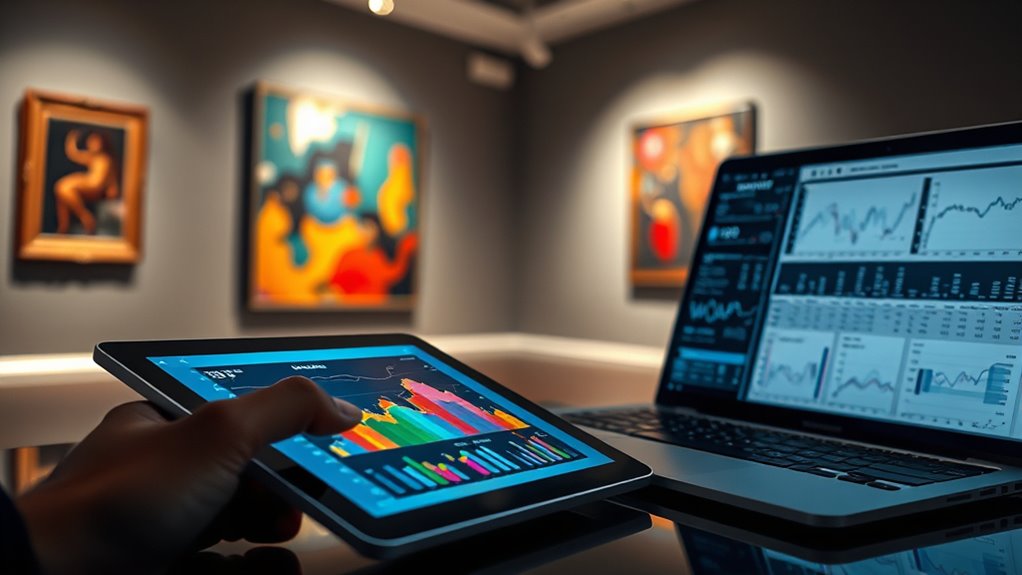

Data analytics plays a vital role in art pricing and valuation by giving you detailed insights into market trends, demand, and future worth. It uses past sales, artist popularity, and economic indicators to create accurate price estimates and predict future values. This helps you make smarter decisions, avoid overpaying, and spot emerging opportunities early. By harnessing these tools, you gain a strategic edge in the art market—discover how these techniques can benefit you further.
Key Takeaways
- Data analytics transforms traditional art pricing methods by analyzing large datasets for more accurate valuations.
- It incorporates market trends, artist popularity, and economic indicators to inform pricing decisions.
- Predictive models estimate future artwork values based on historical data and current market conditions.
- Trend analysis detects emerging artists, styles, and market shifts to guide buying and selling strategies.
- Overall, data-driven analytics enhance transparency, reduce risks, and optimize art investment and portfolio management.

Data analytics is transforming how art prices are determined, allowing collectors, galleries, and investors to make more informed decisions. Instead of relying solely on auction results or expert opinions, you now have access to sophisticated tools like market trend analysis and predictive valuation models. These methods analyze vast amounts of data—such as past sale prices, artist popularity, auction house performance, and economic indicators—to reveal patterns that might otherwise go unnoticed. By understanding these trends, you can better gauge an artwork’s current value and anticipate future shifts in the market.
Data analytics revolutionizes art pricing through trend analysis and predictive models for smarter investment decisions.
Data-driven insights play a crucial role in refining pricing strategies and ensuring more accurate valuations. Market trend analysis plays a pivotal role in this process. It helps you track the trajectory of art prices over time, revealing whether certain artists, genres, or periods are gaining or losing popularity. For example, if you notice consistent increases in the sale prices of contemporary works by emerging artists, you might decide to invest early, confident that demand will continue to grow. Conversely, if a particular artist’s prices plateau or decline, you can choose to hold off on purchases or reassess your holdings. This kind of analysis provides a macro view of the market, enabling you to make strategic buying and selling decisions based on Data-driven insights rather than gut feeling alone.
Predictive valuation models take this a step further by estimating what an artwork might sell for in the future, based on historical data and current market conditions. These models use algorithms that consider variables such as an artist’s career trajectory, exhibition history, provenance, and recent sales trends. By inputting specific details about a piece, you can receive an estimated valuation that helps set realistic price expectations. This reduces uncertainty and minimizes the risk of overpaying or undervaluing artworks. These models are especially valuable when entering new markets or investing in artists with limited sales history, as they provide a grounded forecast derived from data rather than intuition.
Together, market trend analysis and predictive valuation models empower you to approach art investing with greater confidence. They enable you to identify emerging opportunities early, avoid overhyped assets, and optimize your portfolio based on detailed, real-time insights. As data analytics continues to evolve, so will your ability to understand and navigate the complex art market with precision. This shift towards data-driven decision-making is making art pricing more transparent and accessible, ultimately helping you make smarter, more strategic choices in your art dealings.
Frequently Asked Questions
How Accurate Are Data Analytics Models in Predicting Art Prices?
Data analytics models are quite effective in predicting art prices, but their accuracy depends on analyzing historical trends and market fluctuations. You can rely on these models to identify patterns and estimate values, but they aren’t foolproof. Market conditions change unpredictably, so always consider external factors. Use data analytics as a helpful tool, but combine it with expert judgment for the most reliable art valuation.
What Types of Data Are Most Influential in Art Valuation?
You’ll find that provenance records and artistic credentials are the most influential data in art valuation. Provenance verifies a piece’s history, boosting confidence in its authenticity and value. Artistic credentials, like reputation and exhibition history, directly impact prices. When analyzing data, prioritize these factors, as they provide critical insights into an artwork’s significance and market worth, making your valuation more accurate and reliable.
Can Data Analytics Identify Emerging Artists Before Their Market Surge?
Data analytics acts like a crystal ball, revealing emerging artists before their market surges. By analyzing social media trends, auction data, and gallery activity, you can spot rising talents early. These insights help you identify promising emerging artists, giving you a competitive edge before their work skyrockets in value. Acting on this data lets you catch the wave of market surge before it becomes a tidal wave.
How Do Regional Market Differences Affect Data-Driven Art Valuations?
Regional market differences considerably impact data-driven art valuations since regional preferences and cultural influences shape buyer behavior and demand. You’ll notice that data analytics must consider these factors to accurately assess an artwork’s value across different areas. By analyzing local trends and cultural context, you can better understand pricing variations, helping you make informed decisions about investments or sales in diverse regions.
What Are the Limitations of Using Data Analytics for Authenticating Artworks?
You might face authenticity challenges when relying on data analytics because it can’t always verify an artwork’s provenance or detect subtle forgeries. Data quality limitations, like incomplete or inaccurate records, can also hinder accurate authentication. You should remember that analytics supplement expert judgment but cannot replace thorough physical examinations or provenance research, making it essential to combine data insights with traditional authentication methods for reliable results.
Conclusion
Think of data analytics as a compass guiding you through the complex landscape of art pricing. It sheds light on hidden patterns and unseen value, helping you make confident decisions. As you navigate this artistic terrain, let data be your steady anchor amid shifting trends. Embracing analytics transforms uncertainty into clarity, turning your passion into a confident investment. With the right tools, you’ll find your way to true artistic worth, like a ship charting a clear course through stormy seas.