🔍 Read the full analysis: Ring’s Patrol Robot And Flying Drone: What They Do At Home on ThorstenMeyerAI.com

Get the latest gadgets delivered free with Prime
- Fast, free delivery on millions of items
- Prime Video, Amazon Music and more included
- Member-only deals all year
TL;DR
Ring announced two mobile security cameras on Nov. 10, 2026: a drone for homes and a wheeled patrol robot for businesses. The company says both can respond to Ring alerts and use AI Pilot to navigate; the Drone Cam’s sale depends on FCC authorization, and scheduled patrols require a compatible Ring Protect plan.
Ring lists the **Rover Cam at $999.99**, with US shipping scheduled to begin **Dec. 16, 2026**. The company describes it as a business security device that patrols on a schedule, visits a location when another Ring camera, sensor or alarm is triggered, and scans 360 degrees when it arrives. Its adjustable mast carries a periscope camera; Ring also lists a siren, light tower and two-way audio. The company says it can stream and record in up to 4K while moving or patrolling, and can begin recording motion detected in its view even while docked.
The **Drone Cam costs $249.99** and is scheduled to ship in the US on **Jan. 27, 2027**, but Ring says it has not been authorized as required by FCC rules and may not be sold before authorization. Ring lists a 148-degree field of view, 360-degree rotation, 2K video and two LED lights. It says the drone can fly scheduled or on-demand routes and launch when another Ring device detects an event. In its dock, Ring says, the drone powers down with its camera off.
Both products use **AI Pilot**, which Ring says maps their surroundings, suggests patrol points and steers around obstacles with cameras, sensors, vision models and cloud processing. A compatible **Ring Protect plan is required for scheduled patrols**. The Verge reported that the drone relies on an internet connection and, without Wi-Fi, can only land. It also reported a claimed flight time of five to eight minutes on a charge. Those operating details came from media reporting and launch demonstrations, rather than the core product announcement.
Mobile security cameras on the move
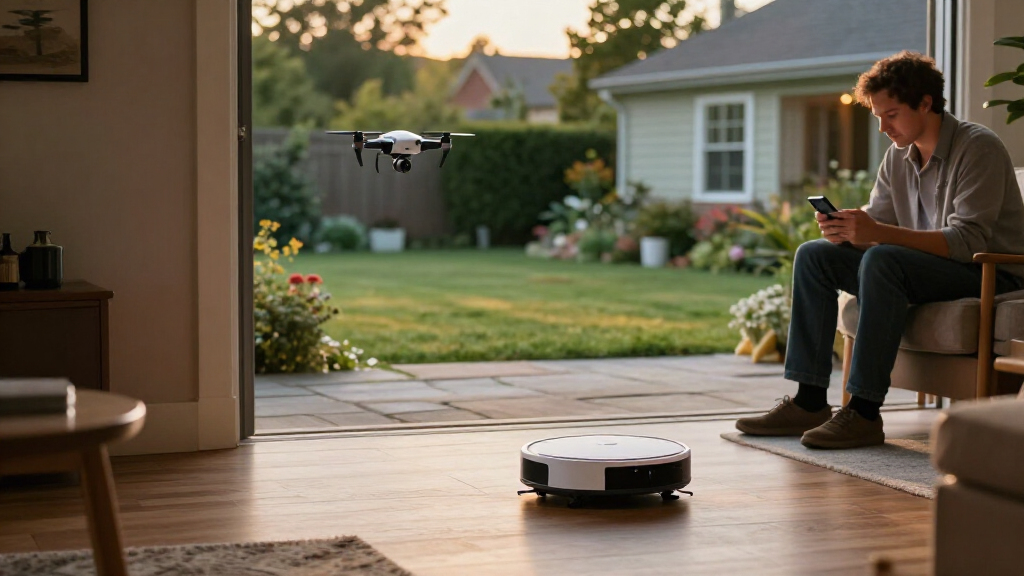
Ring announced a home drone and a business patrol robot. Both can respond to Ring alerts, while their launch dates and operating limits differ.
Two devices, different spaces
Ring designed one to patrol business premises and the other to investigate inside homes.
- Wheeled robot with a periscope camera.
- Can visit alert locations and scan 360 degrees.
- Streams and records in up to 4K, according to Ring.
- Flies indoors on scheduled or on-demand routes.
- Has a 148-degree field of view and 2K video.
- In its dock, the camera is off and the drone powers down.
How patrols work
Ring says both devices use AI Pilot to navigate and respond to events.
AI Pilot uses cameras, sensors, vision models and cloud processing.
A Ring camera, sensor or alarm can prompt a device to visit a location.
Scheduled patrols require a compatible Ring Protect plan.
What to weigh before buying
Drone sale depends on FCC authorization
Ring says the required authorization has not been granted, so its planned shipping date may change.
The drone needs internet access
The Verge reported it can only land without Wi-Fi and has a claimed five-to-eight-minute flight time.
Movement changes where cameras see
Consider where devices travel, when they record and who can access footage, especially around residents, employees and visitors.
TAKE is not end-to-end encryption
Ring says its servers temporarily access keys for cloud features; full end-to-end encryption remains optional.
Mobile Cameras Extend Ring’s Reach
Unlike a fixed camera, a device that moves can bring a view to a location where an alert occurs. That is the central promise Ring is making: **investigate events across a space** instead of relying only on cameras installed at particular points. For a business, Rover could cover areas such as counters or shelves; in a home, the drone is intended to look into places a stationary camera cannot see.
The products also broaden the consequences of a security-camera decision. A mobile camera may record across rooms or work areas, and Rover is designed to record while it moves, according to Ring. That makes **where devices travel, when they record and who can access footage** relevant to residents, employees and visitors—not only the person who buys the equipment. Ring’s privacy controls and encryption claims are therefore central to evaluating the products, alongside their price and performance.
There are practical limits as well as potential benefits. A drone with a short reported flight time and dependence on internet connectivity may not be able to investigate every event. Rover’s reported battery and floor-coverage constraints may shape its usefulness in larger or multilevel premises. Those details should be read as reported specifications, not as independently verified performance results.
Products Worth Considering

LG UltraGear 25G590B-B 25-Inch Full HD 1000Hz Gaming Monitor

LG UltraGear 32GX850A-B 32-inch 4K UHD OLED Gaming Monitor

Bose QuietComfort Headphones (2nd Gen), Wireless Over-Ear Noise-Cancelling Headphones, Black
As an affiliate, we earn on qualifying purchases.
From Astro to Ring Robotics
Ring’s announcement follows years of work on a mobile home camera. CNBC reported that Ring previewed an indoor drone called **Always Home Cam in 2020**. The Verge reported that founder Jamie Siminoff said development began in 2016. Ring now presents the drone as part of a wider product line rather than a standalone experiment.
Rover also draws on an earlier Amazon robot effort. Ring says it developed the business patrol device after Astro customers identified roving security as a feature they valued. The Verge reported that Amazon launched **Astro for Business in 2023** and discontinued the service a year later. Ring describes Rover as purpose-built for security; the announcement does not establish how it will perform in commercial settings.
Ring’s privacy assurances come amid prior scrutiny. In **May 2023, the Federal Trade Commission charged Ring** with compromising customer privacy by allowing employees or contractors access to private videos and by failing to implement basic privacy and security protections. The charge is an allegation in the FTC’s case, not a finding described here. Ring later announced its TAKE encryption in August 2026, describing it as its strongest default encryption yet.
““For years, customers told us they wanted eyes in the places a fixed camera couldn’t reach, and peace of mind in the spots they’d never want one.””
— Jamie Siminoff, Ring founder and chief inventor, in the announcement
Approval, Connectivity and Privacy Questions
The **Drone Cam’s regulatory status is unresolved**: Ring says required FCC authorization has not been granted, and the company’s planned January shipping date depends on approval. The announcement does not specify when authorization might arrive or whether the date will change if it is delayed.
Some operating limits are based on reporting from product demonstrations. The Verge reported that the drone depends on an internet connection, with landing as its only capability without Wi-Fi, and gave a five-to-eight-minute flight time attributed to Ring. It also reported Rover estimates of about 30 minutes of battery life, roughly 5,000 square feet of coverage and operation on one floor. These figures have not been independently verified in the source material, and actual performance could vary by environment.
Ring says its new **TAKE encryption** gives its videos strong protection, but it is not the same as full end-to-end encryption. Ring says its servers temporarily access keys to run cloud features such as smart alerts, then delete them; full end-to-end encryption, in which only a customer’s devices hold the keys, remains optional. The EFF has criticized TAKE’s protections. The source material does not provide an independent security assessment of either new device or details on how privacy controls will work in every use case.
FCC Review and Shipping Dates
The next stated milestone is Rover Cam’s planned **US shipping start on Dec. 16, 2026**. Ring has scheduled Drone Cam shipments for **Jan. 27, 2027**, but that plan is subject to the required FCC authorization. Ring has not provided a confirmed approval date in the source material.
Further product details and independent testing will be needed to establish how reliably AI Pilot navigates, how long each device operates in everyday conditions, and how the privacy and cloud features work in practice. Buyers will also need to check the plan requirements: Ring says scheduled patrols require a compatible Ring Protect plan. Until authorization, final availability and real-world performance are clearer, the announced prices and dates describe Ring’s plans rather than guaranteed delivery.
Key Questions
What are Ring’s new mobile security devices?
Drone Cam is a small indoor flying camera for homes. Rover Cam is a wheeled patrol robot Ring is targeting at businesses.
How much do the devices cost, and when are they scheduled to ship?
Ring lists Rover Cam at $999.99, with US shipping scheduled for Dec. 16, 2026. Drone Cam is listed at $249.99, with shipping planned for Jan. 27, 2027, subject to FCC authorization.
Do the devices need a Ring subscription?
Ring says scheduled patrols require a compatible Ring Protect plan. The source material does not specify whether every other feature requires a subscription.
What has Ring said about privacy?
Ring says the drone’s camera is off while it is docked, Rover has a Sleep Mode, and both devices have recording indicators. The company says videos use TAKE encryption, but the EFF has criticized its protections compared with full end-to-end encryption.
Is the Drone Cam approved for sale?
Not yet, according to Ring. The company says the drone has not received authorization required by FCC rules and may not be sold until it does.
Source: ThorstenMeyerAI.com