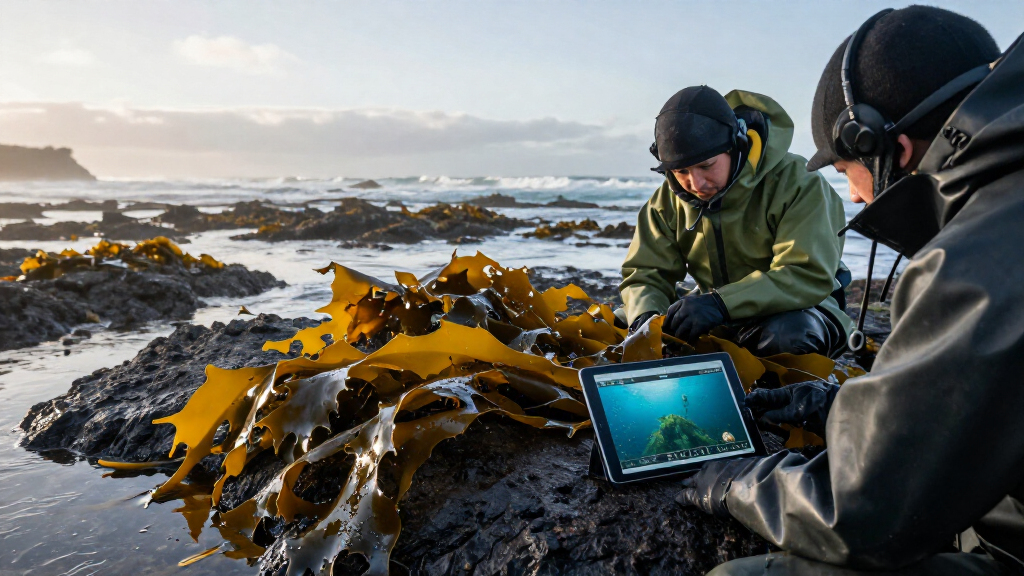

🔍 Read the full analysis: What’s Behind Google And CSIRO’s AI Research On Giant Kelp? on ThorstenMeyerAI.com

Get the latest gadgets delivered free with Prime
- Fast, free delivery on millions of items
- Prime Video, Amazon Music and more included
- Member-only deals all year
TL;DR
Google says CSIRO researchers used AI tools and new Australian giant kelp reference genomes to analyse DNA from 600 wild specimens collected at 40 Tasmanian coastal sites. The work is intended to help select native kelp for selective breeding, but the specimen analysis has not yet been independently documented in a paper or dataset, and survival in warmer seas remains untested.
Google said on November 12, 2026, that Australia’s national science agency, CSIRO, used AI-assisted genomics to analyse 600 wild giant kelp specimens from 40 sites along Tasmania’s coast. The work aims to help researchers identify native kelp for selective breeding as forests that have declined sharply face warmer, nutrient-poor water and sea urchins; whether bred kelp can survive warmer summers in the ocean has not yet been tested.
The project’s genomic work uses two newly published Australian giant kelp reference genomes as a local point of comparison. In a peer-reviewed paper published in BMC Genomics in June 2026, researchers reported sequencing plants from Victoria and Tasmania. They placed 98–99% of each genome into 35 pseudo-chromosomes. The genomes measured 528 to 534 million base pairs, according to the paper’s abstract.
The study found the two Australian genomes differed from each other by 0.2%, while each differed from a Californian reference by 1.5%, a seven-fold difference reported by the researchers. The paper’s authors include CSIRO scientists and a Google researcher, and the genome data is public. The work supports using local reference data when comparing Australian kelp DNA rather than relying only on a genome from another hemisphere.
Google’s November post and accompanying video describe the next step: researchers used a version of DeepVariant retrained for kelp DNA to analyse the 600 wild samples. Google says the analysis found remaining Tasmanian patches to be genetically isolated. That finding, and the 600-sample analysis, are described in the company’s announcement; the source material says no paper or dataset for those results was available at publication time.
Giant kelp · Tasmania · CSIRO with Google AI
From the reef to the lab and back: where the AI fits
Five steps, as described by CSIRO and Google. The AI works in steps 2 and 3; people do the diving, the lab work and the planting.
1Reef
Collect wild kelp
600 wild specimens from 40 sites along the Tasmanian coast, according to Google.
2Lab + AI
Build a local reference
Long-read DNA plus Google’s DeepConsensus and DeepPolisher: two Australian reference genomes, published in BMC Genomics.
AI step3AI
Read each plant
A version of DeepVariant trained for kelp finds where each specimen’s DNA differs.
AI step4Lab
Choose and cross
Distinct survivors with genetic variation and heat-tolerant traits are crossed. Selective breeding, not genetic modification.
5Reef
Replant and watch
Young kelp is attached to rocky reef in pilot tests. Warm summers show which plants survive.
Sources: Google blog post, Nov 12, 2026, and Google Research video; Scharfenstein et al., BMC Genomics, 2026; CSIRO, 2024, and CSIRO on Google Arts & Culture. The scene is a schematic, not a map or real data.
Graphic: Powered by Thorsten Meyer AI
Choosing Kelp for Breeding
The research addresses a practical conservation problem: identifying which surviving plants might be suitable parents for selective breeding. In the proposed process, researchers link DNA information to laboratory tests of traits such as heat tolerance, then cross selected native plants. AI helps analyse genetic variation; it does not itself measure heat tolerance, plant kelp, or establish that a particular strain will survive in the wild.
That distinction matters because Tasmania’s giant kelp forests have declined by about 95%, according to CSIRO. Giant kelp forms habitat and nursery areas for marine life, and its loss can affect an ecosystem beyond the seaweed itself. If selectively bred kelp can withstand hotter conditions, the approach could contribute to restoration. But that outcome remains a research goal, not a result established by the genomic analysis.
The project also illustrates how AI can be used in conservation research in a narrower, testable role: processing biological data to help guide decisions made by scientists. Its potential value depends on the quality of the genomic and laboratory evidence, and ultimately on how kelp performs in the sea.
Products Worth Considering

LG UltraGear 32-Inch QHD 180Hz Curved Gaming Monitor

Bose TV Speaker (2nd Gen) Compact Soundbar

Samsung 37-inch Odyssey G7 Curved 4K UHD Gaming Monitor (G75F)
As an affiliate, we earn on qualifying purchases.
From Mapping to Genomics
The collaboration was announced in February 2024 by Google Australia, CSIRO, the University of Tasmania’s Institute for Marine and Antarctic Studies, The Nature Conservancy, the Great Southern Reef Foundation and the Kelp Forest Alliance. It had two strands: mapping kelp using satellite imagery and tools including Google Earth Engine and Vertex AI, and studying kelp genetics. Google’s November 2026 update concerns the genomic strand, not a report that kelp forests have been restored.
Giant kelp, Macrocystis pyrifera, grows in cold, shallow seas. CSIRO says plants in Tasmanian waters can reach around 30 metres. The agency attributes the decline to warmer, nutrient-poor water and invading sea urchins associated with the East Australian Current extending farther south. CSIRO says warming in the Tasman Sea is occurring at twice the global average. The kelp forest is listed as an endangered marine community type.
For the genomic work, Google says its tools DeepConsensus and DeepPolisher helped correct errors in raw genetic reads used to assemble the reference genomes. DeepVariant’s standard models are described on its project page as trained on human data; the company’s video says researchers trained a version to analyse kelp samples. This account is distinct from the peer-reviewed genome paper, which documents the two reference genomes.
“trained a version of our AI model DeepVariant to analyze our wild samples”
— Google, in a video accompanying its November 12, 2026, announcement
The Field Test Is Pending
The public evidence described so far is uneven. The two Australian reference genomes and their comparison with the Californian genome appear in a peer-reviewed 2026 paper. By contrast, the analysis of 600 wild specimens and the claim that surviving patches are genetically isolated are reported in Google’s blog post and video. The source material says no paper or dataset documenting those results had been found at the time of publication.
It is also unclear which specific genetic patterns or laboratory measurements will determine which kelp are crossed, how many crosses will be tested, and when young kelp will be planted on reefs. Most importantly, there is no reported result showing that the selectively bred kelp can endure warmer summers or establish lasting forests in the ocean. Those are future tests, not demonstrated outcomes.
Breeding and Reef Trials
Researchers plan to cross genetically distinct native survivors in laboratory selective-breeding work, then plant young kelp on reefs, according to the source material. This is selective breeding, not genetic modification. The next evidence readers should look for includes peer-reviewed publication or public data supporting the 600-sample findings, details of how candidate plants are selected, and results from reef trials.
The key measure will be whether planted kelp survives warmer summers and contributes to recovering forests. No schedule or outcome for those trials is specified in the available account, so the project’s conservation impact remains to be established.
Key Questions
What did Google and CSIRO announce?
Google described CSIRO’s use of AI-assisted genomics to analyse 600 wild giant kelp specimens collected from 40 sites along Tasmania’s coast. The goal is to help identify native kelp for selective breeding.
Does the AI measure kelp heat tolerance?
No. The account says laboratory tests measure traits such as heat tolerance, while DNA analysis can be linked to those results. AI is used to help analyse genetic data, not to establish heat tolerance by itself.
Which findings have been peer reviewed?
The two Australian giant kelp reference genomes and their comparison with a Californian reference were reported in a June 2026 paper in BMC Genomics. The 600-specimen analysis and reported genetic isolation of remaining patches were described in Google’s announcement; the source material says no paper or dataset for those results was available then.
Is the project genetically modifying kelp?
No. The planned approach is selective breeding: crossing selected native survivors in a laboratory and then planting young kelp on reefs. The source material says this is not genetic modification.
Has the bred kelp survived warmer summers?
No such result is reported. Whether selectively bred kelp can survive warmer summers and establish in the sea is the central open question; reef trials are still ahead.
Source: ThorstenMeyerAI.com