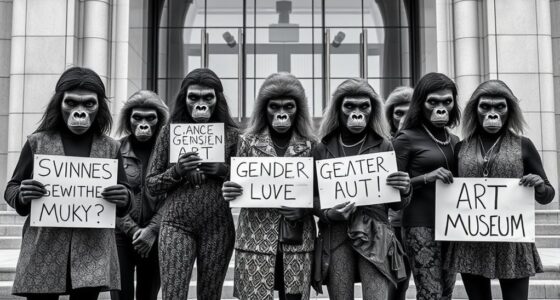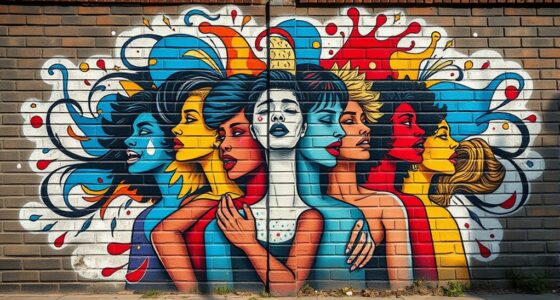
Feminist art movements use creativity to challenge patriarchy and societal norms. They focus on making marginalized voices visible and question traditional ideas of authority and storytelling. Through provocative artwork, community projects, and public displays, these movements push boundaries and foster social change. They also highlight intersectionality, emphasizing how gender intersects with race, class, and sexuality. By exploring these strategies, you’ll discover how feminist art continues to reshape perceptions and inspire activism—more insights await if you stay engaged.
Key Takeaways
- Feminist art movements use visual storytelling to confront patriarchy and elevate marginalized gender identities.
- Art acts as activism, challenging societal norms and sparking conversations on gender inequality.
- These movements emphasize intersectionality, highlighting how gender oppression intersects with race, class, and sexuality.
- Community collaborations empower marginalized groups to share their stories and challenge traditional artistic authority.
- Educational initiatives leverage feminist art to promote awareness and inspire social change toward gender equality.
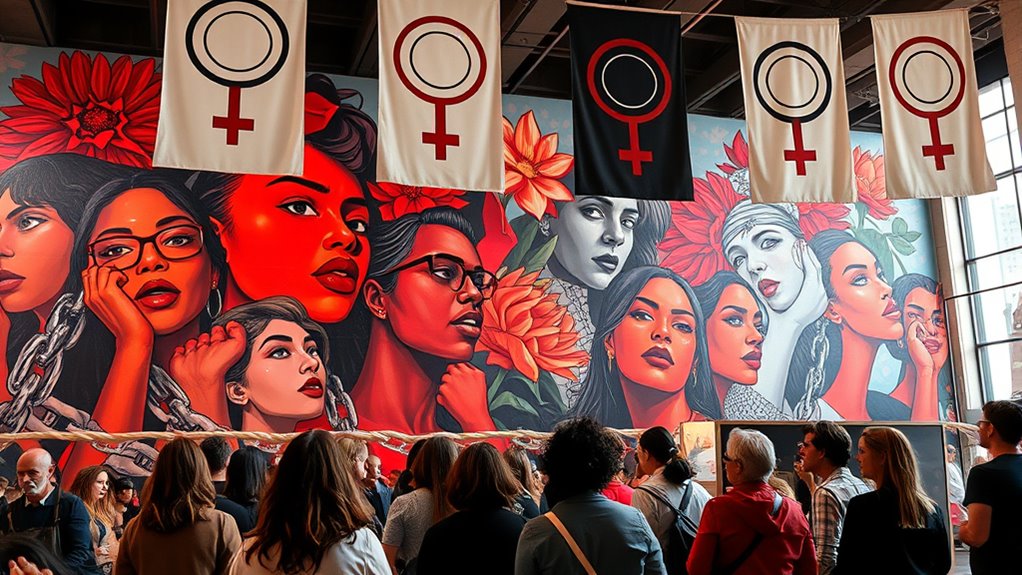
Have you ever wondered how art can challenge gender norms and amplify women’s voices? Feminist art movements harness creativity as a powerful tool to confront ingrained patriarchy, reshaping how society perceives gender roles. At the core of this effort is the focus on gender representation—ensuring women and marginalized genders are visible and heard through visual narratives that break stereotypes. By intentionally spotlighting women’s experiences, feminist artists question the traditional narratives that have long marginalized or misrepresented them. This act of reclamation transforms art into a form of activism, making it a potent vehicle for social change.
Through art activism, feminist artists push boundaries and challenge societal expectations. They create pieces that confront sexism, question power dynamics, and highlight issues like body autonomy, violence against women, and reproductive rights. These artworks often serve as rallying cries, fueling conversations that might otherwise be ignored or silenced. For example, provocative installations or bold visual statements force viewers to confront uncomfortable truths about gender inequality, demanding reflection and action. This approach turns galleries and public spaces into platforms for dialogue, making activism accessible and visceral.
Feminist art confronts sexism and power, inspiring dialogue and action through provocative, boundary-breaking visuals.
Feminist art movements also challenge the traditional notions of artistic authority and who gets to tell stories. By embracing diverse voices and perspectives, artists highlight intersectionality, showing that gender oppression is intertwined with race, class, and sexuality. This broader scope enriches the conversation, making it more inclusive and representative of real-world complexities. As a viewer, you’re invited to see the world through a different lens—one that recognizes the multiplicity of identities and experiences often erased in mainstream art. The vibrant, confrontational, and often provocative nature of feminist art signals a break from the past, emphasizing that art itself can be a form of resistance.
Moreover, feminist art movements often utilize community-based projects and collaborative efforts to foster collective empowerment. These initiatives encourage women and marginalized groups to create and share their stories, amplifying their voices beyond individual expression. By doing so, they challenge the patriarchy not just through individual works but by creating networks of support and solidarity rooted in shared goals for social justice. As you engage with feminist art, you’re witnessing a dynamic, ongoing struggle—one that uses creativity to reshape societal norms and elevate women’s voices in spaces where they’ve historically been silenced. Additionally, incorporating educational initiatives into feminist art practices helps expand understanding and awareness of gender issues among broader audiences. This fusion of art and activism continues to inspire, provoke, and push for a future where gender equality is a fundamental part of cultural expression.
Amazon Product B0DX5LTQCF
As an affiliate, we earn on qualifying purchases.
Frequently Asked Questions
How Do Feminist Art Movements Influence Contemporary Gender Discussions?
Feminist art movements influence contemporary gender discussions by shaping how you view gender representation and societal perceptions. They challenge stereotypes, encouraging you to question traditional roles and biases. Through bold visual narratives, these movements inspire dialogue and awareness, empowering you to recognize and address inequalities. As a result, they push society towards more inclusive, equitable perspectives, fostering ongoing conversations about gender identity, rights, and representation in everyday life.
What Are Some Lesser-Known Feminist Artists Making an Impact Today?
Think of emerging voices as sprouting flowers in a neglected garden; these lesser-known feminist artists are making waves through grassroots initiatives. They challenge mainstream narratives, using bold visuals and stories that push boundaries. Artists like Zanele Muholi, who highlights LGBTQ+ issues, and Nja Mahdaoui, blending traditional craft with activism, are transforming the art scene. Their work sparks conversations, proving that impact isn’t always loud but profoundly rooted.
How Do Feminist Art Movements Intersect With Other Social Justice Causes?
You see that feminist art movements intersect with other social justice causes through intersectionality and solidarity. By engaging in activism and collaboration, artists highlight issues like racial justice, LGBTQ+ rights, and economic inequality. Your involvement amplifies diverse voices, fostering understanding and collective action. This interconnected approach strengthens the impact of feminist art, showing that challenging patriarchy also means fighting for broader social equity and inclusion.
What Challenges Do Feminist Artists Face Within the Mainstream Art World?
You face challenges like limited gallery representation and funding disparities that make it hard to showcase your work. The mainstream art world often favors established, male-dominated narratives, making it difficult for feminist artists to gain equal recognition. You might also encounter skepticism or marginalization, but by persistently advocating for your voice and challenging these barriers, you can push for greater visibility and equality within the industry.
How Has Digital Media Transformed Feminist Art Activism?
Did you know that 70% of feminist artists now use digital media for activism? Digital storytelling has revolutionized how you share your message, allowing you to reach a global audience instantly. Online communities empower you to connect with like-minded activists, amplify your voice, and challenge patriarchy more effectively. You can now create, share, and collaborate in ways that were impossible before, making your activism more dynamic and impactful.

SINGER Heavy Duty 6380 Sewing Machine with Extension Table & Accessory Kit | Strong Motor with Enhanced Piercing Power, 110 Stitch Applications, Full Metal frame, 1-step Buttonhole & LED Light
POWERFUL MOTOR & HIGH-SPEED STITCHING: Equipped with a motor that’s 50% stronger than standard sewing machines, the SINGER...
As an affiliate, we earn on qualifying purchases.
Conclusion
Just like a spark igniting a fire, feminist art movements continue to challenge patriarchy with bold creativity. Your awareness and support can fuel this ongoing revolution, inspiring change and empowering voices that were once silenced. As you embrace these powerful expressions, remember that art is a weapon for justice, shaping a future where equality thrives. Together, you can be part of this vibrant movement, turning passion into progress and making a lasting impact.

SINGER Heavy Duty 6700C Computerized Sewing Machine with Accessory Kit | Strong Motor with Enhanced Piercing Power, 411 Stitch Applications, LCD Screen, Full Metal frame & 1-step Buttonhole
411 STITCH APPLICATIONS FOR ULTIMATE CREATIVITY: The SINGER HD6700C offers 411 stitch applications, including basic, stretch, and decorative...
As an affiliate, we earn on qualifying purchases.

VEVOR Industrial Sewing Machine, 550W Servo Motor and Table Stand, 5000s.p.m Heavy-duty Lockstitch Sewing Machine, Clear Control Panel and Electro-mechanization Intelligent Start-stop for Easy Use
Industrial Sewing Machine: Meet our industrial sewing marvel! The lockstitch sewing machine boasts a 550W servo motor, delivering...
As an affiliate, we earn on qualifying purchases.