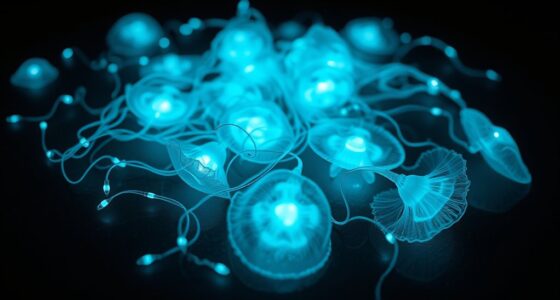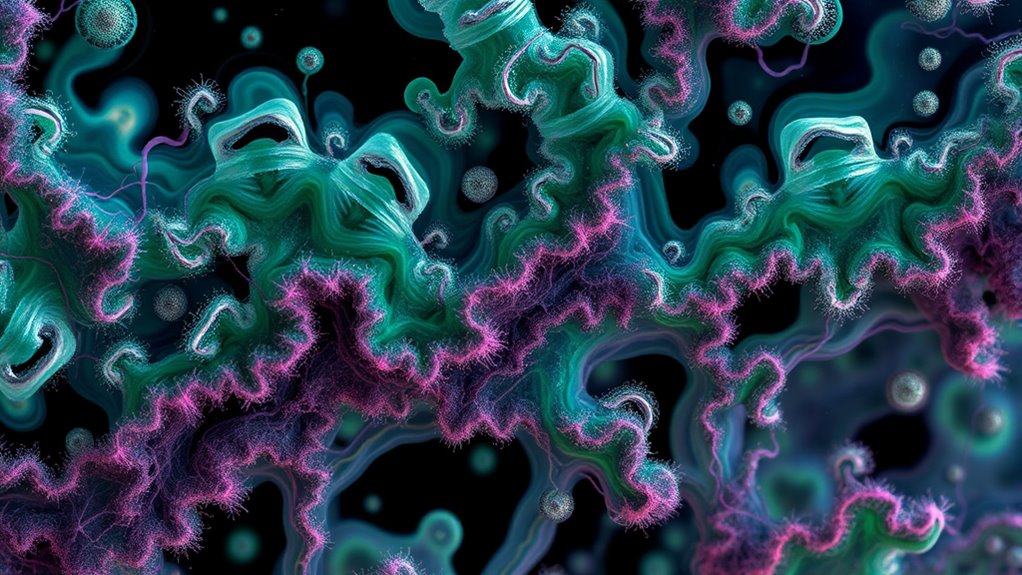

Alexander Fleming’s germ paintings are considered an early form of bioart, where he combined microbiology with artistic expression by showcasing microbial colonies as vibrant, intricate designs. These works highlight the natural beauty of microbes, transforming scientific observations into stunning visual pieces. His innovative approach blurred the lines between science and art, inspiring future bioartists to explore living organisms as creative mediums. Exploring this history reveals how microbial aesthetics helped shape the beginnings of bioart’s exciting evolution.
Key Takeaways
- Fleming’s germ paintings blend microbiology with artistic expression, showcasing microbial forms as visual masterpieces.
- These works highlight the natural beauty, diversity, and intricate patterns of microbial colonies.
- Fleming’s innovative approach is an early example of bioart, integrating science and art seamlessly.
- His paintings influenced future bioartists by demonstrating microbes as subjects of aesthetic exploration.
- Fleming’s work opened new avenues for appreciating microscopic life as both scientific and artistic phenomena.

Alexander Fleming, best known for discovering penicillin, also explored the artistic potential of germs, creating striking “germ paintings” that blend science and art. These early works are a fascinating example of microbial aesthetics, where the natural forms of bacteria and fungi become visual masterpieces. As you explore Fleming’s approach, you’ll see how he saw beyond the biological functions of microbes and appreciated their shapes, colors, and textures as a form of artistic expression. By doing so, Fleming demonstrated how art and science can seamlessly integrate, transforming scientific specimens into captivating visual displays.
Fleming’s germ paintings showcase microbial beauty, blending science and art in captivating microscopic masterpieces.
In Fleming’s germ paintings, you quickly recognize that each microbial colony possesses unique characteristics—some resemble abstract landscapes, others evoke intricate patterns or organic sculptures. This aesthetic diversity isn’t accidental; it’s rooted in the inherent beauty of microbial growth patterns. You might notice the way colonies radiate outward in symmetrical patterns or cluster into fractal-like arrangements. Fleming’s work encourages you to see microbes not just as biological entities but as elements of a visual language that speaks to both science and art. This fusion invites you to appreciate the natural artistry present in microscopic worlds, fostering a deeper connection between scientific inquiry and aesthetic appreciation.
The concept of microbial aesthetics plays a vital role here, as it highlights the visual appeal of microbial life. Fleming’s paintings serve as early examples of how microbial forms can transcend their biological functions to become objects of artistic admiration. When you observe these paintings, you’re witnessing a deliberate act of art and science integration. Fleming’s intention wasn’t just scientific documentation but also an effort to showcase the inherent beauty of the microbial universe. His work foreshadowed later bioart movements, where artists harness biological processes and organisms to create compelling visual works that challenge traditional boundaries. Fleming’s germ paintings demonstrate that microbes can be both subjects of scientific study and sources of artistic inspiration, bridging two worlds that often seem worlds apart. Additionally, these microbial forms exemplify bioart techniques, where living organisms are used as mediums for artistic expression.
You’ll find that Fleming’s pioneering efforts opened doors for future artists and scientists to explore this intersection. Today, bioartists continue to draw inspiration from microbial aesthetics, using living organisms and biological techniques to craft innovative art pieces. Fleming’s germ paintings are more than historical curiosities; they’re a testament to the power of integrating art and science. They prove that when you view microbes through the lens of aesthetics, you reveal a new perspective—one that celebrates the natural artistry of the microscopic world and blurs the lines between scientific discovery and creative expression.
Frequently Asked Questions
How Did Fleming’s Germ Paintings Influence Modern Bioart?
Fleming’s germ paintings influence your understanding of modern bioart by blending artistic inspiration with scientific visualization. They show how biological elements can be transformed into visual art, inspiring artists to explore microbes and cells creatively. You can see these paintings as a bridge, encouraging contemporary bioartists to visualize science vividly, fostering innovation at the intersection of art and biology. This legacy pushes boundaries and enhances the appreciation of scientific imagery in art.
What Materials Did Fleming Use for His Germ Paintings?
You see, Fleming used microbial pigments to create his germ paintings, which served as natural dyes. He applied these pigments onto traditional paint mediums like oil or watercolor to produce vivid, organic images. By combining microbial pigments with standard paint mediums, he transformed biological materials into art. This innovative use of microbial pigments in common paint mediums helped pave the way for modern bioart, inspiring artists to explore living organisms creatively.
Are Fleming’s Germ Paintings Preserved in Any Museum?
You might think Fleming’s germ paintings are lost forever, but some are preserved in museums. These artworks, created with bacteria and fungi, are carefully maintained through museum preservation efforts. You can find germ painting locations in select science and art museums that showcase Fleming’s pioneering bioart. If you’re interested, check museum collections or exhibitions to see these unique biological artworks up close and learn about their historical significance.
Did Fleming Intend to Create Art or Scientific Illustrations?
You might wonder if Fleming intended to create art or scientific illustrations. His artistic intent was to explore the beauty of germs, blending science with art, but his primary goal was scientific purpose—documenting bacteria and mold growth. Fleming aimed to visualize microorganisms in a way that revealed their complexity, which unintentionally became art. So, while his work served science, it also bridged into artistic expression, emphasizing both scientific accuracy and visual appeal.
How Did the Public React to Fleming’s Germ Paintings at the Time?
You’d find that the public reception was mixed, with some marveling at Fleming’s innovative fusion of science and art, while others saw it as artistic controversy. Many appreciated the striking visuals, but critics questioned whether these germ paintings belonged in the art world or scientific labs. Overall, Fleming’s work sparked debate, challenging traditional boundaries and prompting conversations about the role of science in artistic expression.
Conclusion
As you reflect on Fleming’s germ paintings, think of them as tiny, vibrant landscapes where microbes become art. Just like a painter revealing hidden worlds on canvas, Fleming transformed microscopic life into a medium that challenges perceptions. Imagine standing before his work, seeing bacteria not as threats but as brushstrokes of creativity. These paintings remind you that even the smallest organisms can inspire bold, innovative art—proof that beauty and science often collide in surprising, colorful ways.