Bioart focuses on biological processes and living organisms, often manipulating bacteria or plants to create living, evolving artworks that raise ethical questions. Sci-art aims to communicate scientific ideas visually and conceptually, bridging science and the public through data visualizations and interactive displays. Tech art uses digital tools like virtual reality, robotics, and AI to explore new media and immersive experiences. Exploring these distinctions helps you understand how artists challenge perceptions of science, technology, and life—continue to discover more insights.

Get the latest gadgets delivered free with Prime
- Fast, free delivery on millions of items
- Prime Video, Amazon Music and more included
- Member-only deals all year
Key Takeaways
- Bioart manipulates living organisms and biological processes, often raising ethical questions and emphasizing biological life and experimentation.
- Sci-art visualizes and communicates complex scientific concepts to foster understanding and dialogue between science and the public.
- Tech art employs digital tools like VR, AR, and AI to create immersive, interactive experiences exploring technology’s influence on art and perception.
- While overlaps exist, bioart focuses on life and ethics, sci-art on scientific communication, and tech art on digital innovation and interaction.
- Each genre offers a unique perspective: bioart challenges notions of life, sci-art makes science visible, and tech art explores digital possibilities.
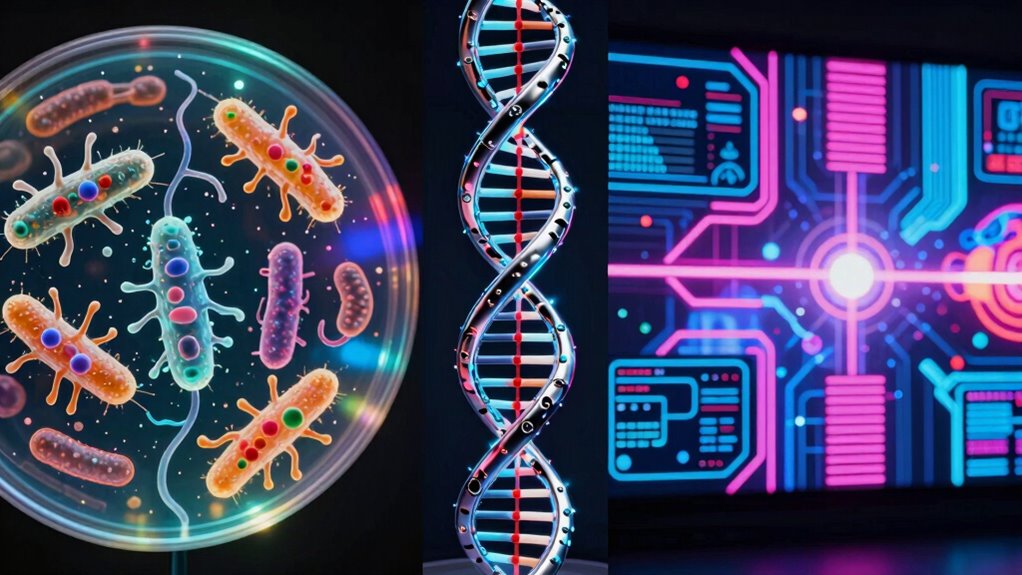
In the rapidly evolving landscape of contemporary art, terms like bioart, sci-art, and tech art often blend together, but they each have distinct focuses and methods. As you explore these genres, you’ll notice that bioart centers on biological processes and living systems. Artists working in this sphere use genetic experimentation to manipulate or incorporate living organisms, often blurring the line between science and art. They might modify bacteria to produce colorful pigments or engineer plants with unique patterns, all to provoke questions about ethics, identity, and the relationship between humans and nature. Your experience with bioart often involves witnessing living artworks that change over time and challenge traditional notions of art as static or inanimate. It’s a field that invites you to reflect on the impact of scientific advancements on life itself.
Sci-art, on the other hand, emphasizes the communication of complex scientific concepts through visual and conceptual means. You’ll find that sci-art works often serve as bridges between the scientific community and the public, making abstract or technical ideas more accessible. Artists incorporate digital aesthetics—such as data visualizations, 3D models, and interactive installations—to translate scientific data into compelling visuals. The goal is to foster curiosity and understanding, often addressing themes like cosmology, quantum physics, or evolution. Sci-art doesn’t just depict science; it interprets and reimagines it, inviting you to see the universe through a new lens. It’s about making the invisible visible and encouraging dialogue between science and society.
Tech art, meanwhile, is characterized by its focus on technological tools and digital innovation. You’ll encounter works that utilize virtual reality, augmented reality, robotics, or AI to create immersive experiences. The emphasis is on exploring the possibilities of new media and digital aesthetics, often challenging the boundaries of perception and interaction. Tech artists experiment with the latest technology to push artistic expression forward, sometimes questioning the implications of automation, data collection, or machine intelligence. As you engage with tech art, you’re invited into interactive environments where the line between creator and viewer blurs, emphasizing experience and participation. This genre constantly evolves alongside technological advancements, making it a dynamic frontier for innovation.
While these categories overlap, each offers a distinct perspective through which you can experience contemporary art. Bioart probes biological life and ethics, sci-art communicates scientific ideas visually, and tech art harnesses the power of digital tools to expand creative possibilities. Understanding these differences helps you appreciate the unique ways artists are reshaping our perception of science, technology, and life itself.
As an affiliate, we earn on qualifying purchases.
Frequently Asked Questions
How Do Artists Choose Their Mediums Within Bioart, Sci-Art, or Tech Art?
You choose your mediums within bioart, sci-art, or tech art based on your artistic experimentation and the message you want to convey. Consider how each medium aligns with your concepts, whether it’s biological materials, scientific tools, or innovative technologies. Your passion for exploration guides medium selection, allowing you to push boundaries and create impactful work that bridges art and science effectively.
Are There Ethical Concerns Specific to Each Art Form?
Think of bioart, sci-art, and tech art as modern Promethean fires—powerful but potentially dangerous. You must navigate bioethics debates and technological implications carefully, as each form raises unique ethical concerns. In bioart, manipulating life questions the boundary between nature and innovation. Sci-art’s use of data sparks privacy issues, while tech art’s reliance on AI or digital tools prompts debates over authenticity and control. You’re responsible for balancing creativity with ethical integrity.
How Do Audiences Typically Respond to These Different Art Styles?
You’ll find that audience engagement varies with each style, influenced heavily by cultural perceptions. Bioart often evokes curiosity or discomfort due to its biological themes, while Sci-Art tends to inspire fascination or skepticism about science’s role in art. Tech Art usually attracts tech enthusiasts or futurists, sparking conversations about innovation. Overall, your audience’s reactions depend on their familiarity with these fields, shaping how they connect emotionally and intellectually with each art form.
What Are the Main Challenges Artists Face in These Fields?
They say, “Every challenge is an opportunity,” and in bioart, sci-art, and tech art, you face hurdles like ethical concerns, technical limitations, and funding. You must foster innovative collaborations, navigate complex regulations, and stay ahead with future technological integration. These challenges push you to think creatively, ensuring your work remains impactful, responsible, and ahead of the curve in a rapidly evolving landscape.
Can These Art Forms Overlap or Be Combined in Projects?
Yes, these art forms can definitely overlap or be combined in projects. You might engage in interdisciplinary collaborations, blending bioart’s living systems with sci-art’s scientific inquiry or tech art’s innovative material usage. Such integration sparks creativity, allowing you to explore new perspectives and techniques. By merging these fields, you create multifaceted artworks that challenge traditional boundaries and inspire audiences with their complexity and originality.
interactive data visualization tools
As an affiliate, we earn on qualifying purchases.
As an affiliate, we earn on qualifying purchases.
Conclusion
So, now you see, bioart’s like nurturing a petri dish baby, sci-art’s the curious scientist dreaming in colors, and tech art’s the geeky wizard wielding gadgets. Together, they’re a wild art party—one planting seeds, one painting in the lab, and the other coding their way to the future. If you’re feeling lost, just remember: it’s not a blurry jungle of science and art—it’s a vibrant, chaotic carnival where innovation and imagination collide, and everyone’s invited.
As an affiliate, we earn on qualifying purchases.
As an affiliate, we earn on qualifying purchases.
Halloween Picks
halloween
As an affiliate, we earn on qualifying purchases.