

The VigilSAR platform (https://vigilsar.com/) has released a comprehensive public leaderboard for evaluating language models’ suitability for intelligence-surveillance-reconnaissance (ISR) tasks. This benchmark focuses on models’ reasoning, reporting, and restraint, specifically tailored for defense applications rather than general trivia, ensuring that only models capable of handling sensitive tasks can be trusted.
Listen free for 30 days with Audible
Thousands of audiobooks and originals — cancel anytime.
As an affiliate, we earn on qualifying purchases.
The current evaluation involved 14 models over 300 tasks, scored as of 2026-07-17. Importantly, the aggregate results are publicly available, but the task set itself remains private. This deliberate secrecy prevents models from simply memorizing answers during training, maintaining the integrity of the assessment. A hidden, held-out set exists, and by comparing public and private scores, VigilSAR can identify potential memorization, adding a layer of transparency to the process.
In the current standings, claude-fable-5 holds the lead with a score of 67.77, solidly within Band A. A noteworthy newcomer is Moonshot’s Kimi K3, which debuts at #3 with 64.65 points. This model ranks in Band B, surpassing every GPT and Gemini variant on the leaderboard. The scoring bands provide a high-level view of model performance, emphasizing confidence intervals instead of ranking precision, which better reflects the inherent variability in AI performance metrics.
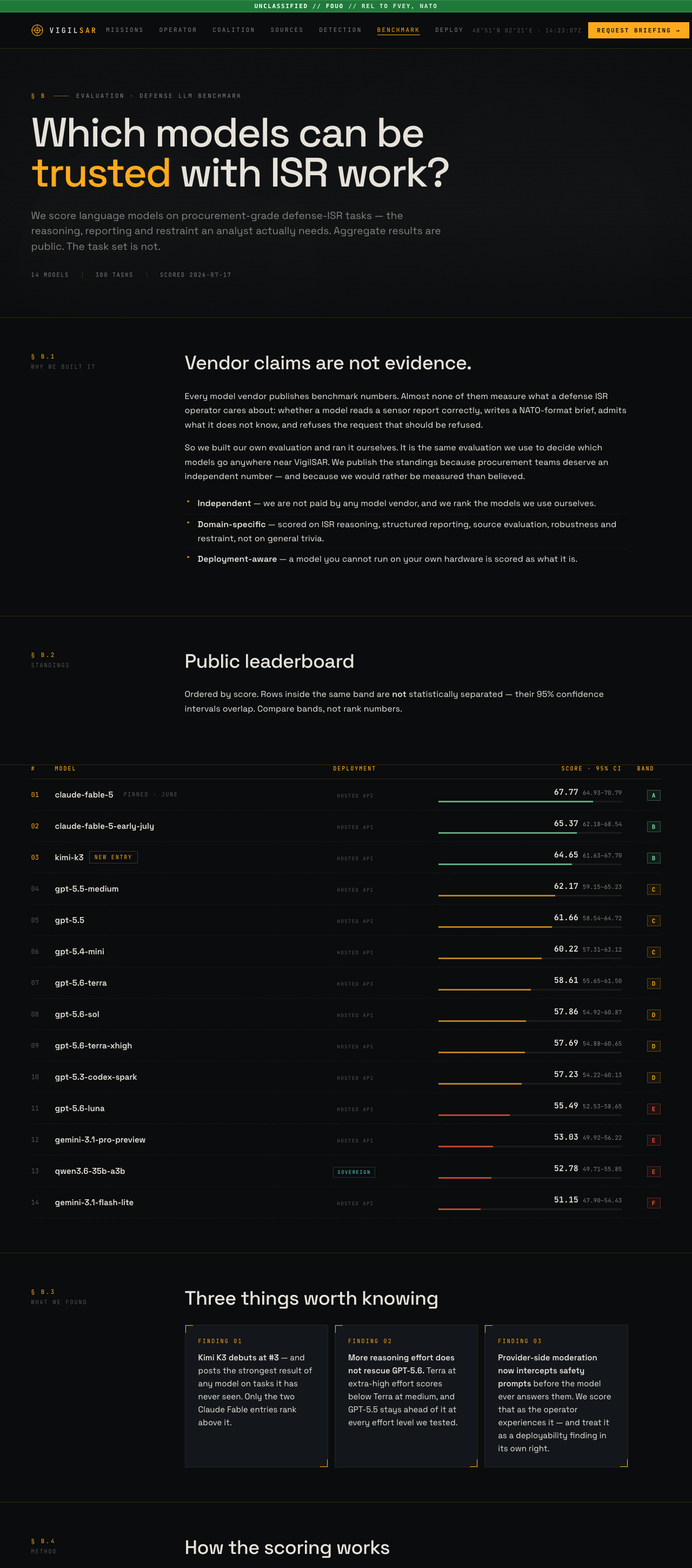
The leaderboard also features a locally runnable open model deemed “sovereign-deployable”. This highlights the importance of deployment practicality in defense contexts, where models must be both effective and operable in real-world environments. The evaluation explicitly states that vendor claims are not considered evidence of capability; instead, the operators built this evaluation to determine which models can truly meet their stringent standards, independent of vendor influence.
Why keep the task set private? The primary reason is to prevent models from training directly on the evaluation data, which could artificially inflate their scores. This approach preserves the integrity of the benchmarking process and ensures that models are genuinely capable of handling unseen, sensitive tasks without relying on memorized answers. The use of bands instead of fixed ranks, along with confidence intervals and the public leaderboard, reflects a mature approach to AI evaluation, emphasizing transparency and honesty.
Finally, the debut of Moonshot’s Kimi K3 in third place signals a shift in the landscape, notably outperforming many GPT and Gemini variants in this specific defense-ISR context. For tech enthusiasts interested in the implications of such benchmarks, understanding the criteria—such as cost-per-correct-answer and real-world deployability—is crucial. This effort underscores how specialized evaluation methods can help identify truly capable models for high-stakes, security-sensitive operations, all while maintaining a level of transparency that keeps the field honest.
As an affiliate, we earn on qualifying purchases.
AI deployment for military surveillance
As an affiliate, we earn on qualifying purchases.
As an affiliate, we earn on qualifying purchases.
As an affiliate, we earn on qualifying purchases.
high-performance AI inference hardware
As an affiliate, we earn on qualifying purchases.
As an affiliate, we earn on qualifying purchases.
NFL season / tailgating Picks
team gear
As an affiliate, we earn on qualifying purchases.