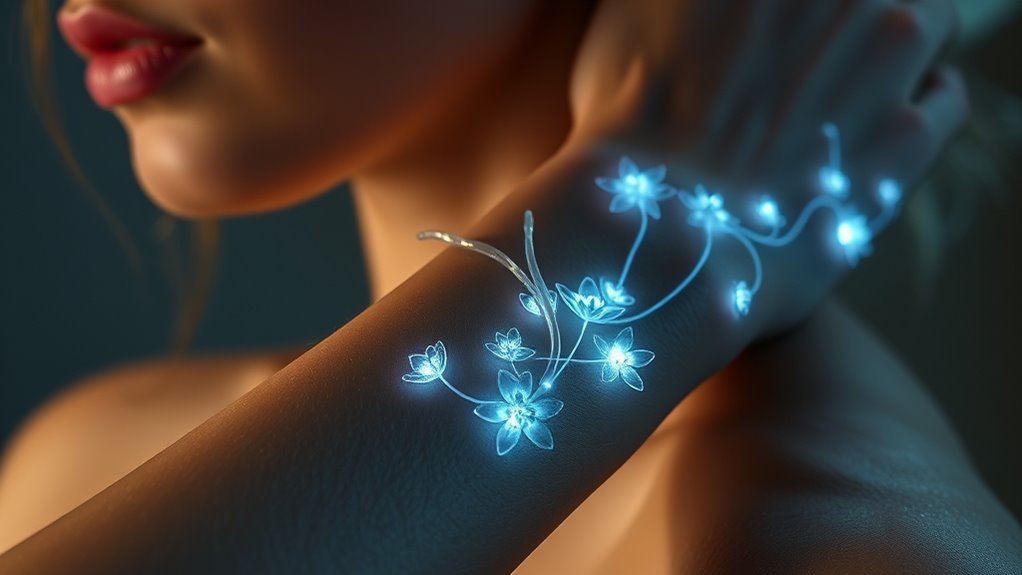

Wearable bioart blends technology and biology to create living jewelry and skin implants that are interactive and dynamic. You can wear bioengineered tissues, microorganisms, or bioluminescent tattoos that respond to your body or environment, challenging traditional beauty standards. These innovations let you express yourself uniquely while embracing ethical considerations around safety and consent. If you explore further, you’ll discover how this fascinating fusion is shaping the future of personal adornment and self-expression.

Get the latest gadgets delivered free with Prime
- Fast, free delivery on millions of items
- Prime Video, Amazon Music and more included
- Member-only deals all year
Key Takeaways
- Wearable bioart integrates living organisms or biological materials into jewelry and skin implants for dynamic, interactive aesthetics.
- It includes glowing tattoos, bioengineered tissue jewelry, and responsive skin patches that change with environmental stimuli.
- Ethical considerations focus on safety, consent, and long-term health impacts of embedding living materials in the body.
- Wearable bioart expands self-expression by creating unique, evolving personal adornments that challenge traditional beauty standards.
- Future developments aim to merge biological and technological boundaries responsibly, redefining the concept of beauty and wearable art.

Wearable bioart merges technology and biology to create living, interactive art you can wear. This innovative field pushes the boundaries of traditional jewelry and fashion, blending biological elements with technological design to produce pieces that are not only beautiful but also alive. As you explore wearable bioart, you’ll find that it challenges conventional ideas about aesthetics and raises important questions about biotechnology ethics. This fusion enables aesthetic innovation that is both provocative and inspiring, transforming the way you perceive adornment.
When you consider wearable bioart, you’re stepping into a world where living materials—such as genetically modified cells, bioengineered tissues, or even microorganisms—become part of your personal expression. Artists and scientists work together to craft jewelry or skin implants that respond to your environment or even interact with your body. For example, glowing bio-luminescent tattoos or skin patches that change color with mood are no longer distant science fiction but tangible realities. These creations redefine beauty by integrating biological processes, making each piece uniquely alive and responsive.
However, as you explore more deeply into this realm, it’s essential to recognize the complex layer of biotechnology ethics involved. Questions about safety, consent, and the long-term effects of embedding living materials into your body are paramount. You must consider how these biological elements are sourced, whether they pose health risks, and how they might evolve over time. The ethical landscape is nuanced, requiring transparency and responsibility from creators and wearers alike. Balancing the pursuit of aesthetic innovation with ethical responsibility ensures that wearable bioart remains a positive force rather than an unregulated experiment.
The pursuit of aesthetic innovation in wearable bioart isn’t just about pushing boundaries; it’s about redefining what adornment can be. Instead of static pieces, you’re engaging with dynamic, living art that changes and evolves. This approach opens new avenues for self-expression, allowing you to wear art that is as alive as you are. Whether through bio-luminescent jewelry that glows softly in darkness or skin implants that shift in color, these innovations challenge traditional beauty standards and invite you to see yourself as part of a living artwork. Additionally, understanding the application timing for pimple patches can inform how carefully integrated biological elements are used in skin-related bioart.
In essence, wearable bioart invites you to embrace a future where biological and technological boundaries blur, creating a new aesthetic landscape. It’s a space that demands both creativity and ethical mindfulness, encouraging you to explore art that is alive, interactive, and deeply personal. As this field develops, it promises to redefine how you wear and experience beauty—making bioart not just an accessory, but a living extension of yourself.
Products Worth Considering

Samsung 32-Inch Odyssey OLED G8 (G80SH) 4K Gaming Monitor

LG UltraGear 32GX850A-B 32-Inch 4K UHD Glossy OLED Gaming Monitor

DJI Osmo Mobile 8 Standard Combo Phone Gimbal Stabilizer
As an affiliate, we earn on qualifying purchases.
Frequently Asked Questions
How Safe Are Bioart Implants for Long-Term Use?
Bioart implants’ safety depends on thorough biocompatibility testing and their long-term durability. You should know that if these tests show minimal immune response and material stability over time, they’re likely safe for long-term use. However, since bioart is still emerging, ongoing research is essential. Always consult with medical professionals and consider potential risks before getting any implant, especially for extended periods.
Can Wearable Bioart Be Customized for Individual Aesthetic Preferences?
Did you know that 65% of people prefer personalized designs? Yes, wearable bioart can be customized to match your aesthetic preferences. You can choose specific patterns, colors, or even incorporate meaningful symbols, making it uniquely yours. This customization allows you to express your individuality while enjoying the biological benefits. So, if you’re looking for something that reflects your style, wearable bioart offers a versatile and personalized approach to living jewelry and skin implants.
What Materials Are Commonly Used in Living Jewelry?
You’ll find that living jewelry often uses biocompatible materials like living cells, algae, and bacteria to guarantee safety and comfort. These materials can be aesthetically customized to match your personal style, allowing for unique designs that integrate seamlessly with your body. By using biocompatible materials, you get a piece of wearable bioart that not only looks stunning but also adapts to your aesthetic preferences, making it truly one-of-a-kind.
Are There Ethical Concerns Related to Bioart and Skin Modification?
Like a double-edged sword, bioart and skin modification pose ethical concerns you should consider. You might face consent complexities, especially if artists or practitioners push boundaries without clear understanding. Cultural implications also matter, as certain modifications could offend or clash with traditions. It’s essential to question whether such practices respect individual autonomy and societal values, ensuring these innovations don’t harm or marginalize communities.
How Do Wearable Bioart Devices Interact With the Body’s Biological Systems?
You interact with wearable bioart devices by wearing or installing them on your skin, where biocompatibility considerations are vital. These devices are designed to minimize triggering your immune response mechanisms, ensuring they don’t cause inflammation or rejection. They may integrate with your biological systems through sensors or implants that monitor or enhance bodily functions. Proper design helps the device work seamlessly with your body’s natural processes, promoting comfort and safety.
Conclusion
Think of your body as a garden, and wearable bioart as the delicate blooms you choose to display. These living jewelry and skin implants are like seeds, blending nature with technology, inviting you to nurture a new harmony. As you wear them, you become a gardener of your own identity, shaping beauty and life itself. Embrace this fusion, for in cultivating these living adornments, you’re planting the future’s most extraordinary blossoms.