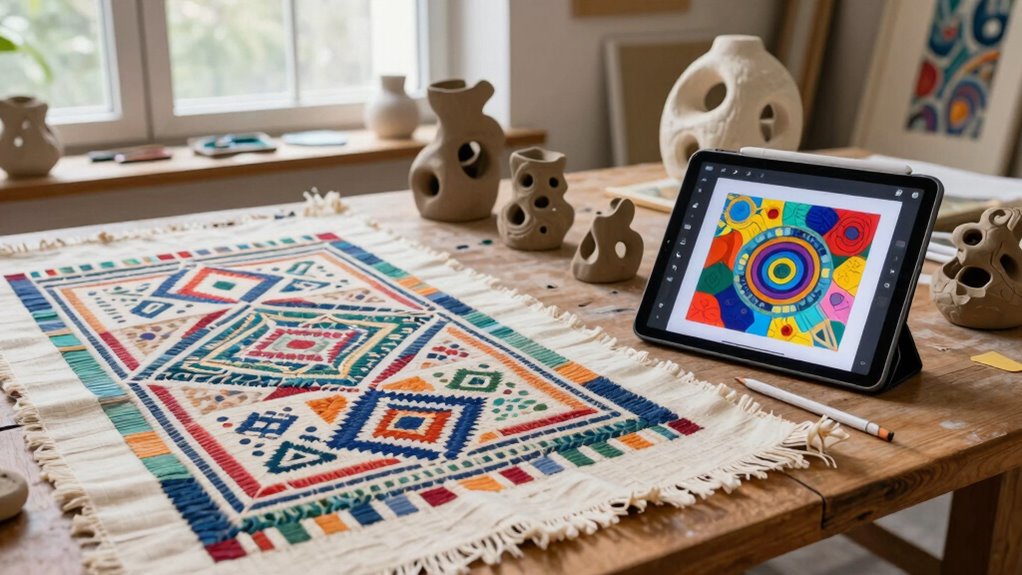

You pair AI with print, textile, and sculpture processes to expand your creative potential and explore new ideas. AI helps you generate complex patterns, refine designs, and simulate interactions with light and space, making your workflows faster and more innovative. It pushes your boundaries by combining human intuition with machine learning, leading to unique textures, forms, and visual concepts. Keep exploring to discover how this technology is transforming artistic possibilities across these mediums.
Key Takeaways
- AI enhances creativity by enabling complex pattern generation and innovative techniques in print, textile, and sculpture arts.
- Artists use AI to accelerate workflows, automate intricate design processes, and explore new visual possibilities.
- AI acts as a collaborative partner, inspiring novel textures, forms, and design ideas beyond traditional limitations.
- It facilitates digital modeling and prototyping, easing the transition from concept to physical artwork.
- Integrating AI broadens artistic boundaries, encouraging experimentation and dynamic evolution of traditional mediums.

Artificial intelligence is revolutionizing the way artists approach traditional mediums like print, textile, and sculpture, opening new avenues for creativity and innovation. You’re now able to see how AI integration transforms your creative process, allowing for experiments and techniques that were once impossible or too time-consuming. With AI tools, you can generate complex patterns, suggest color palettes, or even create entirely new visual concepts, all while maintaining control over your artistic vision. This fusion of human intuition and machine learning fosters a form of creative collaboration where both elements enhance each other’s strengths. You’re not replacing traditional craftsmanship but expanding its boundaries, giving you fresh ways to explore textures, forms, and compositions.
AI expands creative boundaries, blending human intuition with technology to inspire new textures, forms, and visual concepts.
By pairing AI with printmaking, you can automate intricate processes such as layering designs or refining details, freeing you to focus more on conceptual development. AI algorithms can analyze your initial sketches or ideas, then suggest modifications or variations, making your prints more dynamic and innovative. This integration also speeds up the experimentation phase, letting you test multiple ideas rapidly without the usual resource constraints. As a result, your work becomes more exploratory and responsive to new influences, encouraging a more playful and open-ended approach to print art.
In textiles, AI helps you push the limits of traditional fabric design. You can use machine learning to generate unique patterns inspired by nature, geometry, or abstract concepts. AI-driven design tools assist in creating complex weaves or motifs that would be difficult to produce manually. You’re empowered to collaborate with AI as a creative partner, which accelerates your workflow and sparks new ideas. This process often leads to unexpected results, inspiring you to incorporate novel textures or color schemes into your textiles. Over time, this partnership encourages you to see textiles not just as crafts but as dynamic, evolving mediums that benefit from technological innovation. Exploring AI-driven design tools opens up new possibilities for innovation in fabric creation.
When it comes to sculpture, AI can aid in modeling or even suggest structural improvements. You might use AI to simulate how your sculpture interacts with light or space, helping you refine your work before carving or assembling. AI integration can also assist in generating 3D prints or digital prototypes, making the transition from concept to physical piece smoother. Through these collaborations, you’re not just applying technology; you’re actively engaging with it to enhance your artistic voice. The result is a more fluid, experimental process that challenges traditional boundaries, inviting you to reimagine what’s possible in print, textile, and sculpture art forms.
As an affiliate, we earn on qualifying purchases.
Frequently Asked Questions
How Do Artists Ensure Ai-Generated Designs Align With Their Vision?
You guarantee AI-generated designs align with your vision by engaging in creative collaboration and artistic experimentation. You guide the AI by refining prompts, selecting specific styles, and providing feedback throughout the process. This hands-on approach helps you shape the output, making it a true extension of your ideas. By actively participating, you maintain control, ensuring the final piece reflects your artistic intent while exploring innovative possibilities.
What Ethical Considerations Arise When Using AI in Physical Art Processes?
You might think AI ethics is straightforward, but it’s complex, especially concerning physical art. When using AI, you risk compromising creative authenticity, as the tool’s influence can blur the artist’s original voice. Ethical concerns include authorship, ownership, and transparency. You should guarantee your process respects intellectual property, avoids bias, and honestly credits AI’s role, helping maintain integrity and trust in your work while steering through this evolving landscape.
How Accessible Are AI Tools for Emerging Artists in Print and Textile Work?
AI tools for print and textile work are becoming increasingly accessible, but digital accessibility and affordability challenges still exist for emerging artists. You might find some free or low-cost options online, but advanced AI software can be costly and require technical skills. While there’s growing availability, it’s essential to research and seek out resources, grants, or community programs that can help you overcome these barriers and integrate AI into your creative process.
Can AI Impact the Physical Durability of Sculpture and Textile Art?
Think of AI as a vigilant guardian, ensuring your sculpture’s foundation remains steadfast. AI can analyze material properties, helping you improve material longevity and maintain structural integrity over time. While it doesn’t directly alter physical durability, it guides you in selecting resilient materials and designing for longevity. By doing so, AI influences the sculpture’s lasting impact, making your art resilient against wear, weather, and the passage of time.
How Does AI Influence the Traditional Craftsmanship Involved in These Arts?
AI influences traditional craftsmanship by fostering creative collaboration and driving technological innovation. You can use AI to experiment with new patterns, textures, and forms, enhancing your artistic process. It allows you to refine details or generate ideas you might not have conceived alone. This blend of human skill and AI-powered tools expands your creative possibilities, making your print, textile, or sculpture work more dynamic and innovative while respecting traditional craftsmanship.
As an affiliate, we earn on qualifying purchases.
Conclusion
As you embrace this fusion of AI with print, textile, and sculpture, you’re opening doors to a future where creativity knows no bounds. Imagine an artist in a Victorian atelier, wielding a tablet instead of a brush, shaping visions with digital precision. This blend of old and new isn’t just a trend; it’s a revolution, transforming your artistic process into an innovative journey. Embrace the chaos, and let AI be your modern muse.
As an affiliate, we earn on qualifying purchases.
As an affiliate, we earn on qualifying purchases.