
TL;DR
Wireless earbuds for travel work best when their fit stays comfortable, their battery lasts with active noise cancellation on, and their controls let you hear announcements when needed. Compare real-world ANC and call performance, check phone compatibility, and verify whether your flight’s seat-back screen needs a Bluetooth transmitter.
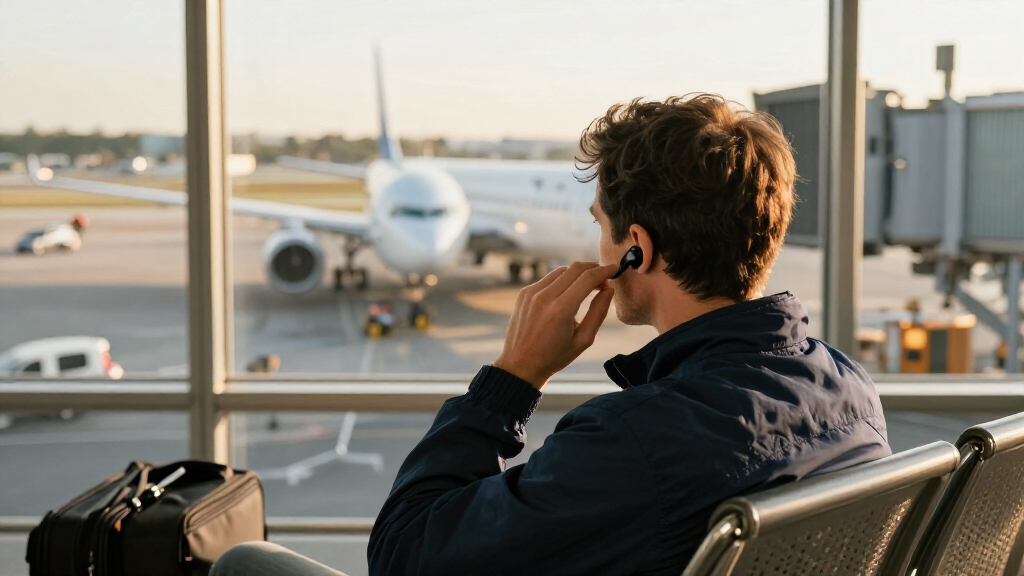
At 6 a.m., the airport floor shines under cold white lights, a suitcase wheel rattles behind you, and the gate agent changes your boarding group. A pair of earbuds can soften the terminal roar, but only if you can still hear the announcement when it matters.

Get the latest gadgets delivered free with Prime
- Fast, free delivery on millions of items
- Prime Video, Amazon Music and more included
- Member-only deals all year
This guide helps you choose wireless earbuds for travel by looking at the details that shape an actual trip: comfort after hours of wear, active noise cancellation, battery life with ANC on, microphone quality, and connections to phones or seat-back screens. The right choice depends on whether you spend more time on planes, trains, calls, or walking unfamiliar streets.
You’ll also get a practical way to compare options without taking every manufacturer claim at face value. Features change with models, software, and devices, so check current specifications and independent reviews before you buy.
Compare battery life with ANC enabled, since headline runtime may describe different settings.
A comfortable ear-tip seal improves passive isolation and can help ANC work better.
ANC reduces steady aircraft and train rumble more effectively than conversation or sudden sounds.
Check multipoint and app features on your actual phone and laptop before depending on them.
For seat-back entertainment, verify that a Bluetooth transmitter works with both the aircraft system and your earbuds.
Choose earbuds that match the trip you actually take
Wireless earbuds for travel should match your longest, noisiest, or most complicated travel day—not just your daily walk to the corner shop. Frequent flyers may value effective ANC and long listening time, while a train commuter may care more about quick transparency controls and clear calls. A compact case can matter more than a premium codec if your bag is already crowded.
Think through a real itinerary. If you take a six-hour flight followed by a train ride, comfort and battery life with ANC on should rank near the top. If you work from airport lounges, reliable microphones and multipoint pairing—the ability to connect to a phone and laptop—may save time. Switching behavior varies by model, so check recent reviews for the devices you own.
A traveler who flies twice a year may not need to pay extra for every advanced feature. By contrast, if you commute by rail four days a week, effective noise control and a case that slips easily into a coat pocket can earn their keep. What matters most is how often a feature solves a problem you actually encounter.
Pick for your longest ordinary travel day, then check that the earbuds still work for your less predictable ones.
Newer models may offer adaptive ANC, personalized sound, spatial audio, or hearing-related software tools. Availability can depend on model, phone, region, and software version. Bluetooth LE Audio and LC3 are also emerging, but support across earbuds, phones, and venues remains uneven. Treat these as features to verify across your whole setup, not promises every traveler can use.
Products Worth Considering

Logitech MX Mechanical Mini for Mac Wireless Keyboard, Space Gray

Logitech MX Mechanical Wireless Illuminated Keyboard, Tactile Quiet, Graphite

Anker SOLIX S2000 Portable Power Station, 2,010Wh, 1,500W
As an affiliate, we earn on qualifying purchases.
Know what ANC can—and can’t—quiet on a plane
Active noise cancellation uses microphones and processing to reduce certain outside sounds; it works best against steady, low-frequency noise such as the continuous rumble of an aircraft or train. It is less effective against nearby conversations, crying, and sudden noises. A snug ear-tip seal adds passive isolation, like closing a window before turning on a fan.
That distinction matters on a flight. ANC may take the edge off the cabin drone during a two-hour delay, but it will not reliably erase the passenger talking across the aisle. If you want to catch a gate change or speak to cabin crew, use transparency mode or remove an earbud. Good transparency makes announcements easier to hear without taking the earbuds out each time, though the result varies between models.
Try a fit check before you judge the noise cancellation. If the bass sounds thin or outside sound leaks around one ear, switch tip sizes and test again. A secure seal can improve both passive isolation and ANC. Models that include several ear-tip sizes give you more room to find a fit that holds through a long ride.
Consumer ANC earbuds are not certified hearing protection for hazardous noise, and cancellation does not make high volume safe. Keep playback moderate, especially on a noisy train where it can be tempting to turn the sound up. If you need awareness while walking through a station, use transparency or wear one earbud only.
For example, a traveler on a night flight might use ANC to soften the steady engine sound, then switch to transparency before the crew serves a meal. That small change keeps the cabin calmer without making announcements a guessing game.
Compare real battery life, comfort, and call quality
Battery life with ANC on is the figure to compare when you expect to use noise cancellation for most of a journey. Advertised runtime may use different settings, and volume, calls, temperature, battery age, and ANC can all affect how long a charge lasts. The charging case adds extra listening time, but it cannot help if you leave it empty in your hotel room.
Picture a full travel day: a morning airport transfer, a flight, a connection, then a video call from the hotel. Your earbuds may spend hours playing audio and handling calls. Check the manufacturer’s figures for ANC settings, then look for independent reviews that describe real use. One-earbud listening can stretch practical use or help you stay aware, though the available controls and ANC behavior differ by model.
Comfort deserves the same scrutiny as the battery number. After several hours, pressure, heat, or a tip that slowly works loose can turn a polished case into dead weight. Lightweight earbuds and a choice of tip sizes can help. If you already know soft foam tips suit your ears, check whether the model accepts compatible tips; the included fit and feel vary.
Calls are another weak point for tiny microphones. Cabin noise, wind, and the hubbub of a crowded station can make your voice hard to follow. Look for reviews that test calls in noisy conditions instead of relying only on manufacturer claims. A quiet hotel room is an easy microphone test; a busy sidewalk shows whether your caller can still understand you.
Before buying, compare these practical details:
| What to check | Why it matters on a trip |
|---|---|
| Runtime with ANC on | Matches the listening mode you are most likely to use |
| Ear-tip sizes and comfort | Helps the seal stay secure during long sessions |
| Noisy-condition call reviews | Shows how well your voice comes through in public |
| Case size and charging speed | Changes how easy it is to pack and top up between legs |
Make your earbuds work with phones, trains, and seat-back screens
Compatibility can determine whether a travel feature works at all. Multipoint may connect a pair to both your phone and laptop, which is handy when a meeting starts just as a boarding update arrives. Switching behavior varies: some earbuds move neatly between devices, while others require you to choose the connection manually. Check how they handle the phones and computers you own.
Also check whether everyday controls depend on a particular app or operating system. Device-finding tools, spatial audio, high-resolution codecs, and app controls may differ between iPhone and Android or require a certain software version. If you travel with more than one device, confirm that the features you care about work on each one before relying on them in an airport.
Seat-back entertainment creates a separate snag. Many aircraft systems still offer a wired headphone socket, and a wireless earbud cannot pair directly with every screen. A small Bluetooth audio transmitter can make aircraft entertainment available through wireless earbuds, but compatibility and audio delay vary. Before packing one, check that it works with your earbuds and the aircraft system you expect to use. Keep wired headphones as a fallback if the movie matters more than a perfectly minimal bag.
Bluetooth LE Audio and the LC3 codec may bring improved power efficiency and broadcast features such as Auracast. But adoption across phones, earbuds, and public venues is uneven. If you plan to use broadcast audio at a station or airport, confirm that your device, earbuds, and the venue all support it; don’t build your trip around a feature you have not verified.
For a practical preflight check, pair your earbuds with the actual phone and laptop you intend to bring, test multipoint, and save any app settings you need. Airline policies and onboard systems vary, so follow crew instructions and current airline guidance about Bluetooth use.
Pack and use earbuds so travel problems stay small
A little preparation can spare you from hunting for a tiny case under a departure-board glow. Charge the earbuds and case before leaving, pack a charging cable, and switch on any available case-tracking or device-finding feature. Earbuds are easy to misplace between a seat pocket, jacket, and hotel nightstand, so a location feature can help when the case goes missing.
On a long-haul journey, check how much charge remains during a connection rather than waiting for a warning at the gate. If your model supports charging the case while you use one earbud, that option can help you spread listening time across a long day. A small power bank is useful when you are away from a wall outlet, but verify the case’s charging method and cable before the trip.
Rain and sweat resistance can help when you walk to a hotel in drizzle or squeeze in a workout. Check the model’s stated water-resistance rating and limits; water resistance does not mean the case or earbuds are safe in every wet situation. Wipe them dry before putting them away, and avoid leaving the case loose in a damp gym bag.
Use this short routine before departure:
- Charge both earbuds and the case, then check the ANC-on runtime against your longest travel leg.
- Fit each earbud with the tip that seals comfortably, and make sure it stays put when you turn your head.
- Test transparency, call quality, multipoint, and any device-finding feature with your travel devices.
- Pack the charging cable and, if you want seat-back audio, a transmitter you have checked for compatibility.
- Set a listening level that keeps music comfortable, and switch to transparency when the surroundings matter.
For example, a commuter headed to a rainy station can stash the compact case in a zipped pocket, use transparency while crossing the street, and return to ANC once seated. That is more useful than chasing a long feature list you rarely touch.
Know when earbuds beat over-ear headphones—and when they don’t
Earbuds are easier to pack and leave room for a hat or neck pillow, while over-ear headphones may feel better for some people during very long listening sessions. Neither style wins every trip. A snug earbud can disappear into your routine on a commute; a traveler who dislikes anything inside the ear may prefer a padded headband over a ten-hour flight.
Fit is personal, so use a specific scenario to make the choice. If you sleep on your side during flights, the earbud housing may press into the pillow; a low-profile pair might help, but it may still bother you. If you carry one small personal item, earbuds’ compact case can be a real advantage. If you want an easy physical control and a cushioned fit, over-ear headphones may suit you better.
Noise cancellation also varies by model and fit, so don’t assume that a larger or smaller design automatically blocks more sound. For either style, look at independent reviews that test a plane-like low rumble and nearby speech. ANC can make the aircraft drone less tiring, but it cannot make an airplane cabin silent.
Cost is another tradeoff. More expensive earbuds may add stronger ANC, better transparency, or convenient device features, but a budget model with comfortable tips and enough battery for your commute can be the better buy. If you travel occasionally, compare the price difference with how often you expect to use the extra features.
Choose the style that you can wear comfortably through your longest typical journey, then value the features you will use during that journey. A compact case will not help if the earbuds hurt after an hour; excellent ANC will not help much if you need to remove them every time someone speaks to you.
Frequently Asked Questions
Are noise-cancelling earbuds good for long flights?
They can make steady, low-frequency aircraft rumble less tiring, especially when the ear tips form a good seal. Check comfort and runtime with ANC on before a long flight. They will not reliably block nearby speech or sudden sounds.
Do ANC earbuds block crying babies, conversations, or announcements?
ANC works best against consistent sounds such as engine rumble, so voices and crying may still come through. Transparency mode can help you hear announcements and people without removing the earbuds. Use it when you need awareness.
Do I need a Bluetooth transmitter for in-flight movies?
Many seat-back systems still use a wired headphone socket, and your earbuds may not pair with the screen directly. A Bluetooth transmitter can be an option, but compatibility and audio delay vary. Check it with your earbuds and the aircraft system before traveling.
How can I avoid ear pain on a long trip?
Try the included tip sizes and choose a secure fit that does not feel painfully tight. Lightweight earbuds may help, but comfort depends on your ears and the model. Take breaks or switch to one earbud if pressure or fatigue builds.
Can I use the same wireless earbuds with an iPhone and an Android phone?
Many earbuds can connect to phones from different manufacturers, but app features and controls may vary by operating system. Check whether pairing, multipoint, device finding, and any sound settings work on both phones. Test the devices before your trip.
Are expensive travel earbuds worth the extra cost?
They may be worth it if you regularly use better ANC, transparency, call performance, or convenient device switching. If you travel occasionally, comfortable earbuds with enough real-world battery life may cover your needs for less. Compare independent reviews and current prices before buying.
Conclusion
Choose earbuds around the longest trip you actually take: check comfort, ANC-on battery life, and device compatibility before paying extra for features you may never use. Test the fit and controls at home, and pack a transmitter only after checking your seat-back setup.
The best travel pair is the one that quiets the steady rumble, stays comfortable, and lets the gate announcement through. Keep the case charged, and let your trip—not the spec sheet—set the volume.