
The secret to truly immersive installation sound lies in strategic speaker placement combined with effective acoustic treatment. Position speakers carefully to guarantee sound reaches listeners from accurate angles, creating a convincing sense of space. Manage reflections and reverberations by using acoustic panels and diffusers, which help prevent sound muddiness. When you align placement with proper acoustic adjustments, your audience experiences precise, multi-dimensional audio. Keep exploring, and you’ll discover even more ways to perfect the spatial experience.
Key Takeaways
- Precise speaker angles and heights are crucial for accurate spatial perception in immersive installations.
- Small adjustments in speaker placement can dramatically improve sound localization and reduce reflections.
- Positioning speakers near reflective surfaces can enhance spatial effects if acoustically treated properly.
- Using dedicated speaker arrays and strategic spacing helps create seamless 3D sound environments.
- Combining optimal placement with acoustic treatments minimizes reverberations and enhances clarity in spatial audio.
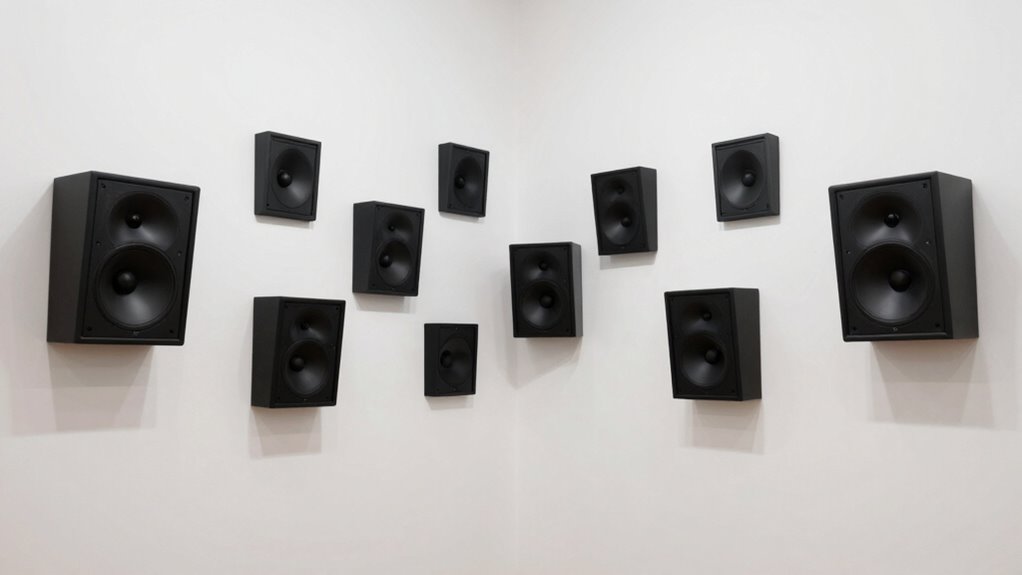
Have you ever wondered how sound transforms a space into a mesmerizing experience? It’s a combination of clever design, precise speaker placement, and the right acoustic treatment. When you’re designing or experiencing an installation, understanding how spatial audio interacts with the environment can make all the difference. Spatial audio isn’t just about stereo sound; it creates a three-dimensional sonic landscape that immerses you, making you feel like you’re right inside the scene. To achieve this, the placement of speakers is vital. Positioning them thoughtfully ensures that sound reaches you from the right angles and distances, enhancing the spatial effect. But it’s not just about where you put the speakers—it’s also about how the space itself influences sound. That’s where acoustic treatment comes into play.
Creating immersive soundscapes relies on strategic speaker placement and effective acoustic treatment.
Acoustic treatment involves managing how sound waves behave within a space. Without it, echoes, reverberations, and dead spots can distort the intended audio experience. When you incorporate acoustic panels, diffusers, and bass traps, you help control sound reflections and absorption. This control allows the spatial audio to come through clearly and accurately. For instance, if you place speakers too close to reflective surfaces, sound reflections might muddle the clarity of the audio, reducing the immersive quality you aim for. Conversely, well-placed acoustic treatment minimizes these issues, allowing the spatial audio to be as precise and enveloping as intended.
Additionally, understanding how spatial audio interacts with the environment can help you optimize the overall sound quality and immersion. When you combine strategic speaker placement with proper acoustic treatment, you craft an environment where sound feels natural and engaging. It’s not just about loudness or clarity but about creating a sense of space and movement within that space. You want the audio to seem as if it’s coming from specific points around you, not just emanating from a single source. This perception is what makes spatial audio so compelling in installations—whether it’s an art exhibit, museum, or immersive theater. By paying attention to how speakers are positioned and how the space is treated acoustically, you’re controlling the sonic environment in a way that heightens emotional impact and viewer engagement.
In essence, the secret to an unforgettable sound installation lies in this often-overlooked aspect: the delicate balance of speaker placement paired with effective acoustic treatment. When you master this trick, you turn a simple auditory setup into a captivating, multi-dimensional experience. The result is a space that doesn’t just sound good but feels alive and real, drawing you deeper into the artistic or experiential narrative.
Frequently Asked Questions
How Does Room Shape Affect Speaker Placement Effectiveness?
Room shape substantially affects speaker placement effectiveness because symmetrical rooms help distribute sound evenly, reducing echoes and dead spots. You should position speakers considering listener height too, ensuring sound reaches ear level for clarity. Avoid placing speakers in corners or against irregular walls, as these distort sound. Adjust placement based on room symmetry and listener height to create a balanced, immersive experience where sound travels smoothly and accurately throughout the space.
What Are the Best Materials to Minimize Sound Reflection?
You should choose materials that promote material absorption, like acoustic panels, foam, or mineral wool, to minimize sound reflection. Adding soundproof barriers such as mass-loaded vinyl or dense curtains can also help block unwanted echoes. These choices work together to absorb excess sound energy and prevent it from bouncing around, creating a clearer and more controlled audio environment in your installation.
How Do Ambient Noise Levels Influence Speaker Positioning?
You might think ambient noise is a minor detail, but it actually dictates your speaker placement. High ambient noise levels call for strategic positioning to prevent sound masking, ensuring your audio stands out. Lower noise allows more flexibility, but if you ignore ambient noise, your sound can drown in the chaos. Pay attention to ambient noise levels, and position your speakers where sound can cut through, not get lost in the background.
Can Speaker Placement Impact Sound Quality Over Long Distances?
Yes, speaker placement can considerably impact sound quality over long distances. Proper positioning influences frequency response and guarantees even sound dispersion. Keep the speaker orientation aimed toward your audience to minimize sound loss and distortion. By strategically placing speakers, you prevent uneven sound distribution, maintain clarity, and enhance overall audio experience, even at a distance. This simple adjustment makes a noticeable difference in how well your installation delivers consistent, high-quality sound.
What Are Common Mistakes to Avoid in Speaker Installation?
Did you know poor speaker placement can reduce sound quality by up to 50%? To avoid this, don’t overlook proper speaker alignment; misaligned speakers cause phase issues and muddled sound. Also, neglecting subwoofer calibration leads to boomy or weak bass. Always make certain your speakers are aligned correctly and calibrate your subwoofer for balanced, clear sound that fills the space without distortion.
Conclusion
Now that you know the secret to speaker placement, you can transform any installation into a mesmerizing soundscape. Think of your setup like a carefully choreographed dance—every move matters. When you position your speakers just right, the sound will envelop your audience like a warm embrace, making the experience unforgettable. Don’t overlook this trick; it’s the missing piece that turns a good installation into an immersive masterpiece. So go ahead, experiment and let your sound truly shine.