📊 Full opportunity report: Could A Property Platform Help Small-Town Main Streets? on IdeaNavigator AI — validation score, market gap, and execution plan.

Get the latest gadgets delivered free — and shop member deals
- Fast, free delivery on millions of items
- Access to Prime Big Deal Days deals on October 6–7
- Prime Video, Amazon Music and more included
TL;DR
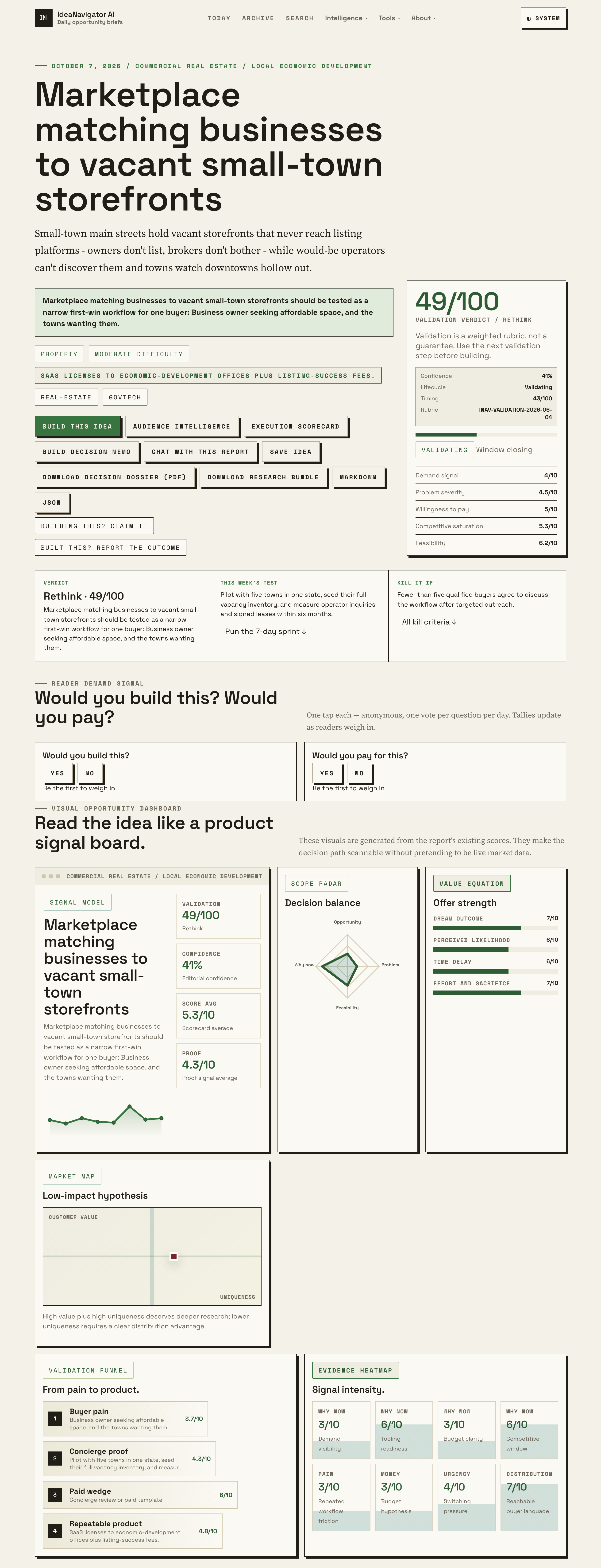
A proposal from IdeaNavigator AI calls for testing a marketplace that matches vacant small-town storefronts with business operators and routes leads to local economic-development offices. The suggested pilot would cover five towns in one state and track inquiries and signed leases over six months; no pilot, funding, or results are confirmed.
IdeaNavigator AI has proposed a pilot marketplace to match vacant small-town storefronts with prospective business operators, with inquiries routed through local economic-development offices. The proposal calls for testing the service in five towns in one state and measuring operator inquiries and signed leases over six months; it does not report that a pilot has begun or that funding has been secured.
According to the IdeaNavigator AI proposal, towns and property owners would be able to list storefronts with photographs, floor area, rent and available incentive programs. Business operators could browse spaces using town profiles and foot-traffic data, then send inquiries to the local development office. The proposal says available grants could be attached to those matches.
The proposal identifies a discovery problem: some owners do not advertise empty commercial spaces on listing platforms, while brokers may not take on properties they consider too small or difficult to market. That can leave prospective operators unaware of available premises and towns with fewer ways to connect them. These are the proposal’s stated problem assumptions, not findings from a reported survey or completed pilot.
IdeaNavigator AI suggests two revenue sources: software-as-a-service licenses paid by economic-development offices and fees when listings lead to successful placements. Its proposed validation plan is to assemble the full vacancy inventory in five towns, then track inquiries and leases for six months. The proposal provides no budget, named participating towns, platform operator or existing performance data.
A Test of Local Storefront Matching
If tested, the marketplace would offer towns a more organized way to show vacant commercial space to people seeking an affordable location. A listing that includes rent, size and incentives could help operators compare options without relying on informal networks or finding a broker for each property. Routing contacts through a local office could also give towns a role in making introductions and explaining available programs.
For readers in small communities, the central question is practical: would improved discovery lead to more inquiries and signed leases? A platform could make information easier to find, but listing a property does not establish that it is affordable, suitable for a particular business or ready to occupy. The six-month test proposed by IdeaNavigator AI would begin to measure activity, though lease outcomes may depend on factors the platform does not control, including financing, building condition and local demand.
The suggested business model also makes adoption a key test. Town offices would need to see enough value to pay subscription fees, while property owners would need reasons to provide accurate, current listings. Success fees could align payment with completed placements, but the proposal does not specify their size or how a successful match would be defined.
commercial storefront listing platform
As an affiliate, we earn on qualifying purchases.
As an affiliate, we earn on qualifying purchases.
From Vacancy Lists to Local Leads
IdeaNavigator AI’s proposal frames the idea around two asserted conditions: renewed interest in small-town commercial space associated with remote-work migration, and economic-development offices having grant money for matching efforts. The proposal gives no data, locations, grant programs or dates to quantify either point. They should be treated as the proposal’s rationale, not independently established evidence of demand or available funding in particular towns.
The suggested product is narrower than a general commercial property listing site. Its proposed users are business operators looking for affordable space and towns seeking to attract them. Listings would combine property details with local information and incentives, while inquiries would go to a development office. That approach depends on local offices having the staff and current information to respond to leads.
The proposal’s stated first step is a controlled pilot rather than a claim that the model already works: select five towns in one state, enter their full vacancy inventory, and observe operator inquiries and signed leases for six months. No timeline for recruitment or launch is given. The proposal reports no interviews with town officials, property owners or prospective tenants, and provides no evidence about how widely unlisted vacancies occur.
As an affiliate, we earn on qualifying purchases.
Pilot, Funding and Demand Unconfirmed
No operating platform or pilot results are described in the IdeaNavigator AI proposal. It does not name participating towns, identify a state, confirm grant commitments or say who would build and maintain the service. It also provides no estimate of development costs, subscription prices, listing fees or the number of storefronts that could be included.
Demand remains untested. The proposal offers no counts of vacant storefronts, operator searches, current lease activity or baseline inquiry rates. Without those measures, it is not possible to judge whether a marketplace would generate additional business openings or simply shift inquiries that would have happened through existing channels.
The proposed six-month measurement period also leaves open how outcomes would be attributed. A signed lease may follow several kinds of outreach, and the proposal does not define what counts as a platform-generated match. It is also unclear how foot-traffic data would be collected, kept current and presented consistently across towns, or whether listed properties would meet operators’ needs for condition, access and permitted use.
business inquiry management software
As an affiliate, we earn on qualifying purchases.
As an affiliate, we earn on qualifying purchases.
Recruit Towns and Track Leases
IdeaNavigator AI’s proposal names the next step as recruiting five towns in one state, collecting a full inventory of their vacant storefronts and publishing listings with comparable property details. If the test proceeds, local development offices would receive operator inquiries and connect matches with relevant grant programs, where available.
At the end of the proposed six months, the key measures identified in the proposal would be inquiries and signed leases. A useful evaluation would also need to explain how those figures are counted and compare them with a baseline, while reporting participation by owners and operators. No launch date, recruitment process or evaluation method has been announced in the proposal, so whether the test will move forward remains unknown.
Source: IdeaNavigator AI
As an affiliate, we earn on qualifying purchases.
Key Questions
What is the proposed marketplace?
It is a proposed service for listing vacant small-town storefronts and connecting them with business operators. The concept includes property details, town profiles, foot-traffic information and local incentives.
Has a pilot started?
No pilot is confirmed in the proposal. It recommends testing the idea in five towns in one state, but does not name participants or a launch date.
How would the platform make money?
The proposed revenue model combines software subscriptions for economic-development offices with fees tied to successful listings or placements. No prices or fee terms are provided.
How would the proposal measure success?
It suggests tracking operator inquiries and signed leases during a six-month pilot. It does not set a baseline or explain how a lease would be attributed to the platform.
Source: IdeaNavigator AI
Fall Picks
fall essentials
As an affiliate, we earn on qualifying purchases.