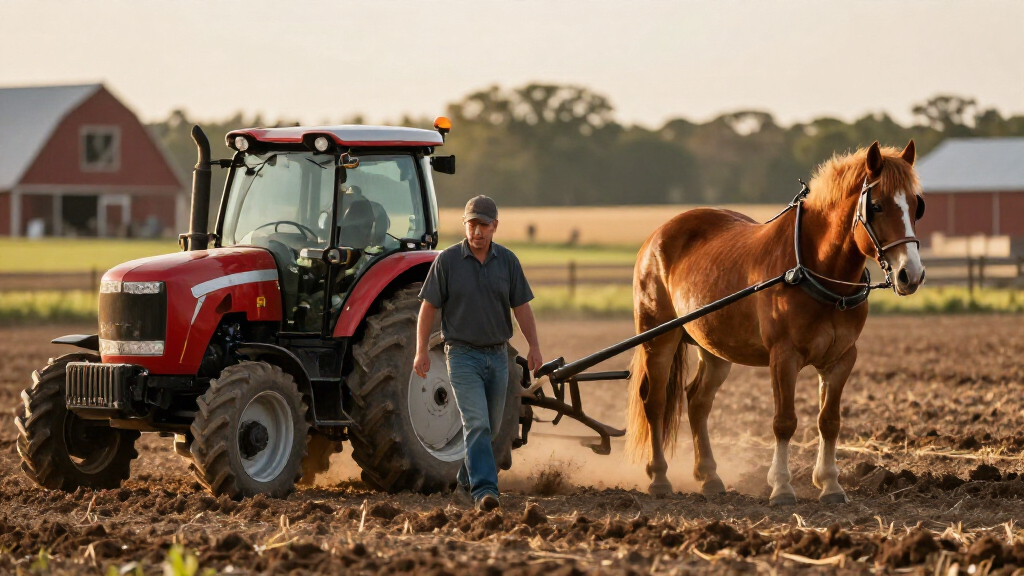
🔍 Read the full analysis: Farm Horses And Tractors: Understanding A Changing Era on ThorstenMeyerAI.com

Get the latest gadgets delivered free with Prime
- Fast, free delivery on millions of items
- Prime Video, Amazon Music and more included
- Member-only deals all year
TL;DR
U.S. farm horses and mules peaked at 26.7 million in 1918, while tractors rose from about 1,000 on farms in 1910 to 4.7 million in 1960. The shift cut the land needed to feed working animals and changed farm employment, but the horse story is an analogy—not a rule—for how automation will affect people today.
A November 4 report from ThorstenMeyerAI.com charts how tractors displaced working horses and mules on U.S. farms during the 20th century, with the animal population falling from 26.7 million in 1918 to 3.1 million in 1960. The history matters as a case study in automation: it shows how a new machine can alter not only jobs, but also land use and the wider economy, while offering no simple forecast for the effects of today’s farm robots on workers.
The figures cited in the report come from the U.S. Census Bureau’s Historical Statistics of the United States, Colonial Times to 1970, which reprints Agriculture Department estimates. Horses alone peaked at 21.4 million in 1915; horses and mules together reached 26.7 million on January 1, 1918. In 1915, farmers grew feed on about 93 million acres, more than a quarter of the 340 million acres of harvested cropland that year.
Tractors were initially costly and heavy, but adoption accelerated after the Fordson went on sale in 1917. The report, citing the Henry Ford museum, describes it as a mass-produced, relatively inexpensive lightweight tractor aimed at small farmers. U.S. farm tractor counts rose from about 1,000 in 1910 to 246,000 in 1920 and 4.69 million in 1960. The report says tractors first outnumbered horses and mules around 1955, when the counts were 4.35 million and 4.31 million, respectively.
Other machinery contributed to the change. The number of combines on U.S. farms rose from about 4,000 in 1920 to more than one million in 1960, alongside the spread of corn pickers, balers and milking machines. The report cites Agriculture Department estimates that one farm worker supplied 7.1 people in 1910 and 47.1 in 1970; the latter figure includes people abroad supplied through exports. Farm employment fell from 13.6 million in 1916 to 4.5 million in 1970, even as the overall U.S. labor force doubled.
The Land and Jobs Behind Mechanization
The shift was bigger than a change in farm equipment. As fewer animals needed feed, land once devoted to oats, corn and hay could be used for crops for people or sale. The report puts horse-and-mule feed acreage at about 5 million acres in 1960, down from 93 million in 1915. That freed land was one material consequence of mechanization, alongside higher output per farm worker.
For workers, the change did not mean that farm employment stayed constant while people simply learned to operate tractors. The report says the number of farm workers declined as agricultural productivity grew, and that new jobs were in cities, requiring many people to move. This history is relevant to present debates about automation because it shows that technological change can reorganize where work happens and what land and labor are used for. It does not, by itself, establish how quickly current technologies will spread or what their net effect on employment will be.
Products Worth Considering

LG UltraGear 32GX850A-B 32-inch 4K UHD Glossy OLED Gaming Monitor

Samsung Odyssey G4 25-inch FHD Gaming Monitor

Logitech MX Master 4 for Mac Wireless Ergonomic Mouse, Space Black
As an affiliate, we earn on qualifying purchases.
From Fordson to Driverless Tractors
The tractor’s rise unfolded over decades, not in a single break. Farm horses and mules numbered 25.7 million in 1920, even as tractor numbers reached 246,000; by 1940 the respective counts were 14.6 million and 1.57 million. The report says farmers largely did not retrain or repurpose the animals at scale: they stopped breeding replacements, and the working population declined as animals aged. That account describes a gradual economic change, not a single event.
The report also connects the history to present-day automation, while stressing that current systems have narrower applications. It cites John Deere’s February 2025 announcement of a 16-camera autonomy kit for tillage on selected large tractors. It also reports that China said about 74% of ploughing, sowing and harvesting was mechanized in 2023. These examples concern different measures and settings; neither establishes that all farm work is autonomous.
In 1983, economist Wassily Leontief compared workers with horses displaced by tractors. The report notes a key difference Leontief himself identified: horses could not vote. The comparison is therefore a prompt for examining economic and political differences, not a law that predicts what will happen to human workers.
“The Fordson was “the first mass-produced and inexpensive lightweight tractor” and was built “to meet the needs of small farmers.””
— The Henry Ford museum, as quoted in the ThorstenMeyerAI.com report
Limits of the Horse Comparison
The historical counts show the scale of the change, but they do not settle how automation affected each group of farm workers, what alternatives were available to them, or how the gains and costs were distributed. The report gives broad employment totals and says new work was concentrated in cities, but does not provide detailed migration or wage data in the supplied material.
It is also unclear from the cited examples how widely driverless tractor systems will be adopted, what tasks they will handle beyond specified operations, or how they will affect farm employment. The 74% figure attributed to China refers to mechanization of ploughing, sowing and harvesting in 2023; it is not a measure of fully autonomous farming. The horse analogy can illustrate disruption, but cannot establish an outcome for human workers.
Tracking Adoption and Farm Work
The historical series in the report ends with the Agriculture Department’s horse-and-mule estimates, which stopped soon after the population had fallen to 3.1 million in 1960. For the present-day comparison, the next useful evidence will be updated, comparable data on how many farms use autonomous equipment, what operations it performs and how adoption changes labor needs.
The report does not identify a forthcoming policy decision, release date or specific next milestone for the technologies it cites. Until more comparable evidence is available, the record supports a clear account of the past shift from animal power to tractors, but not a firm prediction of how driverless machines will reshape farm work.
Key Questions
How many horses and mules worked on U.S. farms at the peak?
The cited historical estimates put the combined total at 26.7 million on January 1, 1918. Horses alone peaked earlier, at 21.4 million in 1915.
When did tractors outnumber farm horses and mules?
The report says the counts crossed around 1955: about 4.35 million tractors compared with 4.31 million horses and mules.
What happened to the animals as tractors spread?
According to the report, farmers generally stopped breeding replacements, and the working population declined as the animals aged. The horse-and-mule count was down to 3.1 million by 1960.
Does the historical shift prove that automation will eliminate human jobs?
No. The report presents the horse story as an analogy, not a law. It documents falling farm employment during mechanization, but does not establish the future effects of current automation on jobs or the wider economy.
Are today’s farm tractors fully autonomous?
The examples cited describe limited applications, not fully autonomous farming across all operations. The report says John Deere’s February 2025 16-camera kit supports tillage on selected large tractors.
Source: ThorstenMeyerAI.com