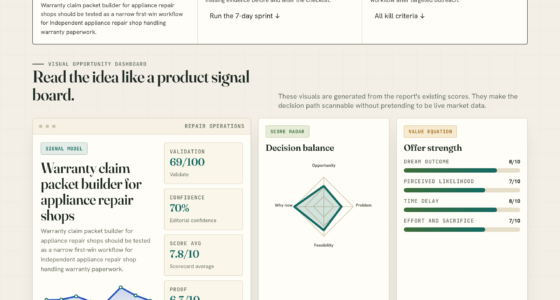

📊 Full opportunity report: The Neocloud Cartel: How the AI Industry Started Renting Compute From Itself on ThorstenMeyerAI.com — validation score, market gap, and execution plan.

Get the latest gadgets delivered free with Prime
- Fast, free delivery on millions of items
- Prime Video, Amazon Music and more included
- Member-only deals all year
TL;DR
In 2026, the AI industry has shifted to a model where companies rent compute from each other and a small group of chip makers, forming a tightly interconnected cartel. Nvidia plays a central role, controlling access and pricing, raising concerns about market stability.
In 2026, the AI industry has transitioned to a model where most companies rent their computational power from each other and a handful of dominant suppliers, notably Nvidia, effectively forming a small, interconnected cartel. This shift has significant implications for market control and supply chain stability, making compute access a tightly held resource.
Almost no AI companies own the hardware they run on; instead, they lease GPU capacity from a small group of firms that dominate the market. CoreWeave, a major player, has over $55 billion in contracted backlog, and companies like Meta and OpenAI have committed tens of billions to this infrastructure. In May 2026, xAI leased its supercomputer to Anthropic and Google for over $26 billion annually, exemplifying the trend of self-renting hardware. This rent loop, where companies pay each other and suppliers, has created a closed network centered around Nvidia, which controls the majority of GPU supply and investment, effectively holding the chokehold on AI compute access.
The Neocloud Cartel
Almost no one racing to build AI owns the machine it runs on. They rent — increasingly from each other — and the money loops back to one chip maker that’s also an investor in nearly everyone at the table.
The cartel isn’t a conspiracy — it’s the endpoint of extreme capital intensity, real scarcity, and one dominant supplier. But the same circularity that makes it powerful makes it a fuse: each cancelled order is someone else’s missing revenue. Don’t be a price-taker at the bottom of a loop you don’t control — own your inference, keep an open-weight fallback, diversify silicon.
Impact of the AI Compute Cartel on Industry Stability
This development matters because it concentrates market power in the hands of a few firms, especially Nvidia, which controls chip supply and allocation. The circular financing and leasing model could lead to price manipulation, supply bottlenecks, and systemic fragility, as the entire AI buildout depends on a small, interconnected group. If any link in this chain weakens or breaks, it could disrupt the entire AI development ecosystem.
As an affiliate, we earn on qualifying purchases.
Formation and Evolution of the AI Compute Cartel
Over the past three years, the AI hardware market has shifted from open competition to a tightly controlled network of leasing agreements. The 2024–25 GPU shortage accelerated this trend, pushing companies to rent instead of own hardware. Major investments from firms like Nvidia, Meta, and OpenAI have further entrenched this model. Nvidia’s $100 billion investment in AI infrastructure and its equity stakes in multiple firms exemplify its central role. The emergence of xAI as a landlord further illustrates the trend of self-renting hardware, blurring the lines between users and providers.
“A gigawatt of AI data center capacity costs roughly $50 billion, with Nvidia capturing most of that revenue.”
— Jensen Huang, Nvidia CEO
As an affiliate, we earn on qualifying purchases.
Unclear Risks and Potential Disruptions to the Cartel
It remains uncertain how sustainable this tightly coupled leasing model is, given its inherent fragility. A disruption in Nvidia’s supply chain, regulatory intervention, or a shift in industry dynamics could fracture the loop. Additionally, the long-term implications of self-renting hardware for market competition are still developing, with questions about whether new entrants can break the cartel’s hold or if regulatory actions might intervene.
high performance GPU for AI training
As an affiliate, we earn on qualifying purchases.
As an affiliate, we earn on qualifying purchases.
Next Steps in Monitoring the AI Compute Market Dynamics
Industry analysts will closely watch Nvidia’s supply policies, potential regulatory responses, and the evolving leasing agreements among AI firms. Further investigation into the financial dependencies and potential vulnerabilities of this network will determine whether the cartel remains stable or begins to fracture. Additionally, new entrants or alternative compute solutions could challenge the current model, reshaping the landscape.
cloud GPU services for AI development
As an affiliate, we earn on qualifying purchases.
As an affiliate, we earn on qualifying purchases.
Key Questions
How does Nvidia control the AI compute market?
Nvidia controls the majority of GPU supply and allocation, financing, and investment in AI infrastructure, effectively holding the chokehold on access to compute resources.
Why do companies prefer renting compute over owning hardware?
The GPU shortage from 2024–25 made owning hardware impractical for many, and renting provides flexible, scalable access to compute power without long-term capital investment.
What risks does this compute cartel pose to the AI industry?
The tight control over supply and pricing creates a fragile system vulnerable to supply disruptions, regulatory actions, or internal conflicts among the firms involved.
Could this model change in the future?
Yes, if new hardware suppliers emerge, regulatory pressures increase, or companies develop alternative compute solutions, the current tightly controlled model could evolve or break apart.
Source: ThorstenMeyerAI.com
Halloween Picks
halloween
As an affiliate, we earn on qualifying purchases.