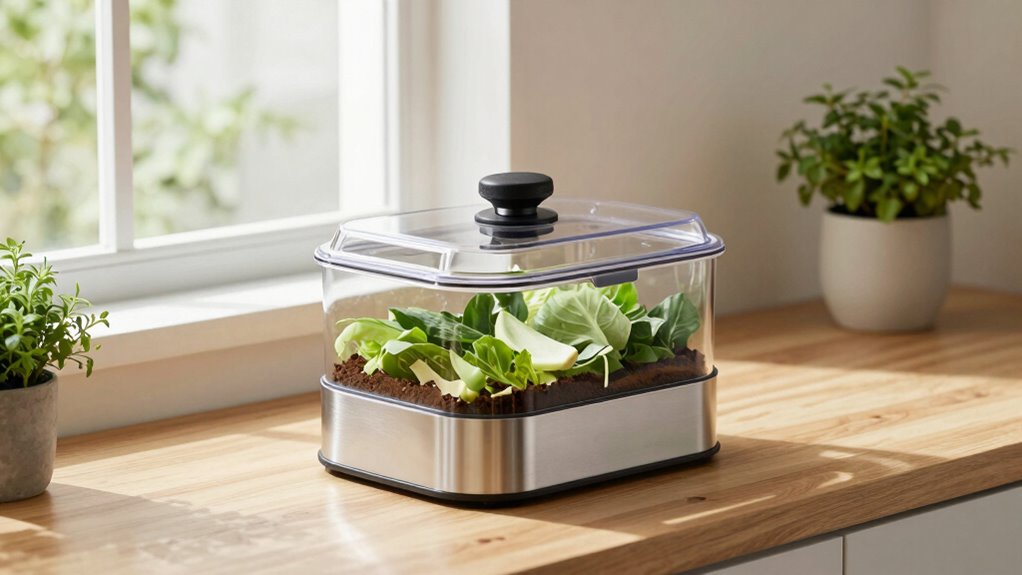

An air-purifying indoor compost system can help contain kitchen-scrap odors, but these seven options differ in how they manage them. My best overall pick is the Assark 5L Electric Kitchen Composter with Auto-Cleaning, which pairs larger capacity with a feature aimed at reducing cleanup work. For a simple, non-electric setup, the Full Circle Fresh Air Kitchen Compost Bin is a compact alternative, while the Airthereal R500 suits shoppers seeking an electric unit with a smaller 2.5-liter capacity. The main tradeoffs are active processing versus passive storage, countertop space versus batch size, and convenience versus ongoing filter and cleaning needs. Read on for how each option fits different kitchens and composting routines.

Get the latest gadgets delivered free with Prime
- Fast, free delivery on millions of items
- Prime Video, Amazon Music and more included
- Member-only deals all year
Complete the kit



Key Takeaways
- The Assark 5L is the strongest all-around fit in this lineup for shoppers who want electric processing and a larger stated capacity than the 2.5L Airthereal R500 or 3L Assark.
- Electric does not automatically mean odor-free or maintenance-free: the Assark 5L advertises auto-cleaning, while the smaller Assark specifically lists a carbon filter; buyers should compare the upkeep features they value.
- Passive bins keep the setup simpler than electric composters, but they store scraps rather than process them, so capacity and emptying frequency matter more.
- The two Full Circle Fresh Air bins and the RED FACTOR bin prioritize countertop storage over electric processing; their smaller capacities suit kitchens that can empty scraps often.
- Capacity labels are not directly comparable across this group: the passive bins list gallons and electric models list liters, so fit the choice to household scrap volume and available counter space rather than the number alone.
| RED FACTOR Stainless Steel Countertop Compost Bin, White, 1.3 Gallon |  | Best Simple Countertop Scrap Keeper | Capacity: 1.3 gallons (5 liters) | Dimensions: 8.7 x 7.3 x 10.8 inches | Weight: 1 kg | VIEW ON AMAZON | See Our Full Breakdown |
| Assark 5L Electric Kitchen Composter with Auto-Cleaning |  | Best for Larger Households Seeking Multiple Modes | Model: HQD-450 | Capacity: 5L in specifications; description also refers to 6L | Modes: Compost, Quick, and Clean | VIEW ON AMAZON | See Our Full Breakdown |
| Airthereal R500 Electric Kitchen Composter – 2.5 L, Gray |  | Best for Fast, Simple Processing | Capacity: 2.5 liters | Dimensions: 12.5 x 10 x 12.5 inches | Weight: 16.8 pounds | VIEW ON AMAZON | See Our Full Breakdown |
| Assark 3L Electric Kitchen Composter with Carbon Filter |  | Best Compact Electric Pick | Model: HQD-260C | Capacity: 3 L | Processing time: 4–6 hours | VIEW ON AMAZON | See Our Full Breakdown |
| Compost Genie 3.6-Gallon Stainless Steel Kitchen Compost Bin, White |  | Best High-Capacity Scrap Collector | Model: I000715 | Capacity: 3.6 gallons | Dimensions: 23.5 inches high | VIEW ON AMAZON | See Our Full Breakdown |
| Full Circle Fresh Air Kitchen Compost Bin, 1.5 Gallon, Gray |  | Best for Airflow-Based Odor Control | Capacity: 1.5 gallons | Dimensions: 9.45 × 8.86 × 8.3 inches | Weight: 2.5 pounds | VIEW ON AMAZON | See Our Full Breakdown |
| Full Circle Fresh Air Odor-Free Kitchen Compost Bin, Black and White |  | Best for Easy Emptying | Capacity: 1.5 gallons | Dimensions: 9.45 × 8.86 × 8.3 inches | Weight: 5.1 ounces | VIEW ON AMAZON | See Our Full Breakdown |
| air purifying indoor compost system | Capacity | Dimensions | Weight | Model |
|---|---|---|---|---|
| RED FACTOR Stainless Steel Cou | 1.3 gallons (5 liters) | 8.7 x 7.3 x 10.8 inches | 1 kg | — |
| Assark 5L Electric Kitchen Com | 5L in specifications; description also refers to 6L | — | — | HQD-450 |
| Airthereal R500 Electric Kitch | 2.5 liters | 12.5 x 10 x 12.5 inches | 16.8 pounds | Revive R500 |
| Assark 3L Electric Kitchen Com | 3 L | — | — | HQD-260C |
| Compost Genie 3.6-Gallon Stain | 3.6 gallons | 23.5 inches high | — | I000715 |
| Full Circle Fresh Air Kitchen | 1.5 gallons | 9.45 × 8.86 × 8.3 inches | 2.5 pounds | — |
| Full Circle Fresh Air Odor-Fre | 1.5 gallons | 9.45 × 8.86 × 8.3 inches | 5.1 ounces | — |
More Details on Our Top Picks
RED FACTOR Stainless Steel Countertop Compost Bin, White, 1.3 Gallon
The RED FACTOR is a straightforward choice for collecting scraps indoors, rather than processing them into finished compost. Its dual carbon filters and ventilated lid are designed to limit odors between trips to an outdoor compost pile or municipal collection, while the stainless steel body offers a sturdier alternative to a basic plastic caddy. At 1.3 gallons, it takes up less counter space than the 3.6-gallon Compost Genie, but that smaller footprint means more frequent emptying for households that cook often. Unlike the Assark electric models, it has no drying cycle or blades; there is less equipment to operate, but scraps remain scraps. I’d choose it for a compact, low-complexity setup, not for anyone expecting an appliance that turns food waste into soil.
Pros:- Dual carbon filters and a ventilated lid are designed to help control odors
- Stainless steel construction is rust-resistant and durable
- Compact cylindrical form and soft-grip handle suit countertop use
- Spare filters are included
Cons:- The 1.3-gallon capacity may need frequent emptying in busy kitchens
- Must be washed by hand with soapy water; it is not machine washable
Best for: Apartment cooks and small households who want a compact, filtered countertop bin for short-term scrap storage.
Not ideal for: Frequent home cooks or anyone seeking a machine that dries, grinds, or processes scraps into a soil amendment.
- Capacity:1.3 gallons (5 liters)
- Dimensions:8.7 x 7.3 x 10.8 inches
- Weight:1 kg
- Material and color:Stainless steel; white
- Shape:Cylindrical
- Odor control:Dual carbon filters and ventilated lid
- Cleaning:Wash with soapy water; not machine washable
- Included:Spare filters
Our verdict“Choose the RED FACTOR for compact, filtered scrap storage; skip it if you want an electric system that processes the waste.”
Assark 5L Electric Kitchen Composter with Auto-Cleaning
Among the electric options here, the Assark HQD-450 is aimed at households that want more operating flexibility than a single-cycle machine. Its Compost, Quick, and Clean modes offer different ways to process scraps and maintain the bucket, while a sealed container and carbon filter are intended to limit kitchen odors. The blade shutoff when the lid opens is a useful safety feature; the listed noise level is below 40 dB. Compared with the 2.5-liter Airthereal R500, this model is described for a 3–5-person household and has a larger stated capacity, although its listing conflicts between 5L and 6L. The output also needs 1–3 weeks of curing before use, so this is not instant, ready-to-spread compost. I’d favor it for mode choice, with the capacity inconsistency as a real buying caveat.
Pros:- Three modes include Compost, Quick, and Clean
- Safety shutoff stops the blades when the lid opens
- Sealed bucket and carbon filter are designed to control odors
- Listed operating noise is below 40 dB
Cons:- Product information gives conflicting 5L and 6L capacity figures
- Processed material needs 1–3 weeks of curing before use
- A carbon filter rated for up to six months will eventually need replacement
Best for: Households of three to five people who want an electric countertop processor with separate quick, compost, and cleaning modes.
Not ideal for: Buyers who need a clearly specified capacity or expect processed material to be ready for plants immediately.
- Model:HQD-450
- Capacity:5L in specifications; description also refers to 6L
- Modes:Compost, Quick, and Clean
- Carbon filter life:Up to 6 months
- Noise level:Below 40 dB
- Safety feature:Blades stop when the lid opens
- Recommended household size:3–5 people
- Curing time:1–3 weeks
- Suggested compost-to-soil ratio:1 part compost to 8–10 parts soil
Our verdict“Pick the Assark HQD-450 for household-scale capacity and flexible modes if you can accept the unclear capacity listing and curing period.”
Airthereal R500 Electric Kitchen Composter – 2.5 L, Gray
The Airthereal R500 is the clearest fit for buyers who value a short processing cycle and uncomplicated operation. Its one-button, four-hour cycle dries and reduces scraps into a powder-like material, with a built-in carbon filter intended to help manage odors indoors. The stated volume reduction of up to 90% can make kitchen waste easier to store or handle, though it does not mean the appliance produces fully matured compost in four hours. Compared with the larger Assark HQD-450, the R500 has a smaller 2.5-liter capacity and fewer listed controls, making it less suited to larger households but simpler for modest daily loads. Its dishwasher-safe aluminum bucket eases cleanup; the tradeoff is a 16.8-pound body that is not especially easy to move. I’d choose it for quick cycles, not high capacity.
Pros:- Four-hour processing cycle produces dry, powder-like material
- One-button operation keeps the process simple
- Built-in carbon filter is designed to reduce odors
- Dishwasher-safe aluminum bucket supports easier cleanup
Cons:- The 2.5-liter capacity may require frequent batches
- At 16.8 pounds, it is heavy to move around the kitchen
- A four-hour cycle does not remove the need to judge whether the output is ready for its intended use
Best for: Small households and indoor gardeners who want a simple electric processor with a short cycle and an easy-to-clean bucket.
Not ideal for: Large households that generate substantial daily scraps or buyers who need a lightweight, highly portable appliance.
- Capacity:2.5 liters
- Dimensions:12.5 x 10 x 12.5 inches
- Weight:16.8 pounds
- Material and color:Aluminum; gray
- Model:Revive R500
- Cycle time:4 hours
- Blade type:SHARKSDEN Tri-blade
- Stated waste volume reduction:Up to 90%
- Warranty:1 year
Our verdict“Choose the R500 for straightforward, fast scrap processing in a smaller household, rather than for large loads or easy portability.”
Assark 3L Electric Kitchen Composter with Carbon Filter
The Assark HQD-260C occupies the middle ground between the small Airthereal R500 and the larger, mode-rich Assark HQD-450. Its 3-liter bucket gives it a modest capacity for everyday kitchen scraps, while automatic drying and crushing cycles take about 4–6 hours and are claimed to reduce waste volume by up to 90%. Three modes and an auto-clean function add flexibility without the HQD-450’s conflicting capacity details. The removable non-stick bucket should make emptying and cleanup more manageable, and the stated noise level is under 40 dB. Odor control depends on a carbon filter rated for up to three months, so replacement is part of ongoing ownership. Like the Airthereal, this is an electric processor rather than a passive storage bin; I’d pick it for a compact appliance footprint, not for large batches.
Pros:- Automatically dries and crushes scraps in 4–6 hours
- Three modes include an auto-clean function
- Removable non-stick bucket supports easier emptying and cleaning
- Listed noise level is under 40 dB
Cons:- The 3-liter capacity is limited for high-volume kitchens
- Carbon filter life is listed as up to three months, so replacements are recurring upkeep
- Processing cycles take several hours rather than handling scraps instantly
Best for: Small kitchens and one- or two-person households seeking an electric processor with a removable bucket and auto-clean mode.
Not ideal for: Large families or frequent cooks who need more than a 3-liter batch capacity, or buyers who want to avoid regular filter replacements.
- Model:HQD-260C
- Capacity:3 L
- Processing time:4–6 hours
- Stated waste volume reduction:Up to 90%
- Noise level:Under 40 dB
- Modes:3
- Carbon filter life:Up to 3 months
- Warranty:12 months limited
- Included items:Electric composter, activated carbon filter, removable compost bucket, and user manual
Our verdict“Choose the HQD-260C for compact electric processing and easier bucket cleanup, but look to the HQD-450 for a larger stated capacity.”
Compost Genie 3.6-Gallon Stainless Steel Kitchen Compost Bin, White
The Compost Genie is the strongest choice here for collecting a larger volume of scraps before emptying, not for turning them into compost. Its 3.6-gallon capacity is substantially larger than the RED FACTOR’s 1.3-gallon bin, which can mean fewer trips to an outdoor pile or collection point. A foot pedal keeps hands free, and the ventilation system with a carbon filter is designed to manage odors and moisture. The removable washable tray, bag-securing hooks, and built-in bag storage make routine handling more organized than with a simple countertop caddy. But its 23.5-inch height calls for floor space, and unlike the Airthereal R500 or Assark electric models, it only holds scraps. I’d choose it for capacity and hands-free use; buyers seeking an air-purifying processing appliance should choose an electric option instead.
Pros:- 3.6-gallon capacity reduces how often a busy household needs to empty the bin
- Foot pedal allows hands-free opening
- Ventilation system and carbon filter are designed to help control odor and moisture
- Includes compostable bags, carbon filters, a washable tray, and built-in bag storage
Cons:- Stores food scraps but does not turn them into compost soil
- Its 23.5-inch height requires more floor space than a countertop bin
- Odor control relies on a ventilation system and filters rather than processing scraps
Best for: Busy households that collect a large volume of food scraps and want hands-free access with organized bag storage.
Not ideal for: Buyers with limited floor space or anyone expecting the bin to process scraps into compost or soil amendment.
- Model:I000715
- Capacity:3.6 gallons
- Dimensions:23.5 inches high
- Material and color:Stainless steel; white
- Operation:Hands-free foot pedal
- Included:8 compostable bags and 4 carbon filters
- Bag capacity:Up to 15 lb of organic waste
- Features:Ventilation system, removable washable tray, bag storage compartment, and bag-securing hooks
Our verdict“Choose the Compost Genie when high-capacity, hands-free scrap storage matters more than electric processing or a compact footprint.”
Full Circle Fresh Air Kitchen Compost Bin, 1.5 Gallon, Gray
The Fresh Air Kitchen Compost Bin is the clearest fit here for shoppers who want odor management without an electric appliance. Its airflow design circulates air around scraps to slow decomposition and help limit odors and fruit flies; that makes it a simpler countertop choice than the Assark 5L Electric Kitchen Composter, which adds powered processing and auto-cleaning. The tradeoff is that this bin stores scraps rather than processing them, so you still need to empty it into an outdoor compost setup or collection service. Its 1.5-gallon capacity suits a smaller household or a kitchen that empties scraps often, but the Compost Genie 3.6-Gallon is a better match for households generating more. A stay-open push-button lid and five included bags make routine loading easier, though the capacity limits how long it can sit between trips.
Pros:- Airflow design is intended to slow decomposition and help reduce odors
- Designed to help keep fruit flies away
- Push-button lid stays open for easier loading
- Includes five 2.5-gallon compostable bags
Cons:- The 1.5-gallon capacity may require frequent emptying in busy kitchens
- Stores scraps rather than processing them like an electric composter
- Odor control depends on airflow and does not eliminate the need to empty the bin
Best for: One- or two-person households that want a low-tech countertop scrap bin with airflow-based odor control and a lid that stays open while cooking.
Not ideal for: Larger households or people seeking an appliance that processes food scraps; its 1.5-gallon capacity fills sooner, and it does not electrically compost or dry scraps.
- Capacity:1.5 gallons
- Dimensions:9.45 × 8.86 × 8.3 inches
- Weight:2.5 pounds
- Material:Recycled plastic
- Color:Gray
- Shape:Round
- Included bags:Five compostable bags, 2.5 gallons each
- Model number:FC11301-GYDTC
Our verdict“Choose this bin for a smaller household that wants passive airflow-based odor control, but pick the Compost Genie 3.6-Gallon for greater storage capacity.”
Full Circle Fresh Air Odor-Free Kitchen Compost Bin, Black and White
This Full Circle Fresh Air bin takes the same passive-airflow approach as the gray Fresh Air model: circulation is meant to slow decomposition and help reduce odors and flies, without motors or processing cycles. Its strongest distinction is the stated easy cleaning and emptying, making it a sensible pick for someone who prioritizes simple daily handling over larger capacity. The black-and-white finish also gives it a different look from the gray version, while both hold 1.5 gallons and use a push-button lid. Compared with the Assark 3L Electric Kitchen Composter with Carbon Filter, this is a storage bin, not an electric unit that processes scraps. That keeps operation straightforward, but means scraps still need to be taken elsewhere and households that cook often may find the capacity restrictive.
Pros:- Airflow design is intended to help reduce odors
- Designed to help reduce flies around stored scraps
- Push-button opening supports quick access while preparing food
- Easy to clean and empty, with five compostable bags included
Cons:- The 1.5-gallon capacity can be limiting for larger households
- Does not process or dry food scraps like the Assark 3L electric model
- Air circulation may help with odors, but the bin still needs regular emptying
Best for: Apartment cooks and small households who want a straightforward, easy-to-empty countertop bin and plan to transfer scraps regularly.
Not ideal for: Families producing a steady volume of scraps or buyers who expect an indoor compost appliance to process food waste; the bin holds only 1.5 gallons and stores scraps for later disposal or composting.
- Capacity:1.5 gallons
- Dimensions:9.45 × 8.86 × 8.3 inches
- Weight:5.1 ounces
- Material:Recycled plastic and partially recycled steel
- Color:Black and white
- Shape:Round
- Included:Five compostable bags
- Model number:FC11301-KW
Our verdict“Pick this model for easy handling in a small kitchen, but choose a larger bin or an electric composter if you need more capacity or scrap processing.”
How We Picked
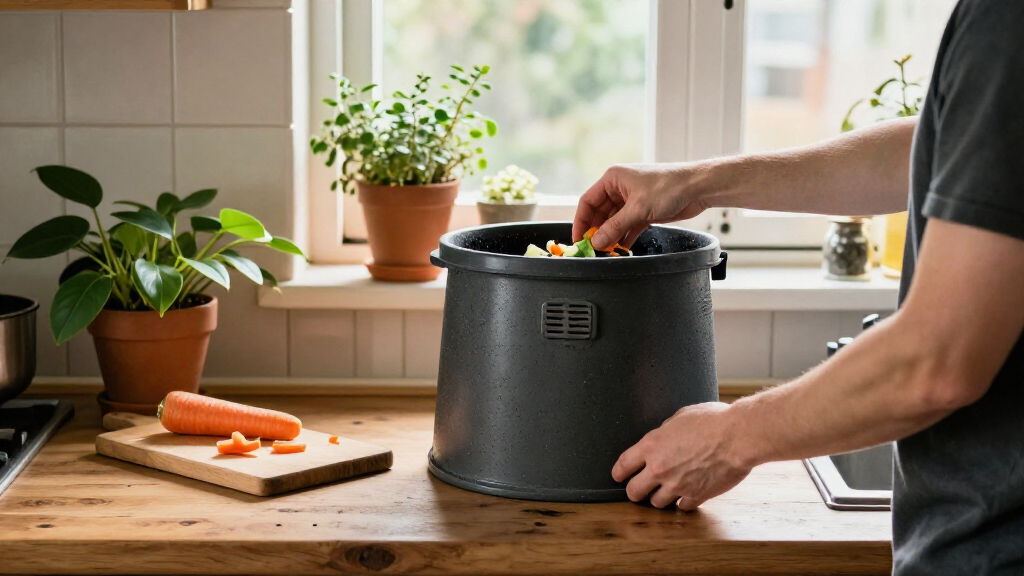
I ranked these options by how well their stated design fits the specific goal of managing food scraps indoors with less odor nuisance. I looked at whether each is a passive storage bin or an electric composter, its listed capacity, and the odor-control or maintenance features named in the product details, such as a carbon filter or auto-cleaning. I also weighed the practical cost of choosing a simpler bin—more frequent emptying and no electric processing—against the space and upkeep an electric unit can bring.
The Assark 5L takes the lead for combining electric processing, the largest stated capacity among the electric models here, and an auto-cleaning feature. The Airthereal R500 and Assark 3L follow as smaller electric alternatives, with the Assark’s named carbon filter giving it a distinct odor-control emphasis. Passive bins rank behind them for shoppers specifically seeking an air-purifying or processing system, but remain sensible picks for simpler storage: the RED FACTOR offers a defined 1.3-gallon size, the Full Circle Fresh Air is a compact 1.5-gallon option, and the Compost Genie provides the largest stated storage capacity overall at 3.6 gallons. Product details do not establish measured odor-removal performance, so I treat odor-control claims as design features rather than proof of a particular result.
| air purifying indoor compost system | Model |
|---|---|
| RED FACTOR Stainless Steel Cou | — |
| Assark 5L Electric Kitchen Com | HQD-450 |
| Airthereal R500 Electric Kitch | Revive R500 |
| Assark 3L Electric Kitchen Com | HQD-260C |
| Compost Genie 3.6-Gallon Stain | I000715 |
| Full Circle Fresh Air Kitchen | — |
| Full Circle Fresh Air Odor-Fre | — |
Factors to Consider When Choosing Air Purifying Indoor Compost System
Choosing an indoor compost system starts with matching its job to your routine: some products hold scraps until you move them, while electric models process a batch. These broader checks can help avoid buying a unit that is too small, too demanding to maintain, or mismatched to where your finished material will go.
Decide Whether You Need Storage or Processing
A countertop bin and an electric composter solve different parts of the kitchen-scrap problem. A passive bin holds scraps for later transfer; it does not turn them into finished compost on the counter. An electric unit can process a batch, but that does not automatically mean its output can go directly into every garden or municipal compost stream. Check the maker’s guidance for what the processed material is and how it should be used or disposed of. A common mistake is choosing an electric model for odor control alone when a well-managed storage routine may meet the need with less equipment. Choose by the outcome you want, not by the word “compost” on the product label.
Match Capacity to Your Scrap Routine
Capacity affects how often you empty or run a unit, but bigger is useful only if the unit fits your counter and routine. Estimate how many scraps your household produces over the interval you are willing to manage, then compare that with the listed capacity. Gallons and liters describe volume in different units, and passive storage capacity is not directly equivalent to an electric batch size. A larger bin can reduce trips to an outdoor pile, yet scraps may sit longer before transfer. A smaller electric unit can be easier to place but may require more frequent cycles. Leave room for the lid to open and for safe handling when the unit is full.
Understand Odor Control as a Maintenance Routine
Odor management depends on more than the presence of a filter or a product name that promises fresh air. Ask whether the unit uses a replaceable carbon filter, how often that filter needs attention, and whether replacement parts are readily available. Keep scraps from sitting longer than your household routine allows, and clean surfaces that collect residue according to the manufacturer’s directions. Do not assume a sealed lid alone will prevent smells; trapped moisture and food residue can still create odor. Likewise, a filter has a maintenance cost in time even when it is built into a simple bin. The best fit is the system whose upkeep you will actually keep up with.
Check Counter Space, Noise, and Power Needs
Electric composters need a suitable outlet and enough clearance for their operating and cleaning routines, while passive bins can usually be placed with fewer setup requirements. Before choosing, measure the space where the unit will sit, including room to lift a lid or remove a container. Consider when you would run a powered cycle if kitchen noise or appliance use affects your household. A compact unit can be easier to place but may offer less batch capacity, while a larger model can claim more counter area. Avoid treating listed capacity as the only measure of fit: footprint, access, and storage for any accessories also shape daily convenience. If your counter is already crowded, a smaller passive bin may serve better than an appliance you have to move each time you use it.
Plan for Cleaning and the Material After Processing
Cleaning effort can matter as much as processing speed because food residue builds up wherever scraps are handled. Look for removable components and clear cleaning instructions, and check whether an auto-cleaning feature reduces work or simply assists with one part of maintenance. Read the instructions before putting liners, liquids, bones, or other uncertain scraps into a machine; accepted materials vary by product. Then decide where processed material will go, since an electric composter’s output may need further handling rather than direct use as garden-ready compost. Buyers who have no suitable destination for that output may prefer a passive bin paired with an existing collection program. A realistic end-to-end routine is more useful than a feature list alone.
Frequently Asked Questions
Does an electric kitchen composter remove all food-scrap odors?
No product details here establish complete odor removal, and a filter or processing cycle should not be read as a guarantee of a scent-free kitchen. Odor can still depend on what goes inside, how long scraps sit, and whether the bin and removable parts are cleaned as directed. The Assark 3L specifically lists a carbon filter, while the Assark 5L highlights auto-cleaning; those features address different parts of the routine. If odor containment is your main concern, check filter replacement guidance and cleaning instructions before buying. Also consider whether you can empty or run the unit regularly.
Should I choose a passive bin or an electric composter for a small apartment?
Choose based on space, noise tolerance, and what you plan to do with the scraps after collection. A passive bin such as the compact Full Circle Fresh Air model uses less appliance-style setup, but it stores scraps and needs periodic emptying. An electric option can process a batch but needs counter clearance and power, and its output still requires a destination. In a small apartment, measure both the unit footprint and the space needed to open, empty, and clean it. If you already use a local food-scrap collection service, a simple bin may fit that routine better than an electric appliance.
Is a larger-capacity system always the better choice?
No; capacity only helps when it matches how quickly your household produces scraps and how often you want to manage them. The Compost Genie lists 3.6 gallons of storage, while the electric options list capacities in liters for processing, so the figures do not represent identical use. A large passive bin can let scraps accumulate longer, and a large appliance may take up more counter space than a smaller household needs. Think about your usual batch size, emptying schedule, and available placement before prioritizing volume. For frequent small batches, a compact option may be easier to live with.
What should I check before relying on a carbon filter or auto-cleaning feature?
Check exactly what the feature does, what parts it covers, and what maintenance remains your responsibility. For a carbon filter, look for replacement instructions and whether the filter is replaceable; a filter that is neglected may not serve its intended purpose. For auto-cleaning, confirm whether it cleans the entire food-contact area or only assists with a specific cycle. Read the care guide for hand-cleaning steps, safe materials, and any parts that need regular attention. These checks help distinguish a genuine reduction in routine work from a feature name that still leaves upkeep to you.
Can I put the output from an electric composter straight into my garden?
Do not assume that processed output is finished, garden-ready compost. The right use can depend on the appliance’s process, the food scraps accepted, and the manufacturer’s directions. Check those directions before adding output to plants, soil, or a compost pile, and follow any guidance about further curing or mixing. If you do not garden, confirm that the output has a practical disposal route where you live. A passive countertop bin may be a better match if your main goal is collecting scraps for an existing composting or food-waste service.
Conclusion
For the broadest mix of electric processing, stated capacity, and a maintenance feature, my best overall choice is the Assark 5L Electric Kitchen Composter with Auto-Cleaning. The best value in simplicity is the Full Circle Fresh Air Kitchen Compost Bin for buyers who want a compact passive container without an electric appliance. For a premium-style electric option, compare the Assark 5L with the Airthereal R500 based on whether you prefer its larger listed capacity and auto-cleaning or a smaller 2.5L format; the product details here do not establish a premium performance advantage. The best pick for beginners is the RED FACTOR 1.3-gallon bin if you want a straightforward place to collect scraps before transferring them. For larger passive storage, choose the Compost Genie’s 3.6-gallon capacity; for buyers prioritizing a named carbon filter in an electric unit, look at the Assark 3L. Match the choice to your space, maintenance habits, and plan for the scraps or processed output—not odor-control wording alone.
Halloween Picks
halloween
As an affiliate, we earn on qualifying purchases.