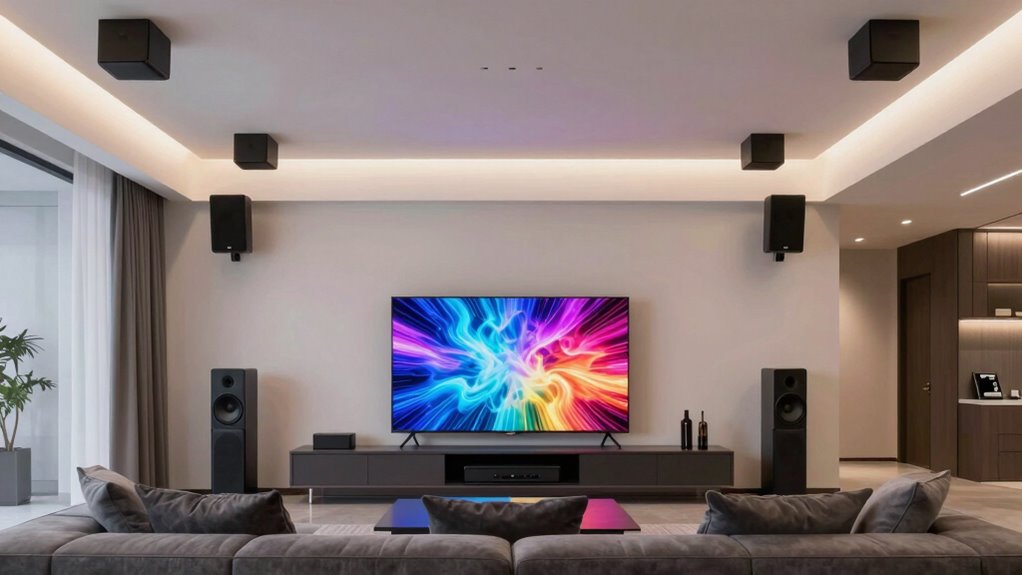

Choosing the right Dolby Atmos speaker system for apartments requires balancing immersive audio with neighbor-friendly volume levels. My top pick, the Klipsch Reference Cinema 5.1.4, stands out for its ability to project directional sound clearly at lower volumes, minimizing bleed-through walls. For those prioritizing ease of setup, the Sony BRAVIA Theater System 6 offers a sleek design and wireless rears that fit seamlessly into tight living spaces. The main tradeoff in this category involves sacrificing true overhead height channels for virtualized audio or accepting larger footprints for better bass response. Continue reading to see how these systems compare in size, connectivity, and acoustic performance for confined residential environments.

Get the latest gadgets delivered free with Prime
- Fast, free delivery on millions of items
- Prime Video, Amazon Music and more included
- Member-only deals all year
Complete the kit



Key Takeaways
- Virtualized Atmos via up-firing drivers often outperforms physical ceiling speakers in rooms with low ceilings or obstructed sightlines.
- Wireless rear speakers are non-negotiable for renters, as running wires through drywall or under baseboards violates many lease agreements.
- Subwoofers with adjustable crossover frequencies allow for precise control over bass leakage, a critical factor for thin apartment walls.
- Compact 5.1.2 systems frequently deliver better directional precision than bulkier 7.1 setups in rooms under 200 square feet.
- HDMI eARC support is becoming standard, but only higher-tier models maintain stable connections with older apartment-built-in smart TVs.
| ULTIMEA Aura A60 Pro 7.1-Channel Dolby Atmos Surround Sound System |  | Best for Flexible 7.1 Surround | Audio channels: 7.1 | Audio format: Dolby Atmos | Surround speakers: 4: 2 wired front and 2 wired rear | VIEW ON AMAZON | See Our Full Breakdown |
| ULTIMEA Skywave X40 5.1.2-Channel Soundbar System |  | Best for Wireless Speaker Placement | Audio output mode: 5.1.2-channel surround sound | Peak power: 530 W | Bass response: Down to 35 Hz | VIEW ON AMAZON | See Our Full Breakdown |
| ULTIMEA 5.1.2-Channel Dolby Atmos Soundbar System |  | Best for Straightforward Atmos Setup | Channels: 5.1.2 | Audio format: Dolby Atmos | Surround speakers: 2 | VIEW ON AMAZON | See Our Full Breakdown |
| Klipsch Reference Cinema 5.1.4 Dolby Atmos System |  | Best for Dedicated Height Channels | Audio channels: 5.1.4 | Speaker type: Satellite | Number of items: 6 | VIEW ON AMAZON | See Our Full Breakdown |
| HiMuses M514 5.1.4 Dolby Atmos Surround Sound System with Subwoofer |  | Best for Multi-Input Flexibility | Audio channels: 5.1.4 | Peak power: Conflicting listings: 900 W and 450 W | Frequency response: 45 Hz; subwoofer bass response listed as 25 Hz | VIEW ON AMAZON | See Our Full Breakdown |
| Sony BRAVIA Theater System 6 5.1-Channel Soundbar with Subwoofer and Rear Speakers |  | Best for Sony TV Owners | Channel Configuration: 5.1 | Audio Formats: Dolby Atmos, DTS:X | Connectivity: Bluetooth, HDMI eARC | VIEW ON AMAZON | See Our Full Breakdown |
| Redragon GS822 5.1.2-Channel Dolby Atmos Soundbar |  | Best Budget Atmos Entry | Channel Configuration: 5.1.2 | Peak Power: 400 Watts | Connectivity: HDMI eARC, Bluetooth 5.3, Optical, AUX, USB | VIEW ON AMAZON | See Our Full Breakdown |
| ULTIMEA Skywave X50 5.1.4-Channel Surround Sound Bar System |  | Best Performance per Dollar | Channel Configuration: 5.1.4 | Peak Power: 760 Watts | Subwoofer Driver: 8 inches | VIEW ON AMAZON | See Our Full Breakdown |
| Amazon Fire TV Soundbar Plus with Subwoofer and Surround Speakers |  | Best for Smart Home Integration | Channel Configuration: 5.1 | Audio Formats: Dolby Atmos, DTS:X | Connectivity: HDMI eARC, Optical, Bluetooth | VIEW ON AMAZON | See Our Full Breakdown |
| ULTIMEA Poseidon M80 5.1-Channel Dolby Atmos Soundbar System |  | Best Compact Setup | Channel Configuration: 5.1 | Peak Power: 312 Watts | Connectivity: HDMI eARC, Optical, USB, Bluetooth 6.0 | VIEW ON AMAZON | See Our Full Breakdown |
| ULTIMEA Aura A60 7.1-Channel Dolby Atmos Soundbar with Subwoofer and 4 Surround Speakers |  | Best Value for Immersive 7.1 Surround | Audio Channels: 7.1 | Audio Format: Dolby Atmos | Surround Speakers: 4 (2 front wired, 2 rear wireless) | VIEW ON AMAZON | See Our Full Breakdown |
| Yamaha YHT-4970U 5.1-Channel Home Theater System |  | Best for Audiophiles and Gamers | AV Receiver: Yamaha RX300A | Audio Channels: 5.1 | Video Support: 4K/120, 8K/60 | VIEW ON AMAZON | See Our Full Breakdown |
| TCL S65K 5.1-Channel Soundbar System with Dolby Atmos and Wireless Surround Speakers |  | Best for Smart Home Integration | Audio Channels: 5.1 | Maximum Output Power: 630 watts | Audio Technologies: Dolby Atmos, DTS:X, DTS Virtual:X | VIEW ON AMAZON | See Our Full Breakdown |
| dolby atmos speaker system for apartment | Connectivity |
|---|---|
| ULTIMEA Aura A60 Pro 7.1-Chann | HDMI eARC; wireless connection between rear speakers and soundbar |
| ULTIMEA Skywave X40 5.1.2-Chan | — |
| ULTIMEA 5.1.2-Channel Dolby At | HDMI eARC; Bluetooth 5.4 |
| Klipsch Reference Cinema 5.1.4 | Wired; RCA |
| HiMuses M514 5.1.4 Dolby Atmos | eARC, Bluetooth, optical, and auxiliary |
| Sony BRAVIA Theater System 6 5 | Bluetooth, HDMI eARC |
| Redragon GS822 5.1.2-Channel D | HDMI eARC, Bluetooth 5.3, Optical, AUX, USB |
| ULTIMEA Skywave X50 5.1.4-Chan | — |
| Amazon Fire TV Soundbar Plus w | HDMI eARC, Optical, Bluetooth |
| ULTIMEA Poseidon M80 5.1-Chann | HDMI eARC, Optical, USB, Bluetooth 6.0 |
| ULTIMEA Aura A60 7.1-Channel D | — |
| Yamaha YHT-4970U 5.1-Channel H | — |
| TCL S65K 5.1-Channel Soundbar | Bluetooth, USB, Wi-Fi, HDMI |
More Details on Our Top Picks
ULTIMEA Aura A60 Pro 7.1-Channel Dolby Atmos Surround Sound System
The Aura A60 Pro suits apartment viewers who want separate front and rear surround speakers rather than relying on a soundbar alone for width. Its four surround speakers and Dolby Atmos support give movies room to spread around a seated listening area, while the app’s 10-band EQ and 121 presets let you tailor sound for dialogue, late-night viewing, or music. Compared with the ULTIMEA 5.1.2-Channel Dolby Atmos Soundbar System, this setup prioritizes more surround speakers over up-firing height channels, so buyers should choose based on whether rear coverage or overhead effects matter more. Wireless links to the rear speakers can reduce some cable runs, but the front and rear speakers still need wires, and the subwoofer is wired. Its recommended room range makes it a more sensible fit for modest apartment living rooms than larger spaces.
Pros:- Four surround speakers provide dedicated front and rear coverage.
- Dolby Atmos support adds multidimensional audio for compatible content.
- App offers 121 presets, six listening modes, and 10-band EQ controls.
- Wireless connection to the rear speakers can reduce some cable clutter.
Cons:- Front and rear surround speakers still require wired connections.
- The wired subwoofer limits placement flexibility.
- Its 7.1 layout does not list dedicated up-firing height channels.
Best for: Apartment residents who want four dedicated surround speakers, extensive app-based sound adjustment, and a system sized for a modest living room.
Not ideal for: Renters who cannot route speaker wires or place a wired subwoofer near an outlet, and buyers whose priority is up-firing height effects.
- Audio channels:7.1
- Audio format:Dolby Atmos
- Surround speakers:4: 2 wired front and 2 wired rear
- Subwoofer:5.25-inch wired
- Peak power:420 W
- Connectivity:HDMI eARC; wireless connection between rear speakers and soundbar
- Room size:Recommended for 108–270 ft²
- Sound customization:Ultimea app; 10-band EQ, 121 presets, and 6 listening modes
Our verdict“Choose the Aura A60 Pro if you want four surround speakers and app tuning in an apartment-sized room, but skip it if overhead effects or minimal wiring matter most.”
ULTIMEA Skywave X40 5.1.2-Channel Soundbar System
The Skywave X40 is a strong fit when an apartment layout makes running speaker cable across the room impractical. Its wireless subwoofer and surround speakers allow more freedom to position those components, while the 5.1.2 layout adds height effects that a conventional 5.1 package lacks. Compared with the ULTIMEA Aura A60 Pro, this model trades the Aura’s four listed surround speakers and detailed app EQ for wireless speaker placement, 4K HDR pass-through, and a deeper specified bass response down to 35 Hz. That combination is useful for movie nights, though a 43.31-inch bar needs adequate TV-stand or wall space. The system still requires corded power, so wireless describes speaker connections rather than a wire-free setup. Its 530W peak rating also makes it a more forceful choice than a compact, low-output apartment system.
Pros:- 5.1.2-channel configuration adds height effects for compatible audio.
- Wireless subwoofer and surround speakers offer more flexible placement.
- 4K HDR pass-through supports a compatible video setup.
- Specified bass response reaches down to 35 Hz.
Cons:- The 43.31-inch soundbar may be wide for smaller TV stands.
- Corded power is still required, despite wireless speaker connections.
- The supplied product details do not list app EQ or room-size guidance.
Best for: Apartment movie watchers who need wireless subwoofer and surround-speaker placement, want height effects, and have room for a 43.31-inch soundbar.
Not ideal for: People seeking a compact bar, a fully cable-free setup, or a system with listed app-based EQ controls.
- Audio output mode:5.1.2-channel surround sound
- Peak power:530 W
- Bass response:Down to 35 Hz
- Subwoofer:6.5-inch; wireless
- Amplifier:GaN
- Audio processing:24-bit/192 kHz
- Video pass-through:4K HDR
- Dimensions:43.31 × 2.76 × 3.94 inches
Our verdict“Pick the Skywave X40 if wireless speaker placement and height effects outweigh the need for a smaller bar or a fully cable-free setup.”
ULTIMEA 5.1.2-Channel Dolby Atmos Soundbar System
This ULTIMEA 5.1.2 system is a practical choice for apartment viewers who want Atmos height effects without assembling a large collection of satellite speakers. Its up-firing drivers handle the height-channel role, while two surround speakers widen effects beyond the TV; HDMI eARC supports lossless audio from compatible televisions. At 31.5 inches wide, it is more manageable for a smaller media console than the Skywave X40, though it gives up that model’s wireless subwoofer and surround-speaker connections. App controls add 121 presets and a 10-band EQ, which helps tailor dialogue or reduce bass impact for shared walls. There is a clear format limitation: it is not DTS-compatible, and the subwoofer is wired. Buyers with mixed-format disc collections should check their sources before choosing it.
Pros:- Up-firing drivers and two surround speakers provide height and rear effects.
- HDMI eARC supports lossless audio transmission from compatible devices.
- App includes a 10-band EQ and 121 sound presets.
- At 31.5 inches wide, it is more compact than the Skywave X40.
Cons:- It is not compatible with DTS audio.
- The subwoofer is wired, which restricts placement.
- Corded power is required.
Best for: Apartment dwellers with a compatible eARC television who want a shorter soundbar, up-firing Atmos effects, and app-based sound adjustments.
Not ideal for: Viewers with DTS-based sources or anyone who needs a wireless subwoofer and surround speakers for flexible placement.
- Channels:5.1.2
- Audio format:Dolby Atmos
- Surround speakers:2
- Subwoofer:5.25-inch wired
- Connectivity:HDMI eARC; Bluetooth 5.4
- Sound controls:App and CEC
- Equalizer and presets:10-band graphic EQ; 121 sound presets
- Dimensions:31.5 × 1.81 × 3.54 inches
- Format limitation:Not compatible with DTS
Our verdict“Choose this system for compact eARC-connected Atmos playback and app tuning, provided your sources do not depend on DTS.”
Klipsch Reference Cinema 5.1.4 Dolby Atmos System
The Klipsch Reference Cinema 5.1.4 is the most speaker-led choice here: four Atmos satellite speakers provide height effects from both the front and rear, rather than asking a soundbar to simulate that sense of space. Its Tractrix horns and aluminum tweeters distinguish it from the ULTIMEA soundbar systems, while the satellite layout suits listeners willing to plan speaker positions around a fixed TV area. That physical layout is also the drawback in an apartment. The system is fully wired, weighs 30 kg, and lists wall mounting, so placement and cable routing call for more planning than the Skywave X40’s wireless connections. A 4-inch subwoofer is specified, smaller than the 5.25-inch units listed for two ULTIMEA systems. Choose Klipsch for discrete height speakers, not for a tidy, minimal-install setup.
Pros:- Four Atmos satellite speakers provide front and rear height effects.
- 5.1.4 layout offers dedicated height channels.
- Tractrix horns and aluminum tweeters define the speaker design.
- Built-in digital subwoofer amplifier is included.
Cons:- No wireless connectivity; the speaker system uses wired connections.
- The 30 kg system and wall-mount orientation require substantial placement planning.
- Its listed 4-inch subwoofer is smaller than the 5.25-inch subwoofers in the ULTIMEA systems.
Best for: Apartment owners or long-term renters with permission to mount and route cables who prioritize discrete front-and-rear Atmos height speakers.
Not ideal for: Renters unable to wall-mount or conceal wiring, and buyers who want wireless components or a compact, easy-to-place system.
- Audio channels:5.1.4
- Speaker type:Satellite
- Number of items:6
- Maximum output power:300 W
- Subwoofer diameter:4 inches
- Connectivity:Wired; RCA
- Mounting:Wall mount
- Weight:30 kg
Our verdict“Choose the Klipsch system when discrete 5.1.4 height speakers matter more than apartment-friendly wiring and placement.”
HiMuses M514 5.1.4 Dolby Atmos Surround Sound System with Subwoofer
The HiMuses M514 fits apartment households that connect several kinds of gear: HDMI eARC, Bluetooth, optical, and auxiliary inputs give it more listed connection choices than the ULTIMEA 5.1.2 system, which centers on eARC and Bluetooth. Its 5.1.4 layout pairs a dedicated center speaker with four surround speakers and four up-firing height channels, a speaker-rich approach for films and games. Wooden cabinets and a wired subwoofer add to the physical footprint, so this is less suited to a small, uncluttered media area than a shorter soundbar package. The product data also conflict on important specs: peak power is listed as both 900W and 450W, driver count as 16 and 13, and Bluetooth as 5.3 and 5.4. I would treat those figures as unconfirmed when comparing systems.
Pros:- 5.1.4 configuration includes four up-firing height channels.
- Dedicated center speaker and four surround speakers support dialogue and surround effects.
- Offers eARC, Bluetooth, optical, and auxiliary connectivity.
- Wooden cabinets and a wired subwoofer form part of the system.
Cons:- Published peak power conflicts between 900 W and 450 W.
- Driver count and Bluetooth version also have conflicting listings.
- Wired subwoofer and multiple speakers require placement and cable planning.
Best for: Apartment households with several source devices who want a 5.1.4 speaker layout and value eARC, optical, Bluetooth, and auxiliary connections.
Not ideal for: Buyers who need consistent published specifications, a wireless subwoofer, or a low-clutter setup with few separate speakers.
- Audio channels:5.1.4
- Peak power:Conflicting listings: 900 W and 450 W
- Frequency response:45 Hz; subwoofer bass response listed as 25 Hz
- Subwoofer:Wired; 13.5 L capacity
- Drivers:Conflicting listings: 16 and 13
- Connectivity:eARC, Bluetooth, optical, and auxiliary
- Bluetooth version:Conflicting listings: 5.3 and 5.4
- Cabinet material:Wood
- Signal-to-noise ratio:110 dB
Our verdict“Pick the M514 if varied inputs and a 5.1.4 layout matter most, but compare cautiously because several published specifications conflict.”
Sony BRAVIA Theater System 6 5.1-Channel Soundbar with Subwoofer and Rear Speakers
This system is engineered specifically for Sony BRAVIA TVs, offering seamless integration that generic soundbars often lack. While it delivers solid 5.1 surround sound, its true strength lies in features like Voice Zoom 3, which clarifies dialogue but requires a compatible BRAVIA TV to function. Compared to the ULTIMEA Skywave X50, this Sony model offers fewer channels (5.1 vs. 5.1.4) and less raw power (1000W vs. 760W peak, though Sony’s wattage claims are often marketing-heavy). However, for those already in the Sony ecosystem, the automatic setup and unified remote control provide a convenience level that competitors like the Redragon GS822 cannot match. It is a pragmatic choice for apartment dwellers who want reliable surround sound without complex configuration, provided they own the matching hardware.
Pros:- Seamless integration with Sony BRAVIA TVs for simplified setup
- Dedicated center channel significantly improves dialogue clarity
- Includes wireless rear speakers and subwoofer for full surround
- Compact soundbar fits easily under most apartment TVs
Cons:- Advanced voice features require a compatible Sony TV
- Remote control requires AAA batteries, adding minor maintenance
- Lacks height channels for true overhead Dolby Atmos effects
Best for: Owners of compatible Sony BRAVIA TVs who want plug-and-play surround sound with integrated remote control.
Not ideal for: Users with non-Sony TVs, as key dialogue-enhancing features are locked behind proprietary hardware compatibility.
- Channel Configuration:5.1
- Audio Formats:Dolby Atmos, DTS:X
- Connectivity:Bluetooth, HDMI eARC
- Speaker Components:Soundbar, Wireless Subwoofer, Rear Speakers
- Mounting Options:Tabletop or Wall Mount
- Control Method:App and Remote
Our verdict“Choose this if you own a Sony TV and prioritize ecosystem integration over maximum channel count.”
Redragon GS822 5.1.2-Channel Dolby Atmos Soundbar
The Redragon GS822 stands out as an accessible entry point into Dolby Atmos for apartment dwellers on a tighter budget. Unlike the ULTIMEA Poseidon M80, which sticks to a 5.1 setup, this model adds two upward-firing channels (5.1.2), attempting to create a vertical soundstage that mimics overhead audio. While the 400W peak power is modest compared to high-end systems, it is sufficient for small to medium-sized rooms. The inclusion of HDMI eARC is a critical advantage over older optical-only budget bars, ensuring you can pass through high-bitrate Atmos signals from modern TVs. However, the wired rear speakers are a significant drawback for renters or those with complex layouts, as running cables across the floor is often impractical. It is a functional compromise that delivers Atmos decoding without the premium price tag.
Pros:- 5.1.2 configuration attempts vertical sound staging
- HDMI eARC support ensures high-quality audio passthrough
- Dedicated EQ modes for movies, music, and games
- Wireless subwoofer reduces clutter near the TV
Cons:- Rear speakers are wired, limiting placement flexibility
- Build quality feels less premium than higher-end competitors
- No app control, relying solely on a physical remote
Best for: Budget-conscious buyers who want to experience Dolby Atmos height effects without investing in a premium system.
Not ideal for: Renters or users with open floor plans who cannot hide or run cables for wired rear speakers.
- Channel Configuration:5.1.2
- Peak Power:400 Watts
- Connectivity:HDMI eARC, Bluetooth 5.3, Optical, AUX, USB
- Subwoofer Type:Wireless, 6.5-inch driver
- Surround Speakers:Wired
- Audio Modes:Movie, Music, Game
Our verdict“A solid value pick for those wanting Atmos height channels who can manage wired rear speaker cables.”
ULTIMEA Skywave X50 5.1.4-Channel Surround Sound Bar System
This system aggressively targets the mid-range market by offering a 5.1.4 channel configuration with wireless rear speakers, a feature typically reserved for much more expensive setups. Compared to the Amazon Fire TV Soundbar Plus, which is a 5.1 system, the Skywave X50 adds four upward-firing drivers for a more convincing overhead effect in Dolby Atmos content. The 8-inch subwoofer and 760W peak power deliver bass that can fill an apartment without overwhelming neighbors, thanks to its GaN amplifier efficiency. While it lacks the brand prestige of Sony or Yamaha, the raw specification sheet is compelling. The dual 5GHz wireless transmission helps reduce interference, a common issue in dense apartment buildings. It represents the best balance of immersive features and cost, making it a strong contender for enthusiasts who want true surround depth without the premium markup.
Pros:- 5.1.4 channel layout provides genuine overhead Atmos effects
- Wireless rear speakers offer flexible placement in apartments
- Large 8-inch subwoofer delivers deep, room-filling bass
- GaN amplifier improves efficiency and reduces heat
Cons:- Requires corded power for all components, including rears
- Lacks advanced room correction software found in premium brands
- No water resistance limits placement near windows or plants
Best for: Audiophiles on a mid-range budget who want true 5.1.4 wireless surround without paying premium brand prices.
Not ideal for: Users who prioritize brand-name support and software updates over raw hardware specifications.
- Channel Configuration:5.1.4
- Peak Power:760 Watts
- Subwoofer Driver:8 inches
- Wireless Transmission:Dual 5GHz
- Video Support:4K HDR Pass-through
- Audio Processing:24-bit/192kHz
Our verdict“The strongest performer in this group for immersive audio, offering wireless 5.1.4 surround at a competitive price.”
Amazon Fire TV Soundbar Plus with Subwoofer and Surround Speakers
This kit is designed for users already invested in the Amazon Fire TV ecosystem, offering a level of software integration that competitors like the Sony BRAVIA System 6 cannot replicate outside their own brand. The inclusion of a dedicated center channel is a smart move for apartment living, where background noise often competes with dialogue. While it is a 5.1 system and lacks the height channels of the ULTIMEA Skywave X50, it compensates with robust voice control via Alexa and seamless switching between devices. The wireless subwoofer and surrounds make setup relatively clean, though all components still require power outlets. It is not the most powerful option here, but its strength lies in usability and the ability to group with other Amazon audio devices. For those who want a “smart” home theater experience with minimal friction, this is the logical choice.
Pros:- Deep integration with Amazon Fire TV and Alexa voice control
- All-surround speakers are wireless for easier placement
- Dedicated center channel enhances dialogue clarity
- Multiple EQ modes including Night mode for low-volume listening
Cons:- Limited to 5.1 channels, lacking upward-firing Atmos drivers
- Extended warranty is not included by default
- Requires multiple power outlets for subwoofer and surrounds
Best for: Amazon Fire TV owners and Alexa users who want seamless voice control and multi-room audio compatibility.
Not ideal for: Audiophiles seeking maximum channel count or overhead Atmos effects, as it is limited to 5.1 channels.
- Channel Configuration:5.1
- Audio Formats:Dolby Atmos, DTS:X
- Connectivity:HDMI eARC, Optical, Bluetooth
- Speaker Components:Soundbar, Wireless Subwoofer, 2 Wireless Surrounds
- Smart Features:Alexa Voice Control, Multi-room audio
- Warranty:1-year limited
Our verdict“Ideal for Amazon ecosystem users who prioritize voice control and ease of use over maximum channel density.”
ULTIMEA Poseidon M80 5.1-Channel Dolby Atmos Soundbar System
The ULTIMEA Poseidon M80 is a straightforward 5.1 system that prioritizes simplicity and connectivity breadth. It features Bluetooth 6.0, which offers better range and stability than the Bluetooth 5.3 found in the Redragon GS822, making it a better choice for streaming music from further away in an apartment. However, it falls short of the Skywave X50 in terms of immersion, offering only 5.1 channels without any upward-firing drivers for vertical Atmos effects. The surround speakers are wired, which limits placement flexibility compared to wireless alternatives. Its six EQ modes provide decent versatility for different content types, and the app control adds a layer of customization. This model is best viewed as a reliable, no-frills upgrade from TV speakers, suitable for those who want solid stereo-to-surround expansion without the complexity or cost of height channels.
Pros:- Bluetooth 6.0 provides stable wireless audio streaming
- App and remote controls offer flexible operation
- Six distinct EQ modes for various content types
- Wireless subwoofer reduces cable clutter near the TV
Cons:- Rear speakers are wired, requiring cable management
- No support for DTS decoding, limiting some disc formats
- Lacks height channels for vertical sound staging
Best for: Users who want a simple, reliable 5.1 upgrade with modern Bluetooth connectivity and app control.
Not ideal for: Those seeking true overhead Dolby Atmos effects, as this system lacks upward-firing drivers.
- Channel Configuration:5.1
- Peak Power:312 Watts
- Connectivity:HDMI eARC, Optical, USB, Bluetooth 6.0
- Audio Formats:Dolby Atmos (Decoding only)
- Subwoofer:Wireless, 5.25-inch driver
- Control Options:App, Remote
Our verdict“A practical, modern 5.1 system for those who want reliable connectivity without the need for height channels.”
ULTIMEA Aura A60 7.1-Channel Dolby Atmos Soundbar with Subwoofer and 4 Surround Speakers
This system stands out by offering 7.1-channel audio at a price point where most competitors stick to 5.1. Compared to the Yamaha YHT-4970U, which relies on separate bookshelf speakers, the Aura A60 integrates the front surrounds into the bar itself, saving floor space in cramped apartments. The wireless rear speakers are a huge win for renters who cannot run cables across the room, though the subwoofer remains wired, limiting placement options. With 121 EQ presets, it offers more manual control than the TCL S65K’s automated calibration, appealing to users who enjoy tweaking their sound profile. However, the reliance on wired connections for the front and rear satellites means you still need a nearby power outlet for the bar’s full array, which can be messy behind a TV stand.Pros:- True 7.1 channel configuration with four surround speakers
- Wireless rear speakers eliminate cross-room cable runs
- Extensive app control with 121 EQ presets
- Integrated front surrounds save floor space
Cons:- Subwoofer is wired, restricting placement flexibility
- Front surround speakers require physical wiring to the bar
- No dedicated HDMI eARC port mentioned in specs
Best for: Renters and apartment dwellers who want true surround sound without complex wiring but have space for a wired subwoofer.
Not ideal for: Minimalists who want a completely wireless system, as the subwoofer and front speakers require physical cabling.
- Audio Channels:7.1
- Audio Format:Dolby Atmos
- Surround Speakers:4 (2 front wired, 2 rear wireless)
- Subwoofer:4-inch wired
- EQ Presets:121
- Control:App and Remote
- Recommended Room Size:108–270 ft²
Our verdict“Choose this if you prioritize a dense 7.1 soundstage and manual audio control over complete wireless freedom.”
Yamaha YHT-4970U 5.1-Channel Home Theater System
This kit is the enthusiast’s choice, pairing a dedicated AV receiver with discrete speakers for superior separation compared to integrated soundbars like the TCL S65K. The inclusion of automatic room correction with a setup microphone ensures the sound is tuned specifically to your apartment’s acoustics, a feature often missing in budget systems. For gamers, the support for 4K/120 and VRR via HDMI 2.1 makes it future-proof for next-gen consoles, whereas many soundbars struggle with high-frame-rate passthrough. The tradeoff is complexity and footprint; the receiver requires shelf space, and the five separate speakers need careful placement. Unlike the ULTIMEA Aura A60’s all-in-one bar design, this system demands more setup effort but rewards users with richer, more dynamic audio performance suitable for critical listening.Pros:- Dedicated AV receiver with automatic room correction
- Supports advanced gaming features like ALLM and VRR
- Discrete 5.1 speaker setup for better sound separation
- Bluetooth Multipoint for easy device switching
Cons:- Bulky receiver requires dedicated shelf space
- Complex setup involving multiple wires and speaker placement
- Speaker dimensions and power ratings are not specified
Best for: Gamers and audiophiles who want discrete speaker placement and high-end video features like VRR and 8K support.
Not ideal for: Those seeking a simple, single-bar setup, as this requires managing multiple speakers, wires, and a separate receiver box.
- AV Receiver:Yamaha RX300A
- Audio Channels:5.1
- Video Support:4K/120, 8K/60
- HDMI Features:HDMI 2.1, eARC, ALLM, VRR
- Audio Formats:Dolby Atmos, DTS Virtual:X
- Room Correction:Automatic with included mic
- Total Weight:50.4 pounds
Our verdict“This is the superior choice for those who value audio fidelity and gaming performance over compact convenience.”
TCL S65K 5.1-Channel Soundbar System with Dolby Atmos and Wireless Surround Speakers
The TCL S65K balances power and convenience with its 630-watt output and fully wireless surround and subwoofer components. Unlike the ULTIMEA Aura A60, which ties you to wired connections for key elements, the S65K offers total placement freedom, ideal for open-plan apartments. The AI room calibration automatically adjusts audio profiles, removing the guesswork found in manual EQ systems. It supports both Dolby Atmos and DTS:X, providing broad format compatibility. However, some advanced features like ChoruSound are optimized for compatible TCL TVs, creating a slight ecosystem lock-in. While it lacks the discrete receiver complexity of the Yamaha YHT-4970U, it delivers impressive volume and clarity for a soundbar-based system, making it a strong contender for users who prioritize ease of use and wireless flexibility.Pros:- Fully wireless subwoofer and surround speakers
- AI room calibration for automatic sound optimization
- High 630-watt maximum output power
- Supports both Dolby Atmos and DTS:X
Cons:- Requires two AAA batteries for the remote
- Some features like ChoruSound are best with TCL TVs
- Lacks the discrete component flexibility of a receiver-based system
Best for: Users who want a powerful, fully wireless surround setup with automatic tuning and minimal manual configuration.
Not ideal for: Non-TCL TV owners who want all features unlocked, as some proprietary technologies are optimized for TCL hardware.
- Audio Channels:5.1
- Maximum Output Power:630 watts
- Audio Technologies:Dolby Atmos, DTS:X, DTS Virtual:X
- Subwoofer Driver:6.5 inches
- Connectivity:Bluetooth, USB, Wi-Fi, HDMI
- Mounting Type:Wall mount
- Power Source:Corded electric
Our verdict“Pick this for a hassle-free, high-volume surround experience that adapts to your room without manual tweaking.”

How We Picked
I evaluated these systems based on their physical footprint, wireless connectivity reliability, and acoustic isolation capabilities. Since apartment living demands minimal visual clutter and low sound bleed, I prioritized units with compact subwoofers and discrete satellite speakers. I also examined user feedback regarding setup complexity, favoring systems that pair effortlessly with common streaming devices without requiring extensive manual calibration.
Ranking was determined by the balance between immersion and discretion. Systems that offered robust Dolby Atmos decoding without requiring excessive volume to fill small rooms received higher marks. I also penalized setups that relied heavily on wired connections, as these are impractical for most renters. The final list reflects a mix of dedicated home theater components and integrated soundbars, categorized by their suitability for specific apartment layouts and noise constraints.
Factors to Consider When Choosing Dolby Atmos Speaker System For Apartments
Selecting audio equipment for a shared or confined living space differs from choosing for a dedicated media room. The following factors address the unique acoustic and logistical challenges of apartment dwellers.
Acoustic Isolation and Bass Management
In an apartment, bass management is less about punch and more about containment. Low-frequency waves travel easily through structural elements like drywall and floor joists, causing disturbances for neighbors. Look for systems with adjustable subwoofer levels and downward-firing drivers, which couple less with the floor than front-facing models. Some advanced units offer night modes that compress dynamic range and limit low-end output, allowing you to enjoy clear dialogue without shaking the walls. If your building has thin floors, prioritize systems with sealed subwoofer enclosures over ported ones, as they produce less resonant noise that transmits to units below.
Physical Footprint and Rental Compatibility
Landlords rarely appreciate permanent modifications, so wireless connectivity is a primary constraint. Systems requiring wired rear speakers often necessitate drilling holes or running long cables across floors, which can damage deposits. Opt for wireless rear satellites that connect via proprietary protocols or Wi-Fi. Additionally, consider the physical size of the soundbar and subwoofer. Compact subwoofers fit better in corners or behind furniture, reducing the visual clutter and trip hazards common in small apartments. Verify that the system’s stand or mounting hardware does not require wall anchors that exceed your lease’s permission limits.
Room Calibration and Reflective Surfaces
Small rooms are acoustically unforgiving, often causing standing waves and muddy bass due to close proximity to walls. High-end systems include automatic room correction microphones that analyze reflections and adjust EQ accordingly. This feature is vital in apartments where furniture placement is fixed by layout rather than preference. Without calibration, a system might sound boomy or thin depending on its position relative to corners and glass windows. When comparing models, check if the calibration tool is included or sold separately, as this impacts the true cost and convenience of achieving balanced sound in a confined space.
Connectivity with Apartment-Standard TVs
Many apartments come equipped with older or basic smart TVs that lack modern audio outputs. Verify your TV’s capabilities before purchasing; if it only has optical audio, a system relying solely on HDMI eARC will be unusable without additional converters. Conversely, if you plan to stream via external devices like Apple TV or Roku, HDMI passthrough ensures you maintain 4K and HDR signals. Bluetooth connectivity is useful for music playback but often compresses audio quality, making it less ideal for immersive film soundtracks. Ensure the system supports your primary source to avoid compatibility headaches.
Frequently Asked Questions
Do I need physical ceiling speakers for Dolby Atmos in an apartment?
Generally, no. Most apartment ceilings are too low (8-9 feet) and too close to the floor to allow for the distinct vertical separation that physical up-firing speakers require. Instead, virtualization technology uses psychoacoustic tricks to simulate height by bouncing sound off walls and ceilings or using advanced digital signal processing. In tight spaces, these virtualized effects often sound more cohesive and less localized than physical speakers, which can create a ‘roof’ effect that feels unnatural when you are close to the ceiling.
How can I prevent my subwoofer from disturbing downstairs neighbors?
Start by placing the subwoofer on a decoupling isolation pad, which separates the unit from the floor and reduces vibration transfer. Next, use your system’s app or remote to lower the crossover frequency, limiting the subwoofer to only the deepest bass notes that are less directional. Finally, avoid placing the sub in a corner, where bass builds up and resonates through the structure. If neighbors still complain, consider switching to a sealed subwoofer enclosure if your current model is ported, as sealed designs produce less audible ‘chuffing’ noise.
Is a soundbar with wireless rears better than a traditional 5.1 system for renting?
For most renters, yes. Traditional 5.1 systems require running speaker wire from the receiver to the rear speakers, which is often impossible without damaging walls or creating safety hazards. Wireless rear satellites plug into a nearby power outlet and connect wirelessly to the main unit, preserving your security deposit and keeping floors clear. While traditional wired systems offer slightly better latency and reliability, the convenience and legal safety of wireless setups make them the superior choice for temporary or lease-restricted living situations.
Can I use a Dolby Atmos system with a projector instead of a TV?
Yes, but you must check your projector’s audio capabilities. Most projectors lack HDMI inputs for audio sources, so you will likely need to connect your streaming device (like a Blu-ray player or Apple TV) directly to the sound system, then run video to the projector. This setup, known as audio passthrough, ensures the sound system receives the high-bitrate Atmos signal. If your projector has HDMI eARC, you can connect it directly to the soundbar, but verify that the projector supports high-bandwidth HDMI to avoid signal dropouts.
Why does my Atmos sound feel flat despite having a system?
This usually results from incorrect speaker placement or poor room acoustics. In small apartments, rear speakers placed too close to the main listener or too high on the wall can cause sound to blend rather than separate. Ensure rear speakers are slightly behind and at ear level, and angled inward. Additionally, if your ceiling is angled or vaulted, up-firing speakers may not reflect sound correctly back to your ears. Running an auto-calibration routine can help correct timing and level errors, but manual adjustment of rear speaker angles often yields the best improvement in spatial separation.
Conclusion
For those seeking the most accurate spatial audio in a compact package, the Klipsch Reference Cinema 5.1.4 remains the best overall choice due to its efficient driver design and clear dialogue reproduction. If you prioritize a minimalist aesthetic and easy setup, the Sony BRAVIA Theater System 6 offers the best value for renters who cannot run wires. Beginners should consider the ULTIMEA Skywave X40 for its straightforward interface and forgiving placement options. For audiophiles with larger apartment living rooms who can tolerate a bigger footprint, the Yamaha YHT-4970U provides traditional component flexibility. Finally, for tight budgets, the TCL S65K delivers respectable Atmos immersion without the premium price tag of flagship brands.
Fall Picks
fall essentials
As an affiliate, we earn on qualifying purchases.