For travel photography, I rank the DJI Mini 5 Pro as the best overall pick for its balance of portability and advanced camera features, while the DJI Air 3S suits travelers who want a more capable camera system and the Potensic ATOM offers a lighter, more approachable alternative. The main tradeoff is between image and flight capability and the size, cost, and learning curve you are willing to carry. Small drones pack easily, but larger or more advanced models can offer greater creative flexibility. I compare all 13 options by travel-ready performance, controls, and practical kit value so you can see which fits your kind of trip. Read on for the full breakdown and buying advice.

Get the latest gadgets delivered free with Prime
- Fast, free delivery on millions of items
- Prime Video, Amazon Music and more included
- Member-only deals all year
Complete the kit



Key Takeaways
- The DJI Mini 5 Pro is the strongest all-around travel choice in this lineup when portability and advanced creative control matter more than keeping the kit simple.
- The DJI Air 3S is the premium step-up for travelers prioritizing a more capable camera system, but its larger footprint makes it less convenient for minimalist packing.
- The Potensic ATOM stands out as a compact alternative for buyers who want GPS flight features and 4K capture without moving to a larger premium drone.
- Included screen controllers and extra batteries change trip convenience: the SKYROVER X1 combo and several Fly More bundles reduce reliance on a phone or frequent recharging.
- Camera claims alone do not settle the choice; gimbal stabilization, controls, portability, and the practical limits of flying abroad matter as much as headline photo or video resolution.


More Details on Our Top Picks
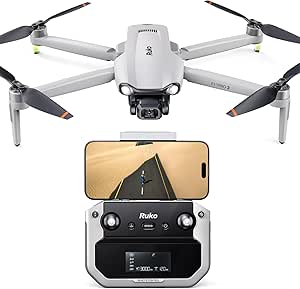
Ruko F11PRO 2 Drone with 6K Camera
For travel photographers who want more time in the air without swapping batteries, the Ruko F11PRO 2 is a practical fit: its two included batteries provide up to 70 minutes of combined flight time, and its three-axis mechanical gimbal steadies 4K/30 fps footage. Its 6K photos and 19 MP effective still resolution offer a different emphasis from the Potensic ATOM’s 12 MP Sony camera, while GPS return-to-home and automated Follow and Orbit modes can simplify capturing moving subjects. The tradeoff is portability: at 3,200 mAh per battery and without a listed weight, this is less clearly travel-light than the 249 g Potensic ATOM or DJI Neo. The gimbal cover also needs removal before startup, and the remote’s separate ports may cause setup confusion.
Pros:- Three-axis mechanical gimbal steadies footage during flight.
- Two batteries provide up to 70 minutes of stated combined flight time.
- 6K photos and 19 MP effective still resolution.
- GPS return-to-home and Follow and Orbit flight modes.
Cons:- The product data does not list the drone’s weight, making travel portability harder to judge.
- The gimbal cover must be removed before powering on.
- Separate charging and data ports on the remote may complicate setup.
Best for: Travelers who prioritize stabilized 4K footage, automated flight modes, and extended outings over a clearly documented sub-250 g design.
Not ideal for: Ultralight travelers or photographers who need a compact drone with clearly stated weight and simple controller setup.
Our verdict“Choose the Ruko F11PRO 2 if stabilized footage and longer outings matter more than a confirmed ultralight travel weight.”
Bwine F7MINI GPS Drone with 4K Video, 8K Photos, and 3-Axis Gimbal
The Bwine F7MINI pairs a listed 48 MP camera with a 1/2-inch CMOS sensor, giving still-photo detail the lead over the Potensic ATOM’s 12 MP camera. It also records 4K/30 fps video through a three-axis gimbal and weighs 249 g, a useful combination for travelers who want stabilized clips in a compact package. Three batteries provide up to 96 minutes of stated total flight time, matching the ATOM’s headline endurance, while GPS modes include return-to-home, Follow, Orbit, and waypoint flight. The main reservation is confidence in the claims: the stated 20,000-foot range comes with no independent performance evidence in the supplied details. Compared with the more thoroughly specified ATOM bundle, the F7MINI makes a stronger pitch on still resolution but a less substantiated one on range.
Pros:- 48 MP camera and 1/2-inch CMOS sensor are geared toward detailed still photos.
- Three-axis gimbal supports stabilized 4K/30 fps video.
- 249 g weight suits compact travel packing.
- Three batteries provide up to 96 minutes of stated total flight time.
Cons:- The 20,000-foot transmission range may depend heavily on conditions.
- The supplied product details provide no independent evidence for performance claims.
- The stated total flight time requires using all three batteries.
Best for: Travel photographers who favor detailed stills, a sub-250 g design, and several batteries for a full day of shooting.
Not ideal for: Buyers who want independently substantiated range claims or prefer a camera and accessory package with more clearly documented details.
Our verdict“Pick the F7MINI if high-resolution stills and a light airframe matter more to you than well-supported range claims.”
Potensic ATOM 4K GPS Drone Fly More Combo
The Potensic ATOM earns this spot by balancing a lightweight airframe, stabilized 4K video, and a useful set of travel-ready extras. Its 249 g weight is easy to pack, while the 12 MP Sony CMOS camera and three-axis brushless gimbal suit travelers who value smooth clips over the Bwine F7MINI’s higher listed still resolution. Three batteries are rated for up to 96 minutes total, and the bundle adds a charging hub, storage bag, and 64 GB microSD card—practical inclusions for a trip. GPS return-to-home, visual tracking, and QuickShots give beginners ways to capture repeatable footage. The limit is that 96 minutes spans three batteries, not one outing without a swap, and the camera’s 12 MP still resolution is modest beside the F7MINI’s 48 MP claim.
Pros:- 249 g drone with a three-axis brushless gimbal.
- 12 MP Sony CMOS camera records 4K video at up to 30 fps.
- Three batteries offer up to 96 minutes of stated combined flight time.
- Bundle includes a charging hub, storage bag, and 64 GB microSD card.
Cons:- The 96-minute figure depends on using all three batteries.
- 12 MP still resolution is lower than the Bwine F7MINI’s listed 48 MP.
- The listed maximum transmission range is 6 km, not a guarantee of usable range in every setting.
Best for: Travelers seeking a lightweight 4K drone kit with a stabilized camera, spare batteries, and storage accessories included.
Not ideal for: Still-photo specialists who prioritize the highest listed megapixel count or anyone expecting 96 minutes from a single battery.
Our verdict“Choose the ATOM if you want a balanced, lightweight travel kit with stabilized 4K video and useful accessories.”
N11 Pro 4K GPS Camera Drone with Three Batteries
The N11 Pro is aimed at casual travelers who want GPS-assisted framing and easy-to-follow flight modes, rather than the stronger video specification offered by the Potensic ATOM. Follow Me, Tap Fly, and Point of Interest give beginners simple ways to vary a shot, while GPS and optical flow support hovering and automatic return if the signal drops or battery runs low. Its 181 g weight and three included batteries are travel-friendly on paper, with up to 90 minutes of combined flight time. The important compromise is image quality: despite the 4K label, the listed video resolution is 2048 × 1080, below the ATOM’s 4K at up to 30 fps. Its control range is also limited to 3,328 feet, so it suits nearby scenes better than wide-open aerial routes.
Pros:- Lightweight 181 g design.
- Follow Me, Tap Fly, and Point of Interest GPS modes.
- GPS and optical flow support hovering and automatic return.
- Three batteries provide up to 90 minutes of stated combined flight time.
Cons:- Listed video resolution is 2048 × 1080, below the Potensic ATOM’s stated 4K capture.
- The 90-minute flight figure combines three batteries rather than one flight.
- Maximum listed control range is 3,328 feet.
Best for: New drone owners who want guided GPS modes for nearby travel scenes and a lightweight aircraft with spare batteries.
Not ideal for: Travel videographers who require clearly specified 4K capture or need a longer stated control range.
Our verdict“The N11 Pro suits beginner travelers who value guided modes and portability more than high-resolution video.”
DJI Neo Mini Drone with 4K UHD Camera
At 135 g, the DJI Neo is the easiest pick here to slip into a travel bag for spontaneous clips. Palm takeoff and landing, controller-free operation, voice or app control, subject tracking, and eight QuickShots modes lower the effort of getting a short aerial sequence. That makes it a different proposition from the Potensic ATOM, which offers a three-axis gimbal and three batteries for longer shooting sessions. The Neo lists 4K UHD video and 12 MP stills, but its included setup has just one battery, so it is better for brief moments than all-day coverage. Activation also requires downloading the DJI Fly app from DJI’s website. Full-coverage propeller guards add reassurance around people and obstacles, though they do not replace careful flying.
Pros:- 135 g weight is the lightest listed in this group.
- Palm takeoff and landing with controller-free, voice, app, or remote control options.
- Subject tracking and eight QuickShots modes simplify short clips.
- Full-coverage propeller guards are included.
Cons:- The standard package includes only one battery.
- Activation requires downloading the DJI Fly app from DJI’s website.
- Its 12 MP still resolution is lower than the Bwine F7MINI’s listed 48 MP.
Best for: Travelers who want the lightest, simplest drone in this group for quick clips, subject tracking, and palm launches.
Not ideal for: Photographers planning long shooting days, needing multiple batteries in the standard package, or wanting the stated three-axis mechanical gimbal found on other picks.
Our verdict“Choose the DJI Neo for quick, low-fuss travel clips and minimal carry weight, not for extended shooting sessions.”
SKYROVER X1 Drone Combo with Screen Controller, 4K Camera, 360° Obstacle Avoidance, and 3 Batteries
The SKYROVER X1 is a strong fit for travelers who want capable capture and a ready-to-use controller in one package. Its 5.5-inch, 700-nit touchscreen keeps the live view visible outdoors without relying on a phone, while the 48MP camera, 1/1.32-inch sensor, and 4K/60fps HDR give you room to frame stills and smooth motion footage. Compared with the DJI Mini 5 Pro, it offers a similarly travel-friendly stated weight and three batteries, but the Mini 5 Pro specifies a larger 1-inch sensor and true vertical filming. The X1’s 360° obstacle sensing can add confidence around varied scenery; its main tradeoff is that the advertised 9.32-mile transmission range depends on open conditions, and the supplied details do not establish the same portrait-focused tools. Its 96-minute figure is combined time across three batteries, not one continuous flight.
Pros:- 5.5-inch, 700-nit touchscreen controller provides a bright phone-free live view
- 48MP stills and 4K/60fps HDR video cover both detailed photos and smooth footage
- 360° obstacle sensing and Smart Return to Home add flight-safety support
- Three batteries provide up to 96 minutes of stated combined flight time
Cons:- The stated 9.32-mile transmission range is dependent on open flight conditions
- The 96-minute figure is shared across three batteries rather than a single flight
- Compared with the DJI Mini 5 Pro, the listed sensor is smaller and true vertical filming is not specified
Best for: Travel photographers who want a bright built-in controller screen, obstacle sensing, and multiple batteries without carrying a separate phone for flight viewing
Not ideal for: Creators who prioritize a 1-inch sensor or built-in true vertical capture, or who expect the maximum transmission range in obstructed travel environments
- Video:4K/60fps HDR; 4K/100fps slow motion
- Photo resolution:48 MP
- Image sensor:1/1.32-inch CMOS
- Gimbal:3-axis stabilization
- Remote display:5.5-inch HD touchscreen, 700 nits, 60 Hz
- Obstacle avoidance:360°
- Maximum flight time:Up to 96 minutes with three batteries
- Weight:249 g
Our verdict“Choose the SKYROVER X1 if a bright standalone controller and three-battery kit matter more than a larger sensor or specified vertical-video tools.”
DJI Air 3S Drone with RC 2 Fly More Combo and 64GB Card Bundle
The Air 3S earns its place for travelers who want to vary framing without changing aircraft: its dual-camera setup supplies wide and telephoto perspectives, useful for mixing expansive landscapes with tighter subject compositions. The RC 2 built-in display and three-battery Fly More kit make it better equipped for extended shooting days than the single-battery DJI Mini 3 package. The bundle also includes ND filters and a 64GB card, so several useful capture accessories travel together. The tradeoff is portability: the listing gives a weight of 8 pounds, making it a less convenient carry than the roughly 249-gram SKYROVER X1 or Mini 5 Pro. It also provides limited camera and flight-time detail beyond 4K and HDR support, so buyers who need precise spec comparisons should look closely at the full configuration before choosing it.
Pros:- Dual cameras provide wide and telephoto perspectives in one aircraft
- RC 2 controller includes a built-in display
- Three batteries and a charging hub support longer shooting days
- Bundle includes ND filters, a 64GB memory card, and a shoulder bag
Cons:- The listed 8-pound weight is a substantial travel-carry tradeoff compared with the Mini 5 Pro and SKYROVER X1
- Product details provide limited camera specifications and flight-time information
- The larger multi-accessory bundle may be more kit than casual travelers need
Best for: Travel creators who want wide and telephoto framing options, a built-in-screen controller, and a multi-battery kit for planned shooting sessions
Not ideal for: Backpackers and light-packing travelers who prioritize low carry weight, or buyers who need clearly stated flight-time and camera specifications before deciding
- Capture resolution:4K
- Camera system:Dual camera
- Video features:10-bit video and HDR video capture
- Controller:DJI RC 2 with built-in display
- Included batteries:3 intelligent flight batteries
- Included filters:ND8, ND32, and ND128
- Memory card:64GB
- Listed weight:8 pounds
Our verdict“Pick the Air 3S bundle when switching between wide and telephoto aerial views matters more than keeping your travel kit light.”
DJI Mini 5 Pro Fly More Combo with DJI RC 2
For travelers who want a small aircraft without giving up more advanced imaging tools, the Mini 5 Pro makes a compelling middle ground. Its 1-inch CMOS sensor and 4K/60fps HDR capture are paired with true vertical filming, which can save time when composing footage for portrait-oriented sharing. The 225° gimbal roll and ActiveTrack 360° add creative movement and subject-following options, while omnidirectional sensing offers more coverage than the SKYROVER X1’s stated 360° sensing alone can describe without further detail. At approximately 249.9 grams, it remains close to the compact travel class, though the listed weight has a ±4-gram range. The three-battery bundle offers up to 36 minutes per battery, but that is less total stated flight time than the SKYROVER X1’s 96 minutes across three batteries. Android users must also download DJI Fly from DJI’s website.
Pros:- 1-inch CMOS sensor supports 4K/60fps HDR video
- True vertical filming suits portrait-oriented travel clips
- Omnidirectional obstacle sensing and ActiveTrack 360° assist tracking flights
- Fly More Combo includes three batteries, DJI RC 2, charging hub, and ND filters
Cons:- Up to 36 minutes is the stated flight time per battery, below the SKYROVER X1’s combined three-battery figure
- DJI Fly must be downloaded from DJI’s website on Android
- Listed weight is approximately 249.9 grams with a ±4-gram range
Best for: Travel video creators who want a compact kit with a larger sensor, portrait-ready footage, subject tracking, and a built-in-screen controller
Not ideal for: Android users who only want app installs through the usual app store, or travelers who prioritize the longest stated combined battery time over camera flexibility
- Sensor:1-inch CMOS
- Video:4K/60fps HDR
- Gimbal rotation:225° roll
- Flight time:Up to 36 minutes per battery
- Internal storage:42GB
- Obstacle sensing:Omnidirectional
- Included batteries:3
- Weight:Approximately 249.9 g ± 4 g
Our verdict“Choose the Mini 5 Pro if sensor size and portrait-friendly shooting matter more than maximum multi-battery flight time.”
Bwine F7GB2 Pro Drone with 4K Camera and 3-Axis Gimbal
The Bwine F7GB2 Pro is aimed at travelers who value GPS-assisted flight modes and a bundled carry case more than a sub-250-gram form. Its 3-axis gimbal helps steady 4K footage, while follow-me, waypoint, circle flight, and automatic return offer several ways to plan a route or keep the aircraft oriented around a subject. Three batteries provide up to 75 minutes of combined flight time, giving it a useful endurance advantage over the DJI Mini 3’s stated 38 minutes on its included standard battery. That kit comes with a clear portability cost: at 550 g, the Bwine is heavier than the Mini 3 and the compact DJI Mini 5 Pro. Its app control and Wi-Fi connection also differ from the built-in-screen controller included with those DJI options. The 3 km range is a stated maximum, not a guarantee in every location.
Pros:- 4K camera with a 3-axis gimbal supports stabilized aerial footage
- Follow-me, waypoint, circle flight, and automatic return provide varied GPS flight options
- Three batteries offer up to 75 minutes of combined flight time
- Carrying case and spare propeller blades are included
Cons:- At 550 g, it is much heavier than the DJI Mini 3 and Mini 5 Pro
- App control and Wi-Fi may be less convenient than a built-in-screen controller
- The stated 3 km range depends on flight conditions
Best for: Travelers who want GPS route modes, follow-me functions, multiple batteries, and a protective case, and are comfortable carrying a heavier drone
Not ideal for: Carry-on-light travelers who want a drone under 249 grams or anyone who prefers a controller with a built-in display instead of app-based control
- Camera resolution:4K UHD (2160p)
- Gimbal:3-axis
- Digital zoom:5x
- Flight time:Up to 75 minutes with three batteries
- Maximum range:3 km
- GPS features:Automatic return, follow-me, waypoint, and circle flight
- Control and connectivity:App control; Wi-Fi
- Weight:550 g
Our verdict“The Bwine suits travelers who favor GPS flight modes and a multi-battery case over the lighter carry of DJI’s Mini models.”
DJI Mini 3 Drone with DJI RC Controller
The Mini 3 is the straightforward choice for travelers who want stable 4K HDR footage without stepping up to the more feature-rich Mini 5 Pro. It weighs under 249 grams with the standard battery, folds for transport, and has a DJI RC controller with a 5.5-inch built-in display, so framing a shot does not depend on a phone. Its 3-axis mechanical gimbal and true vertical shooting make it useful for landscapes and portrait-format clips alike. Compared with the Mini 5 Pro, it gives up the specified 1-inch sensor, omnidirectional obstacle sensing, and ActiveTrack 360°, but keeps the travel setup simpler. The standard battery is rated for up to 38 minutes; extending that to 51 minutes requires a separately sold battery, which also raises the aircraft above 249 grams. A charger is sold separately.
Pros:- Under 249 grams with the standard battery for a light travel carry
- 4K HDR video and a 3-axis mechanical gimbal support stable footage
- True vertical shooting and QuickShots offer accessible creative options
- DJI RC includes a built-in 5.5-inch HD display
Cons:- Charger is sold separately
- The battery that extends flight time to 51 minutes is sold separately and raises weight above 249 grams
- Compared with the Mini 5 Pro, it lacks the listed 1-inch sensor and omnidirectional obstacle sensing
Best for: First-time travel drone buyers who want a lightweight foldable aircraft, a built-in-screen controller, and straightforward 4K HDR capture
Not ideal for: Creators who need omnidirectional sensing, advanced tracking, or a larger sensor, or travelers who want charging gear included without sourcing it separately
- Weight:Under 249 g with standard battery
- Camera:4K HDR video
- Gimbal:3-axis mechanical
- Flight time:Up to 38 minutes with standard battery; up to 51 minutes with Intelligent Flight Battery Plus
- Controller:DJI RC with built-in 5.5-inch HD display
- Video transmission range:Up to 10 km (FCC)
- Wind resistance:Level 5, up to 38 kph
- Maximum takeoff altitude:4,000 m
Our verdict“Choose the Mini 3 for a light, approachable travel kit with a built-in controller screen, rather than the Mini 5 Pro’s expanded camera and sensing features.”
DJI Mini 4K Fly More Combo Drone with 4K UHD Camera
The DJI Mini 4K Fly More Combo is a strong travel pick for newcomers who want stabilized 4K footage without a heavier kit. Its under-249 g weight is easier to pack, while the three-axis gimbal helps smooth video when the drone moves. GPS Return to Home and beginner-friendly controls also make it less demanding to fly than a feature-heavy option such as the Ruko F11PRO 2 Plus. The combo’s three batteries and shoulder bag suit trips where charging access is limited, though the stated 93 minutes is spread across batteries rather than one flight. Its camera is less photo-resolution-focused than the Ruko’s 48MP stills, and the DJI Fly app must be downloaded from DJI rather than Google Play. Range and flight-time claims vary with conditions.
Pros:- Under-249 g weight makes it easier to carry on trips.
- Three-axis gimbal stabilizes 4K aerial video.
- Three batteries provide up to 93 minutes of stated combined flight time.
- GPS Return to Home, charging hub, and shoulder bag support easier travel use.
Cons:- DJI Fly must be downloaded from DJI’s website rather than Google Play.
- The 93-minute figure covers three batteries, not a single flight.
- Transmission range and flight time depend on conditions.
Best for: First-time travel drone buyers who prioritize a lightweight setup, stabilized 4K video, and straightforward return-to-home features.
Not ideal for: Photographers focused on maximum still-image resolution or Android users who want to install the flight app directly from Google Play.
- Camera:4K UHD
- Gimbal:3-axis stabilization
- Weight:Under 249 g
- Maximum video transmission:10 km
- Maximum flight time:Up to 93 minutes with three batteries
- Wind resistance:38 kph (Level 5)
- Included accessories:Three batteries, two-way charging hub, and shoulder bag
Our verdict“Choose this combo for approachable, travel-friendly 4K video and battery flexibility, but look elsewhere if high-resolution stills are your main priority.”
Ruko F11PRO 2 Plus Drone with 48MP Camera
For travelers who want detail-rich stills alongside 4K video, the Ruko F11PRO 2 Plus puts its 48MP camera ahead of the DJI Mini 4K’s more beginner-oriented 4K setup. Its 1/2-inch CMOS sensor and three-axis mechanical gimbal give photo-minded users a useful mix of resolution and stabilized footage, while GPS-assisted return features help with basic flight management. Two batteries offer up to 74 minutes of combined flight time, less than the 96 minutes stated for the three-battery Ruko foldable 8K/4K model, but they mean fewer packs to carry. The listed 20,000-foot transmission range is subject to operating conditions. One travel-planning gap is that the product details do not state its weight, so I can’t confirm how it compares with sub-249 g options for packing and portability.
Pros:- 48MP still resolution supports detailed aerial images.
- 1/2-inch CMOS sensor and 4K/30fps video broaden its capture options.
- Three-axis mechanical brushless gimbal helps steady footage.
- GPS-assisted return features and two batteries support practical trip use.
Cons:- Product details do not specify the drone’s weight.
- Up to 74 minutes of flight time is divided across two batteries.
- The 20,000-foot transmission figure depends on operating conditions.
Best for: Travel photographers who prioritize high-resolution aerial photos, want 4K/30fps video as well, and are comfortable checking weight before packing.
Not ideal for: Light-pack travelers who need a confirmed under-249 g drone or buyers who want the longest stated combined flight time in this group.
- Camera sensor:1/2-inch CMOS
- Still resolution:48 MP
- Photo format:8K
- Video resolution:4K at 30 fps
- Gimbal:3-axis mechanical brushless
- Total flight time:Up to 74 minutes with two batteries
- Transmission range:Up to 20,000 feet
- Battery capacity:3200 mAh
Our verdict“Pick the F11PRO 2 Plus when high-resolution stills matter more than confirmed sub-249 g portability or maximum battery count.”
Ruko Drone with Camera, 4K Video and 8K Photos, 96-Minute Flight Time
The foldable Ruko is the battery-heavy choice for trips where extra flying time matters more than keeping the kit to a single pack. Three batteries provide up to 96 minutes of combined flight time, the longest stated total among these three options, and its under-249 g weight helps keep the aircraft easy to carry. A 48MP CMOS sensor captures 8K photos, while the three-axis gimbal plus EIS supports steadier 4K/30fps video. Compared with the DJI Mini 4K Fly More Combo, it adds EIS and a longer stated battery total, but its 20,000-foot transmission range is not a guarantee in real travel settings. GPS, TOF, optical flow, and barometer positioning, along with automatic return, cater to beginners; still, the 96-minute figure is cumulative across batteries, not a single uninterrupted flight.
Pros:- Three batteries provide up to 96 minutes of stated combined flight time.
- Under-249 g weight and foldable design suit travel packing.
- 48MP sensor captures 8K photos and 4K/30fps video.
- Three-axis gimbal, EIS, and automatic return support steadier, simpler flights.
Cons:- The 96-minute figure is total time across three batteries, not one flight.
- The stated 20,000-foot transmission range depends on conditions.
- The 2200 mAh battery capacity is specified, but the product data does not give flight time per battery.
Best for: Travelers who want an under-249 g foldable drone, high-resolution photos, and multiple batteries for longer shooting days.
Not ideal for: Buyers who need the stated flight time in one uninterrupted session or who want a transmission range that remains predictable across varied environments.
- Image sensor:1/2-inch 48MP CMOS
- Photo resolution:8K
- Video resolution:4K at 30fps
- Stabilization:3-axis brushless gimbal and EIS
- Total flight time:Up to 96 minutes with three batteries
- Weight:Under 249 g
- Maximum transmission range:20,000 feet (6 km)
- Positioning:GPS, TOF, optical flow, and barometer
- Storage media:Micro SDXC
Our verdict“Choose this Ruko for a lightweight travel kit with three batteries and photo-focused resolution, while planning around battery swaps rather than one long flight.”

How We Picked
I ranked these drones around the needs of travel photographers: camera usability, stabilized footage, portability, and flight confidence. A high resolution claim has limited value if the drone is cumbersome to carry or the camera cannot produce steady, usable clips. I also weighed controls, battery inclusions, GPS features, obstacle sensing, and how much setup a traveler may face at a new location.
The order favors balanced travel kits over models that lead in only one spec. That puts compact, capable options near the top, with premium picks recognized for their creative headroom and budget-oriented models judged by the tradeoffs they ask buyers to accept. Bundles can improve trip readiness, but they do not automatically outrank a better-balanced aircraft; camera consistency, ease of operation, and packability carry more weight than accessories alone.
Factors to Consider When Choosing Travel Photography Drones
Choosing a travel drone is less about finding the biggest camera number and more about matching the aircraft to your trip. I would plan around where you can legally fly, how much gear you will carry, and the kind of photographs you actually want to bring home.
Prioritize Stabilization Over Headline Resolution
Resolution figures can make two drones seem closer than their footage will look in practice. A stabilized camera helps keep landscapes and moving shots watchable when the aircraft shifts in wind or changes direction. Before paying for a higher photo or video number, check whether the camera is mounted on a mechanical gimbal and what capture modes it supports. Digital cropping can help frame a shot, but it cannot fix every shaky clip or poor exposure. For still travel scenes, also think about whether you need flexible framing after the flight. Choose the camera system that supports your intended edits, not the largest number printed on the box.
Match Drone Size to Your Actual Trip
A foldable drone may fit a day bag, but the full kit also includes a controller, batteries, charging gear, and sometimes spare propellers. A heavier setup can become a burden on walking trips even if the aircraft itself packs neatly. Conversely, choosing the smallest model only to save space can limit your framing choices or flight features. Check the combined carry weight and dimensions of the package you plan to take, rather than comparing aircraft weight alone. For a multi-stop itinerary, compactness often saves more effort than a feature you will rarely use. For a dedicated landscape trip, extra camera capability may justify the added kit.
Treat Battery Count as Part of the Camera Plan
Travel days do not always offer a convenient place to recharge, and a single flight can disappear quickly while you wait for the right light. Extra batteries give you more chances to work a location, but they also add bulk and require safe transport. Think about whether you will shoot short planned sequences or spend hours exploring several viewpoints. A bundle with multiple batteries can be more useful than a small accessory upgrade if you expect long days away from power. Check charging options and battery handling rules for your route before packing. Do not assume a stated flight duration equals the time available for composing and filming; real use includes repositioning and returning safely.
Look Beyond Obstacle Avoidance Claims
Obstacle sensing can add confidence around certain objects, but it does not make a drone safe to fly in every setting. Sensors may have limits around thin branches, wires, low light, or surfaces that are hard to detect. Learn what directions the system covers and whether it assists in flight or only during specific modes. GPS, return-to-home behavior, and clear control feedback also matter when flying somewhere unfamiliar. A beginner may benefit more from predictable controls and practice than from relying on automated avoidance. Keep a clear flight path and retain enough room to land even when a feature is available.
Check Local Rules Before Choosing a Trip Drone
Drone rules can differ by country, region, and location, and protected parks or crowded landmarks may prohibit flights altogether. A small aircraft is not automatically exempt from registration, operator requirements, or local restrictions. Research the rules for the places you plan to visit before buying around a particular weight class or assuming you can fly at scenic stops. Some locations also limit flights near airports, wildlife, events, or people. Build time into your itinerary for checking maps and permissions instead of treating a drone flight as an improvised photo stop. If your destinations have tight restrictions, a compact drone may still spend much of the trip packed away.
Choose a Controller and Bundle You Will Actually Carry
A screen controller can simplify setup and keep your phone free, but it adds weight and another device to charge. A phone-based controller may suit a light kit, though it depends on a compatible handset and can be less convenient in bright outdoor conditions. Bundle accessories are useful when they solve a real trip problem, such as limited battery time or a need for a ready-to-fly setup. Avoid choosing a package solely because it includes more items; spare parts and add-ons are dead weight if they stay unused. Compare the complete packed kit and check what is included before arranging separate purchases. The right controller is the one that makes you more likely to bring and use the drone.
Frequently Asked Questions
Is a sub-250-gram drone always the best choice for international travel?
Not automatically. A lighter drone can be easier to carry and may face different rules in some places, but regulations vary and weight alone does not grant permission to fly. Check operator registration, remote identification, and local no-fly restrictions for every destination. Also compare camera stabilization and control features, since the lightest option may involve creative tradeoffs. If your itinerary includes locations where drones are prohibited, even the most travel-friendly model may not be usable there.
Should I choose a drone with a screen controller or use my phone?
A screen controller is convenient when you want a dedicated display and do not want to connect your phone before flying. It can also keep your phone available for maps or communication, though it adds weight and needs charging. A phone-based setup is often easier to pack, but sunlight, battery drain, and compatibility can affect usability. Think about how often you fly and how much you value a ready-to-use controller against a lighter bag. For occasional short flights, a phone may be enough; for longer travel days, a dedicated screen can make the kit more self-contained.
Is a higher megapixel or video resolution claim enough to pick a travel drone?
No. Resolution affects how much detail a file can contain, but it does not tell you whether footage will be steady, whether colors suit your editing, or how well the camera performs in changing light. Stabilization, lens characteristics, exposure controls, and useful shooting modes all shape the final result. A lower headline figure with dependable stabilization may produce more usable travel clips than a camera chosen by numbers alone. Compare sample footage from reliable sources when available, and match the camera to how you plan to share or edit your work.
How many batteries should I take on a photography trip?
The right number depends on how many locations you plan to shoot and whether you will have access to power between flights. One battery can work for a brief outing, but it leaves little room for waiting on light, repeating a shot, or changing locations. Extra batteries add meaningful flexibility while also increasing kit weight and requiring careful transport. Estimate how many flight sessions you want in a day, then check the actual charging method and battery rules for your route. Carrying more batteries is useful only if you have a safe, practical plan to store and recharge them.
Should I buy a premium drone if I am still learning to fly?
Only if you already know you will use its additional camera and flight capabilities. A premium model can give you more room to grow, but its cost and larger kit may be wasted if you are unsure whether drone photography fits your trips. Beginners should value clear controls, dependable GPS behavior, and an easy practice routine as much as advanced capture modes. Start by learning local flight rules and practicing in an open, permitted area before attempting scenic or crowded locations. If you expect to pursue aerial photography seriously, a capable premium option may make sense; otherwise, a simpler compact model can lower the commitment.
Conclusion
For most travel photographers, I recommend the DJI Mini 5 Pro as the best overall because it balances a compact travel profile with advanced creative options. The Potensic ATOM is my best value-style pick for buyers who want a compact GPS drone and 4K capture without stepping into a larger premium kit, while the DJI Air 3S is the best premium choice for travelers willing to carry more in exchange for greater camera capability. New pilots should look closely at the DJI Mini 4K for a straightforward entry into travel aerial photography. For a built-in screen controller and a multi-battery package, the SKYROVER X1 combo is the specific-fit option; choose it only if those conveniences outweigh a simpler, lighter setup. Match the drone to your destinations and the kit you will genuinely carry, then check local flight rules before you travel.
Halloween Picks
halloween
As an affiliate, we earn on qualifying purchases.