To stop LEDs from overheating and build safely, accurately calculate their power consumption by subtracting the LED’s forward voltage from your supply voltage, then dividing by the resistor to find current. Multiply this current by the voltage to get power; stay within the LED’s maximum ratings. Proper heat sinks, ventilation, and adjusting current help manage heat. Keep these principles in mind, and you’ll gain a clearer understanding of safe LED setup techniques.
Key Takeaways
- Calculate current accurately using Ohm’s Law to prevent excessive heat from overdriving LEDs.
- Determine power consumption with P = V × I to assess heat generation and ensure it stays within safe limits.
- Use proper heat sinks and ventilation to dissipate heat effectively and prevent overheating.
- Always verify LED datasheet maximum ratings and avoid exceeding recommended power levels.
- Incorporate current limiting components and proper circuit design to maintain safe operating temperatures.
Have you ever wondered how to determine the power consumption of an LED? Understanding this is essential for building safe, efficient circuits and preventing overheating. To start, you need to grasp two key concepts: heat dissipation and current calculation. Heat dissipation refers to how much heat the LED generates when it’s operating, and managing it is critical to ensure your LED doesn’t overheat or fail prematurely. Accurate current calculation involves knowing how much current flows through the LED, which directly impacts both its brightness and heat output.
Understanding LED power consumption is key to safe, efficient circuit design and heat management.
First, you need to determine the LED’s forward voltage (Vf), usually specified in its datasheet. Once you have this voltage, you can calculate the current if you know the resistor value used in your circuit. The most common way is to apply Ohm’s Law: Current (I) equals voltage difference divided by resistance (R). For example, if your power supply provides 5V, and your LED’s Vf is 2V, with a resistor of 220 ohms, then the current is I = (5V – 2V) / 220Ω, which equals about 0.0136 amps, or 13.6 milliamps. This current calculation is essential because it determines how much power your LED consumes and how much heat it produces.
Once you’ve calculated the current, you can find the power consumption using the formula: Power (P) equals voltage times current (P = V × I). Using the previous values, the power consumption would be approximately 2V × 0.0136A, which is about 0.0272 watts. This low wattage is typical for indicator LEDs, but high-power LEDs require more careful calculations. Knowing the power helps you estimate heat dissipation—higher power LEDs generate more heat, which needs to be managed through proper heat sinks or ventilation.
Heat dissipation is a significant factor when designing your circuit because excess heat can cause performance issues or damage the LED. To prevent this, you should consider adding heat sinks or ensuring adequate airflow around the LED. Proper heat management ensures the LED operates efficiently without overheating, prolonging its lifespan. Always check the LED’s maximum power rating and compare it to your calculated power consumption. If you’re nearing or exceeding those limits, reduce the current or improve heat dissipation methods. Additionally, understanding the Free Floating concept can help in designing more efficient and safe LED circuits by minimizing unintended current paths and potential overheating issues.
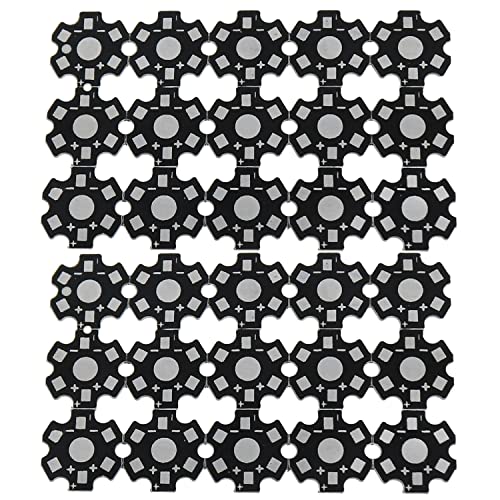
LED Heatsink ZZHXSM 30PCS High Power 1w /3w /5w Light-Emitting Diode Heat Sink with 2 Pins, Aluminum Base Plate 20mm Star DIY Cooling Heatsink, Light-Emitting Diode Heatsink
- High Power LED Chips: Available in 1W, 3W, 5W options
- Long-lasting & Eco-friendly: Durable, low power consumption, environmentally friendly
- Anodized Surface Finish: Easy DIY customization
As an affiliate, we earn on qualifying purchases.
As an affiliate, we earn on qualifying purchases.
Frequently Asked Questions
How Do I Choose the Right LED Driver for My Project?
When choosing the right LED driver, you should consider your project’s current regulation needs and guarantee it matches your LED’s requirements. Check the driver’s current output and make sure it’s compatible with your LEDs to prevent overheating. Additionally, verify dimming compatibility if you want adjustable lighting. This way, you’ll ensure safe operation, ideal performance, and easy integration into your project.
What Safety Precautions Should I Take When Working With LEDS?
Did you know that improper handling can cause electrical safety hazards in over 50% of LED projects? When working with LEDs, always wear insulated gloves and safety glasses to prevent shocks and damage. Handle components carefully to avoid static discharge, and make certain power is off before making connections. Follow handling precautions closely to protect yourself and ensure your project’s safety, preventing overheating and potential electrical failures.
How Can I Troubleshoot Overheating Issues in LED Setups?
To troubleshoot overheating issues in your LED setup, first check your thermal management system—make sure heatsinks are properly attached and airflow is unobstructed. Verify your power supply is delivering correct voltage and current, as overloads can cause overheating. Also, inspect connections for loose wiring or poor contact. Improving thermal management and maintaining power supply safety keeps LEDs cool, prevents damage, and ensures your setup operates efficiently and safely.
Are There Specific Materials That Improve LED Heat Dissipation?
You should consider using heat sink materials like aluminum or copper, which are excellent for heat dissipation. Applying thermal interface materials such as thermal paste or pads between the LED and the heat sink enhances heat transfer. These materials help keep your LED setup cool, preventing overheating and ensuring safe, reliable operation. Always choose high-quality thermal interface materials to maximize efficiency in your cooling system.
How Does Ambient Temperature Affect LED Performance and Longevity?
Ambient temperature directly impacts LED performance and longevity by affecting thermal management. Higher environmental temperatures make it harder for your LED to dissipate heat, increasing the risk of overheating and reducing lifespan. To guarantee ideal performance, you should consider environmental factors and incorporate proper cooling solutions. Keeping the surrounding temperature controlled helps maintain consistent brightness, efficiency, and longevity, ultimately protecting your investment and ensuring safe, reliable operation.

LONELY BINARY 12-Pack 10-Segment LED Bar Graph 6-Color Resistor PCB Case
- 12-Pack Multi-Color LED Bar Graphs: Includes 12 LED displays in 6 colors
- Built-In Resistor PCB Boards: Integrated resistor arrays for easy wiring
- Protective 3D-Printed Cases: Snap-on cases for LED protection and finish
As an affiliate, we earn on qualifying purchases.
As an affiliate, we earn on qualifying purchases.
Conclusion
Now that you’ve uncovered the secrets behind LED power math, you’re on the brink of transforming your lighting projects. But beware—missteps in wattage calculations could lead to overheating and costly failures. Are you prepared to apply these insights and build safely? The key to long-lasting, efficient LEDs lies in your next move. Stay vigilant, double-check your math, and access the full potential of your lighting designs—because the difference between success and setback is just one calculation away.

Thermalright 5 Pack TL-C12C-S CPU Fan 120mm ARGB Case Cooler Fan, 4pin PWM Silent Computer Fan with S-FDB Bearing Included, up to 1550RPM Cooling Fan(5 Quantities)
- High Performance Cooling: PWM control up to 1550RPM for optimal cooling
- Quality S-FDB Bearings: Reduces noise and extends fan lifespan
- ARGB Lighting Effects: 17 customizable lighting modes with motherboard sync
As an affiliate, we earn on qualifying purchases.
As an affiliate, we earn on qualifying purchases.

Proshopping 150A RC Watt Meter, High Precision Power Analyzer, DC 0-60V
- Multi-Function Power Analyzer: Displays Current, Voltage, Watts, and more
- Universal Battery Compatibility: Supports 7V-60V, 0-150A input range
- High Precision Measurements: Accurate to 0.01A, 0.01V, 0.1W, 0.001Ah
As an affiliate, we earn on qualifying purchases.
As an affiliate, we earn on qualifying purchases.