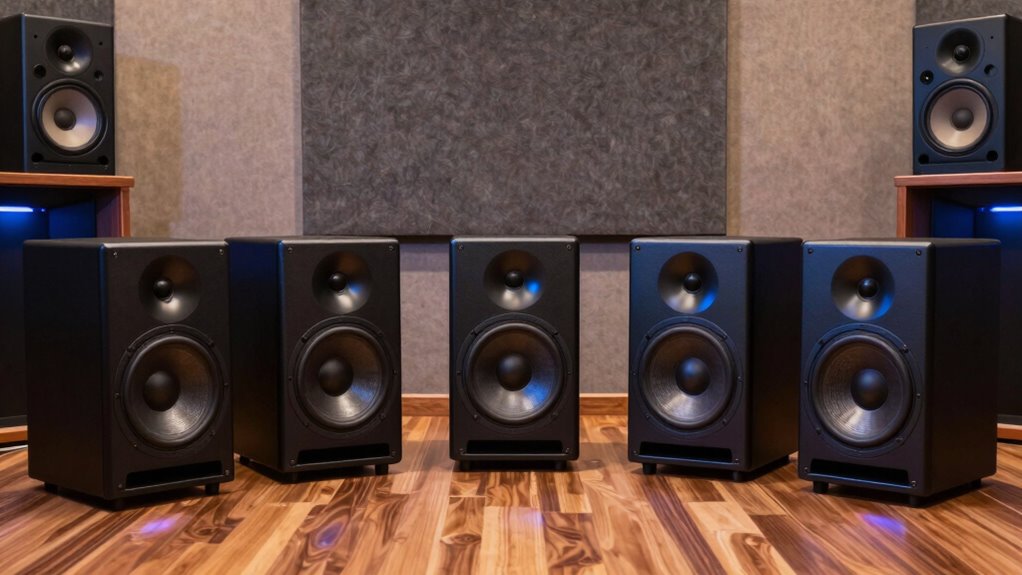
When selecting a subwoofer for studio monitoring, the goal is to achieve accurate, deep bass without muddying the mix. The Macie CR8SBT stands out as the best overall choice for its balanced performance and remote control, while the JBL LSR310S offers excellent clarity for professional settings. Buyers often face tradeoffs between power, size, and fidelity—more bass often means less precision or increased cost. Continue reading for a detailed breakdown of these options and how to choose the right subwoofer for your studio.

Get the latest gadgets delivered free with Prime
- Fast, free delivery on millions of items
- Prime Video, Amazon Music and more included
- Member-only deals all year
Complete the kit



Key Takeaways
- Top picks balance performance, build quality, and price, with the Mackie CR8SBT standing out as the most versatile overall.
- Size and power are critical; larger subwoofers like the JBL LSR310S deliver deeper bass but require more space and power handling.
- Connectivity options such as Bluetooth and remote control add convenience but may introduce slight compromises in audio fidelity at lower price points.
- The tradeoff between size and sound accuracy is a recurring theme; smaller subwoofers save space but may underperform in large or bass-heavy mixes.
- Price often correlates with refinement; premium models like Yamaha HS8 Sub provide cleaner, more precise bass at a higher cost.
| Mackie CR8SBT 8″ Studio Subwoofer for CR Monitors with Bluetooth and Remote |  | Best Overall for Versatile Studio Setups | Speaker Size: 8 inches | Woofer Diameter: 8 inches | Frequency Response: 40 Hz | VIEW ON AMAZON | See Our Full Breakdown |
| JBL Professional LSR310S – Studio Monitor Subwoofer, 10-Inch, Black |  | Best for Deep, Professional-Grade Bass | Driver Size: 10 inches | Frequency Response: Down to 20 Hz | Peak Output: 113 dB | VIEW ON AMAZON | See Our Full Breakdown |
| M-Audio BX3 3.5-inch Wired Studio Monitors Pair |  | Best for Compact Desktop Monitoring | Driver Size: 3.5 inches | Woofer Material: Kevlar | Power Output: 120W | VIEW ON AMAZON | See Our Full Breakdown |
| KRK S10.4 S10 Generation 4 10-inch Powered Studio Subwoofer |  | Best for Loud, Precise Studio Bass | Woofer Size: 10 inches | Bass Extension: 28Hz | Max SPL: 117 dB | VIEW ON AMAZON | See Our Full Breakdown |
| Yamaha HS8 Studio Subwoofer, Black |  | Best for Deep, Balanced Bass in Compact Size | Speaker Type: Subwoofer | Enclosure Material: Stainless Steel | Color: Black | VIEW ON AMAZON | See Our Full Breakdown |
| KRK S8.4 S8 Generation 4 8-Inch Powered Studio Subwoofer |  | Best Overall for Versatile Studio Monitoring | Woofer Size: 8 inches | Frequency Response: 30Hz | Max SPL: 112 dB | VIEW ON AMAZON | See Our Full Breakdown |
| Polk Audio PSW10 10-Inch Subwoofer, 100 Watts |  | Best for Small to Mid-Size Rooms | Size: 10 inches | Power: 100 Watts | Crossover Frequency: 80-160 Hz | VIEW ON AMAZON | See Our Full Breakdown |
| Rockville APM10C 10″ Classic Wood Powered Active Studio Reference Subwoofer |  | Best for Professional Studio Monitoring | Power: 400W peak, 200W RMS | Size: 10 inches | Construction: High-grade MDF wood | VIEW ON AMAZON | See Our Full Breakdown |
| Edifier T5s Powered Subwoofer, 70W RMS, 8-inch Woofer, Deep Bass, Black |  | Best Compact Subwoofer for Space-Saving Design | Power: 70W RMS | Woofer Size: 8 inches | Frequency Response: 35Hz deep bass | VIEW ON AMAZON | See Our Full Breakdown |
| PreSonus Eris Sub 8BT 8-Inch Powered Subwoofer with Bluetooth |  | Best for Wireless Studio Monitoring | Size: 8 inches | Power: 100 watts | Frequency Response: 30 Hz and up | VIEW ON AMAZON | See Our Full Breakdown |
| subwoofer for studio monitoring | Frequency Response | Power |
|---|---|---|
| Mackie CR8SBT 8" Studio Subwoo | 40 Hz | — |
| JBL Professional LSR310S | Down to 20 Hz | — |
| M-Audio BX3 3.5-inch Wired Stu | — | — |
| KRK S10.4 S10 Generation 4 10- | — | — |
| Yamaha HS8 Studio Subwoofer | 22Hz – 150Hz | 150W |
| KRK S8.4 S8 Generation 4 8-Inc | 30Hz | — |
| Polk Audio PSW10 10-Inch Subwo | 40-160 Hz | 100 Watts |
| Rockville APM10C 10" Classic W | — | 400W peak, 200W RMS |
| Edifier T5s Powered Subwoofer | 35Hz deep bass | 70W RMS |
| PreSonus Eris Sub 8BT 8-Inch P | 30 Hz and up | 100 watts |
More Details on Our Top Picks
Mackie CR8SBT 8″ Studio Subwoofer for CR Monitors with Bluetooth and Remote
The Mackie CR8SBT stands out for its combination of powerful bass and flexible connectivity, including Bluetooth, RCA, and TRS, making it ideal for both studio and casual home use. Its remote control and adjustable crossover allow for precise tuning, which is a step above basic subwoofers like the Yamaha HS8 Sub, that lack remote access. However, its lack of waterproofing and complexity in setup can be drawbacks for users seeking a straightforward, portable solution. Compared to the JBL LSR310S, it offers less deep bass response but compensates with more versatile connectivity options, making it a well-rounded choice for those who need convenience alongside performance.
Pros:- Powerful 8-inch subwoofer with clear, deep bass
- Versatile connectivity including Bluetooth, RCA, and TRS
- Remote control and adjustable crossover for custom sound
Cons:- No waterproof rating, unsuitable for outdoor use
- Requires power outlet, not portable
Best for: Studio owners or home hobbyists who want a flexible, easy-to-adjust subwoofer with Bluetooth capabilities.
Not ideal for: Outdoor or mobile users, as it requires power and isn’t waterproof or portable.
- Speaker Size:8 inches
- Woofer Diameter:8 inches
- Frequency Response:40 Hz
- Connectivity:Bluetooth, RCA, TRS
- Control Method:Remote Control
- Color:Black Vinyl Wrap
Our verdict“This subwoofer suits users seeking a versatile and adjustable option for studio or home environments with seamless connectivity.”
JBL Professional LSR310S – Studio Monitor Subwoofer, 10-Inch, Black
The JBL LSR310S excels at delivering deep, tight bass down to 20 Hz, making it a top pick for critical listening and professional mixing. Its 10-inch driver and patented port design produce high SPLs up to 113 dB, outperforming smaller or less specialized subwoofers like the KRK S10.4 in depth and clarity. Its balanced XLR and 1/4″ inputs make it suitable for studio setups, but it may require professional calibration for optimal results, especially in complex environments. Unlike the more consumer-oriented Yamaha HS8 Sub, the JBL is aimed at professionals who value precise bass response and high SPLs.
Pros:- Deep bass response down to 20 Hz
- High peak output of 113 dB
- Professional balanced input/output options
- Enhanced bass with XLF setting for dance/EDM
Cons:- Requires careful setup for best performance
- Designed primarily for studio use, not portable
Best for: Audio engineers or studio professionals needing deep, accurate bass for mixing and mastering.
Not ideal for: Casual users or those with limited space, as it benefits from a dedicated setup and may be overkill for casual listening.
- Driver Size:10 inches
- Frequency Response:Down to 20 Hz
- Peak Output:113 dB
- Inputs:Balanced XLR and 1/4″
- Outputs:XLR
- Sensitivity Switch:-10dBV / +4 dBu
Our verdict“This subwoofer makes the most sense for professionals who need precise, impactful bass in a studio environment.”
M-Audio BX3 3.5-inch Wired Studio Monitors Pair
The M-Audio BX3 offers a highly compact form factor, making it ideal for desktop setups where space is limited. Its 3.5-inch Kevlar woofers deliver surprisingly full bass for such a small driver, though it naturally can’t match the depth or volume of larger subwoofers like the KRK S10.4. The inclusion of multiple inputs (1/4-inch, 1/8-inch, RCA) makes it adaptable for various devices, but it lacks wireless connectivity and might require careful placement to achieve balanced sound. Compared with larger monitors, its size limits its suitability for bigger or more demanding environments, but it excels in small, controlled spaces.
Pros:- High-quality sound with deep bass and clear highs
- Multiple input options for versatile connectivity
- Compact, attractive design perfect for desktops
- Includes accessories and software for immediate use
Cons:- Limited driver size restricts deep bass
- No wireless or portable options
Best for: Desktop music producers, streamers, or gamers seeking high-quality sound in tight spaces.
Not ideal for: Large-room or professional studio environments where bigger drivers and deeper bass are required.
- Driver Size:3.5 inches
- Woofer Material:Kevlar
- Power Output:120W
- Inputs:1/4-inch, 1/8-inch, RCA
- Included Accessories:Passive speaker, active speaker, foam feet, interconnect cables, MPC Beats software
Our verdict“This monitor set is perfect for users needing high-quality sound in small, desktop environments without the bulk of larger speakers.”
KRK S10.4 S10 Generation 4 10-inch Powered Studio Subwoofer
The KRK S10.4 offers a robust 10-inch driver with a bass extension down to 28Hz, making it suitable for demanding studio environments where loud, clear bass is essential. Its 160-watt Class D amplifier provides ample power, and the front-firing bass port allows flexible placement, even in smaller spaces. While it lacks included footswitch control or built-in crossover adjustments, its high SPL of 117 dB makes it a solid choice for mixing engineers who need loud, precise low-end. When compared to the Yamaha HS8 Sub, which has a broader frequency response, the KRK focuses more on loudness and punch, which benefits certain mixing scenarios but might sacrifice some of the deepest bass extension.
Pros:- Powerful 160W Class D amp
- Front-firing port for flexible placement
- High SPL for loud, clear sound
- Bass extension down to 28Hz
Cons:- Footswitch not included for on/off control
- Requires external crossover adjustments for optimal use
Best for: Mixing engineers and producers who prioritize loud, punchy bass with flexible placement options.
Not ideal for: Users needing a compact or budget-friendly subwoofer, or those seeking extensive tone shaping controls.
- Woofer Size:10 inches
- Bass Extension:28Hz
- Max SPL:117 dB
- Amplification:Class D
Our verdict“This subwoofer is best suited for professionals needing loud, impactful bass with flexible placement options.”
Yamaha HS8 Studio Subwoofer, Black
The Yamaha HS8 Subwoofer delivers a balanced, deep bass response with an 8-inch driver, extending down to 22Hz, making it a reliable partner for studio and home setups. Its 150W amplifier provides ample power, and the adjustable low and high cut controls give precise tuning, useful for matching with the KRK S10.4 or other monitors. Its sturdy stainless steel enclosure ensures durability, but it only supports wired connections, lacking wireless options or waterproofing. Unlike larger subs, it may not reach the deepest bass for certain genres, but it offers a compact solution with professional-grade performance.
Pros:- Powerful 150W amplifier with deep bass
- Adjustable low and high cut controls
- Compact 8-inch design suitable for various setups
- Sturdy stainless steel enclosure
Cons:- Limited to wired connectivity
- No waterproofing or wireless options
- Frequency response may not cover very deep bass for some applications
Best for: Home studio owners or multimedia creators needing a compact subwoofer with balanced, deep bass.
Not ideal for: Outdoor or portable setups, since it requires a power outlet and isn’t water-resistant.
- Speaker Type:Subwoofer
- Enclosure Material:Stainless Steel
- Color:Black
- Subwoofer Diameter:8 inches
- Frequency Response:22Hz – 150Hz
- Power:150W
Our verdict“This subwoofer offers a compact, balanced low-end solution for studio and home use without the need for large, unwieldy gear.”
KRK S8.4 S8 Generation 4 8-Inch Powered Studio Subwoofer
The KRK S8.4 S8 Generation 4 stands out for its robust bass extension down to 30Hz, making it a strong all-around choice for both mixing and mastering. Its front-firing bass port offers flexible placement options, especially useful in tight studio spaces. When compared to the PreSonus Eris Sub 8BT, it provides a slightly higher SPL and more traditional wired connectivity, though it lacks wireless features. This model’s lightweight yet powerful Class D amp ensures reliable performance without adding bulk. The main tradeoff is that the footswitch control isn’t included in the box, and the sleek design might not match all studio aesthetics. Overall, this subwoofer is ideal for creatives who need a capable, adaptable monitoring solution that balances power and placement flexibility.
Pros:- Deep bass extension down to 30Hz for accurate monitoring
- Front-firing port for easy placement in tight spaces
- Lightweight with a powerful Class D amplifier for portability
Cons:- Footswitch control not included, requiring extra purchase
- Lack of explicit connectivity options in product description
Best for: Producers and engineers who require a versatile, high-performance subwoofer adaptable to various studio setups
Not ideal for: Small home studios with limited space or users seeking wireless connectivity exclusively
- Woofer Size:8 inches
- Frequency Response:30Hz
- Max SPL:112 dB
- Amplification:Class D
Our verdict“This subwoofer suits studio professionals seeking a balanced, flexible monitor upgrade.”
Polk Audio PSW10 10-Inch Subwoofer, 100 Watts
The Polk Audio PSW10 offers a compact 10-inch design that delivers rich, deep bass, making it suitable for smaller studio environments or multimedia use. Its 100-watt amplifier powers the driver effectively, providing clear low-end that complements mid-range monitors. When set against the Rockville APM10C, it’s more streamlined and easier to integrate into consumer setups, but it lacks the professional-grade connectivity options. The crossover adjustment allows tailoring sound to specific room acoustics, though its limited size means it might struggle in large, open spaces. This makes it a good choice for hobbyists or those with space constraints who want reliable bass without complexity.
Pros:- Deep, rich bass suited for small to mid-size rooms
- Easy integration with existing audio setups
- Adjustable crossover for personalized sound
Cons:- Limited to small-to-mid size room coverage
- Requires connection to an external receiver for operation
Best for: Home studio owners or musicians needing a straightforward, space-efficient subwoofer
Not ideal for: Large recording studios or professionals requiring very high SPLs and extensive connectivity
- Size:10 inches
- Power:100 Watts
- Crossover Frequency:80-160 Hz
- Frequency Response:40-160 Hz
Our verdict“This subwoofer is a practical choice for smaller studios prioritizing simplicity and effective bass.”
Rockville APM10C 10″ Classic Wood Powered Active Studio Reference Subwoofer
The Rockville APM10C is designed with studio precision in mind, boasting a substantial 400W peak power and 200W RMS, ensuring accurate, minimal-distortion bass crucial for professional mixing. Its high-grade MDF wood enclosure enhances sound quality and durability, giving a more natural sound profile compared to plastic or composite builds. Its connectivity options—RCA, XLR, and ¼” TRS—cater to various studio gear, making it highly versatile. Compared to the Edifier T5s, it offers more power and a more sophisticated build, but it is bulkier and might not fit smaller spaces. This choice is best for those who prioritize professional-level sound and durability at the expense of size.
Pros:- Powerful 400W peak for demanding studio sessions
- High-quality MDF construction for durability and sound fidelity
- Versatile inputs suitable for professional setups
Cons:- Bulkier size may be unsuitable for tight spaces
- Requires proper setup for optimal performance
Best for: Audio engineers and producers needing a high-power, durable subwoofer for critical monitoring
Not ideal for: Small home studios or users with limited space looking for compact equipment
- Power:400W peak, 200W RMS
- Size:10 inches
- Construction:High-grade MDF wood
- Crossover frequency:50Hz-150Hz
- Inputs/Outputs:RCA, XLR, ¼” TRS
Our verdict“This subwoofer is ideally suited for professionals demanding high power and durability in monitoring.”
Edifier T5s Powered Subwoofer, 70W RMS, 8-inch Woofer, Deep Bass, Black
The Edifier T5s combines a compact footprint with impressive bass performance, thanks to its 8-inch long-throw woofer and 70W RMS power. Its deep bass down to 35Hz makes it suitable for small rooms or desktop setups where space is limited. The adjustable low-pass filter and phase control allow precise tuning, but the setup requires some familiarity with series connections for optimal performance. Compared to larger subwoofers like the KRK S8.4, it sacrifices some power for portability and aesthetics. Its energy-efficient auto-standby mode adds convenience. This pick is ideal for users who value space and sleek design but don’t need extreme SPLs.
Pros:- Deep bass response down to 35Hz in a compact form
- Adjustable filters for tailored sound
- Energy-efficient auto-standby mode
Cons:- Requires setup knowledge for series connection
- Limited to indoor use and not waterproof
Best for: Home users or desktop producers seeking a space-efficient subwoofer with good bass extension
Not ideal for: Large studios or demanding audio environments where maximum SPL is necessary
- Power:70W RMS
- Woofer Size:8 inches
- Frequency Response:35Hz deep bass
- Dimensions:15.71″D x 6.69″W x 16.14″H
Our verdict“A smart choice for space-conscious users who want deep bass without sacrificing style or size.”
PreSonus Eris Sub 8BT 8-Inch Powered Subwoofer with Bluetooth
The PreSonus Eris Sub 8BT introduces wireless convenience to studio monitoring with Bluetooth 5.0, making it especially appealing for modern setups. Its 8-inch driver and 100W power output deliver accurate, deep bass down to 30Hz, comparable to the KRK S8.4 but with added wireless flexibility. The multiple input options, including RCA and ¼” TRS, ensure seamless integration with existing gear, while the adjustable crossover and tuning controls allow precise tailoring of sound. The main tradeoff is its smaller size, which may limit the maximum SPL in larger spaces, and some setup knowledge is needed to optimize performance. It’s a promising choice for those prioritizing convenience and connectivity in their monitoring system.
Pros:- Wireless Bluetooth 5.0 connectivity for hassle-free pairing
- Multiple input options for flexible setup
- Adjustable crossover and tuning controls for precision
Cons:- Limited to 8-inch size, less suitable for large rooms
- Power output may not meet the demands of very loud environments
Best for: Home producers and multimedia creators seeking a wireless, easy-to-integrate subwoofer
Not ideal for: Large professional studios or users who need extremely high SPLs for loud environments
- Size:8 inches
- Power:100 watts
- Frequency Response:30 Hz and up
- Connectivity:Bluetooth 5.0, RCA, ¼” TRS, aux
Our verdict“A solid, modern option for wireless monitoring with customizable sound tailored for smaller spaces.”

How We Picked
This roundup evaluates subwoofers based on several key criteria: sound quality, build durability, connectivity options, power handling, and size. Priority was given to models that deliver accurate, tight bass essential for studio work, while also considering ease of use and value. We compared features across different price points to identify which models offer the best balance of performance and practicality. Rankings reflect overall versatility and how well each option meets the demands of professional and home studio environments.Factors to Consider When Choosing Subwoofer For Studio Monitoring
Choosing the right subwoofer for studio monitoring involves several considerations beyond just wattage or size. Understanding your room size, intended use, and existing monitor setup can help narrow your options. It’s also important to consider how the subwoofer integrates with your current speakers and whether you need features like remote control or Bluetooth connectivity. Avoiding common pitfalls, such as overestimating power needs or selecting a subwoofer that is too large or too small, ensures a better fit for your space and workflow.Room Size and Space Constraints
The size of your studio space significantly influences your choice. Larger rooms benefit from bigger subwoofers with higher power handling, like the JBL LSR310S, which can fill the space with deep bass without distortion. Smaller rooms or nearfield setups, however, often require less powerful, more compact options to prevent overwhelming the space and creating muddiness. Measure your room and consider placement options to avoid bass buildup or cancellation issues.Sound Accuracy and Response
For studio work, precision in bass reproduction is paramount. Look for subwoofers with flat frequency response and minimal resonance. Cheaper models might boost certain bass frequencies, leading to inaccuracies in mixes. High-quality options like the Yamaha HS8 Sub focus on delivering tight, controlled bass that complements your monitors without coloring the sound, helping you achieve more reliable mixes.Connectivity and Integration
Ensure the subwoofer offers compatible inputs for your setup, whether RCA, XLR, or TRS. Features like Bluetooth or remote control can add convenience, especially in complex setups or for quick adjustments, but may sometimes compromise sound fidelity. Consider whether you need wireless control or multiple input options to keep your workflow smooth and clutter-free.Power Handling and Headroom
A subwoofer’s power rating indicates how much it can handle without distortion. Overestimating this can lead to unnecessary expense, while underestimating may cause distortion or damage at high volumes. Match the subwoofer’s power capacity with your monitor system and room size to ensure clean, distortion-free bass at all listening levels.Budget and Long-term Value
While lower-priced models can be tempting, investing in a higher-quality subwoofer often pays off in better sound accuracy and durability. Consider your long-term needs—if you plan to upgrade your studio or expand your setup, choosing a slightly more capable model now can save money later. Balance your budget with the features that matter most for your specific environment.Frequently Asked Questions
Will a subwoofer improve my studio monitoring for vocal recordings?
A good subwoofer can enhance your monitoring by providing more accurate bass representation, which is especially useful for vocal recordings with deep low-end content. However, it’s essential that the subwoofer integrates seamlessly with your monitors to avoid muddying the overall sound. Proper setup and calibration are key to ensuring the subwoofer improves your mix accuracy without overshadowing mids and highs.Is a larger subwoofer always better for studio use?
Not necessarily. While larger subwoofers like the JBL LSR310S can produce deeper bass and higher volume levels, they also require more space and power. For smaller rooms or nearfield monitoring, a smaller subwoofer like the KRK S8.4 may provide more controlled, accurate bass without overwhelming the space. The best choice depends on your room size and specific monitoring needs.Can I use a home theater subwoofer for studio monitoring?
While some home theater subwoofers can work in a pinch, they are typically designed for different acoustic environments and may lack the flat frequency response needed for accurate studio work. Studio subwoofers prioritize transparency and precise bass response, so investing in a dedicated studio model ensures more reliable results. Using a home theater sub may compromise mix accuracy.How important is Bluetooth connectivity on a studio subwoofer?
Bluetooth can be convenient for quick adjustments or casual listening, but it generally introduces slight compromises in audio fidelity, which is critical in a studio setting. For professional use, wired connections like XLR or RCA are preferred for their stability and clarity. If you value seamless control and minimal latency, prioritize models with remote or app-based controls over Bluetooth.Should I prioritize power or size when choosing a subwoofer for my studio?
The decision depends on your space and sound needs. Larger, more powerful subwoofers deliver deeper, more impactful bass, suitable for bigger rooms or bass-heavy genres. However, they can be cumbersome and may require more careful placement. Smaller subwoofers are more manageable and better suited for nearfield setups, but might not provide the same depth or volume, especially in larger spaces.Conclusion
For most home or project studios, the Macie CR8SBT offers a balanced combination of performance and features, making it the best overall choice. Budget-conscious buyers will appreciate the Polk Audio PSW10 for its value, while professionals seeking the clearest, most accurate bass should consider the Yamaha HS8 Sub. Beginners or those with limited space benefit from compact options like the KRK S8.4. Ultimately, your choice should align with your room size, budget, and the level of precision you require for studio work.