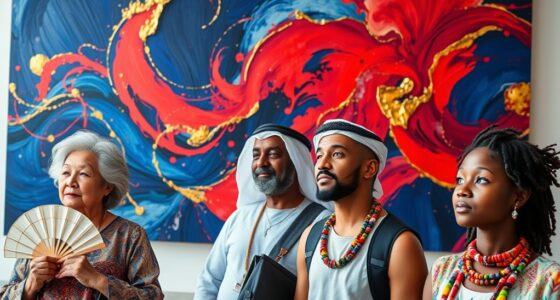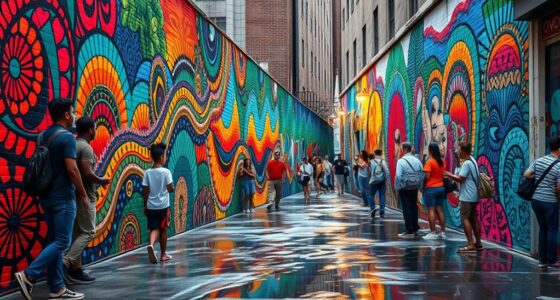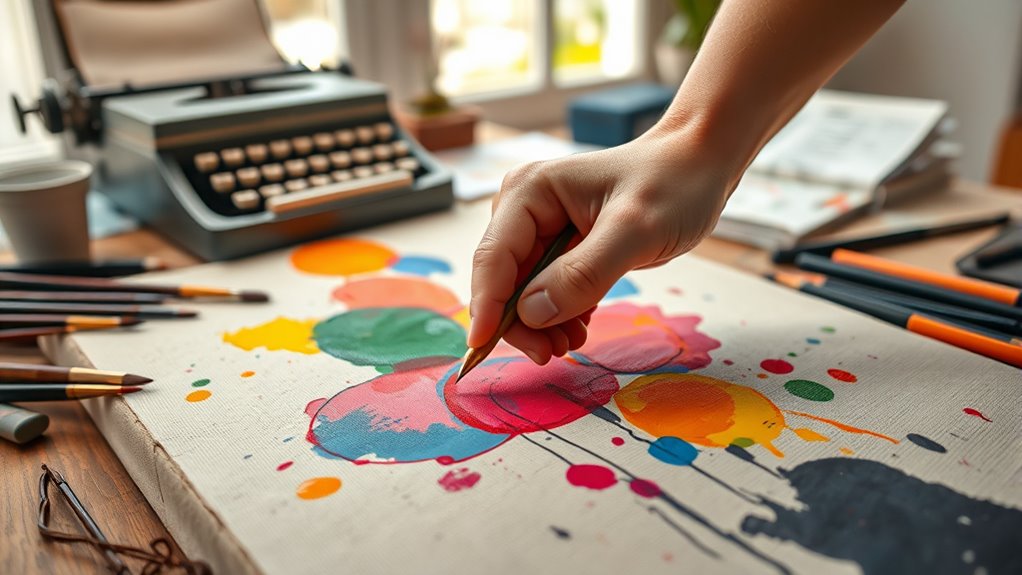

You’ll see that art acts like a visual language, using symbols, colors, and forms to communicate ideas and feelings that words sometimes can’t fully express. It bridges cultural gaps and taps into shared human experiences, creating emotional dialogues without spoken language. Artists experiment with metaphors and abstract symbols to convey complex concepts, often reaching subconscious levels. Continuing this exploration will reveal how art and language work together to deepen our understanding of human identity and expression.
Key Takeaways
- Art functions as a visual language, using symbols and imagery to communicate messages beyond verbal words.
- Visual cues in art evoke emotions and ideas, creating an interpretive dialogue with viewers.
- Artists employ symbols, metaphors, and abstract forms to express complex concepts that language may struggle to capture.
- Art complements spoken and written language by expressing human experiences and cultural identities visually.
- Technical mastery in art enhances its ability to serve as an effective, expressive form of communication.

Art and language are deeply interconnected forms of human expression that influence and shape each other. When you look at a painting or sculpture, you’re not just observing colors and shapes—you’re interpreting a visual communication that conveys meaning, emotion, or ideas. Art uses visual elements as a language of its own, relying on expressive symbolism to communicate messages that words alone might struggle to express. In this way, art becomes a universal language, breaking down linguistic barriers and allowing you to connect with others across cultures and backgrounds. The symbols embedded in a work of art often carry layered meanings, inviting you to decode what the artist intends to express, much like reading a complex sentence. These symbols serve as a visual vocabulary that enriches your understanding and emotional response. Moreover, the use of color accuracy in visual art enhances the authenticity and emotional impact of a piece, demonstrating how technical elements contribute to effective communication.
As you engage with art, you realize that it’s not just about aesthetics but about conveying concepts in a way that transcends language. For example, a red rose in a painting might symbolize love or passion, while a dark, turbulent sky could evoke feelings of chaos or despair. These visual cues function as a form of expressive symbolism that taps into shared human experiences and emotions. You might find yourself drawn to certain images or motifs because they resonate with your personal feelings or memories. This emotional dialogue between viewer and artwork demonstrates how visual communication and symbolic language work in tandem to create a powerful, immediate connection. Unlike spoken or written language, which relies on syntax and vocabulary, art communicates through visual cues that can be instantly understood or felt on a visceral level.
Furthermore, art can challenge or expand your understanding of language itself. Artists often experiment with symbols, abstract forms, and visual metaphors to express complex ideas that are difficult to articulate verbally. When you interpret these works, you’re engaging in a dialogue that blurs the boundaries between language and visual expression. This process highlights how both art and language serve as tools for exploring human identity, culture, and emotion. You might notice that some artworks seem to speak directly to your subconscious, bypassing rational language and tapping into a deeper level of understanding. Through this interaction, you realize that visual communication in art isn’t just an alternative to language but a crucial, complementary form of human expression—one that often communicates what words cannot fully capture.
Frequently Asked Questions
How Does Non-Verbal Art Communicate Complex Ideas Effectively?
Non-verbal art communicates complex ideas effectively through visual metaphors and abstract representations. You can interpret symbols and forms that evoke emotions or concepts beyond words, making the message universally understood. By using these techniques, you engage viewers’ imagination, allowing them to explore multiple layers of meaning. This active interaction helps convey nuanced ideas succinctly, making art a powerful language that transcends linguistic barriers and invites personal reflection.
Can Language Limitations Hinder Artistic Expression?
Yes, language limitations can hinder artistic expression because linguistic barriers may restrict how artists convey complex ideas. When words fall short, visual ambiguity becomes essential, allowing viewers to interpret artwork beyond literal meaning. You might find that relying solely on language narrows understanding, but embracing visual ambiguity in your art helps communicate nuanced concepts, overcoming language gaps and enriching your audience’s experience.
What Role Does Symbolism Play in Bridging Art and Language?
Symbolism acts as a superpower, transforming simple images into vast worlds of meaning. You see, visual metaphors and cultural symbolism become bridges, connecting raw art with language’s limits. They allow you to communicate complex ideas instantly, making the unseen seen and the unspoken understood. Without symbolism, art risks becoming silent, but with it, your creations speak in a language that transcends words, uniting viewers through shared cultural symbols and vivid visual metaphors.
How Have Digital Media Transformed Art-Language Interactions?
Digital media transform your art-language interactions by making them more dynamic and immersive. You can engage in interactive storytelling, where visuals and narrative blend seamlessly, enhancing emotional impact. Visual symbolism becomes more vivid through multimedia elements, allowing you to interpret and connect with art on a deeper level. This technology empowers you to explore new ways of expressing ideas, breaking traditional boundaries between art and language, and creating richer, more personalized experiences.
Are There Cultural Differences in Interpreting Artistic Language?
You’ll notice cultural differences markedly influence how you interpret artistic language. Cultural nuances shape your interpretive frameworks, making meanings vary across societies. What resonates deeply in one culture might seem obscure or different in another. As you engage with diverse artworks, you adapt your understanding based on these nuances, allowing for richer, more varied interpretations that reflect the unique cultural contexts from which the art originates.
Conclusion
You might think art and language are worlds apart, but they actually feed into each other beautifully. Art uses visual language to communicate emotions, while language gives voice to artistic ideas. Some say words can’t capture the full essence of art, but that’s not true—you just need to look at how images and words blend to tell powerful stories. Embracing both helps you see the deeper connections and enriches your understanding of human expression.