
Deconstructing Cubism reveals how it started in early 20th-century Paris, challenging traditional art with geometric forms and multiple perspectives. You’ll see how artists like Picasso and Braque broke objects into facets, emphasizing structure over realism. This approach influenced art worldwide, inspiring movements in sculpture, architecture, and beyond. Its emphasis on fragmented viewpoints continues to reshape how we perceive art and reality, and exploring further will uncover its lasting global impact.
Key Takeaways
- Cubism originated in early 20th-century France, pioneered by Picasso and Braque, emphasizing geometric fragmentation.
- It challenged traditional perspective, depicting multiple viewpoints simultaneously to redefine visual perception.
- Cubism’s techniques influenced diverse art forms, including sculpture, architecture, and collage, expanding its global impact.
- The movement inspired later avant-garde styles like Futurism and Constructivism, shaping modernist art worldwide.
- Its emphasis on deconstructing reality fostered new ways of visual interpretation across cultures and artistic disciplines.
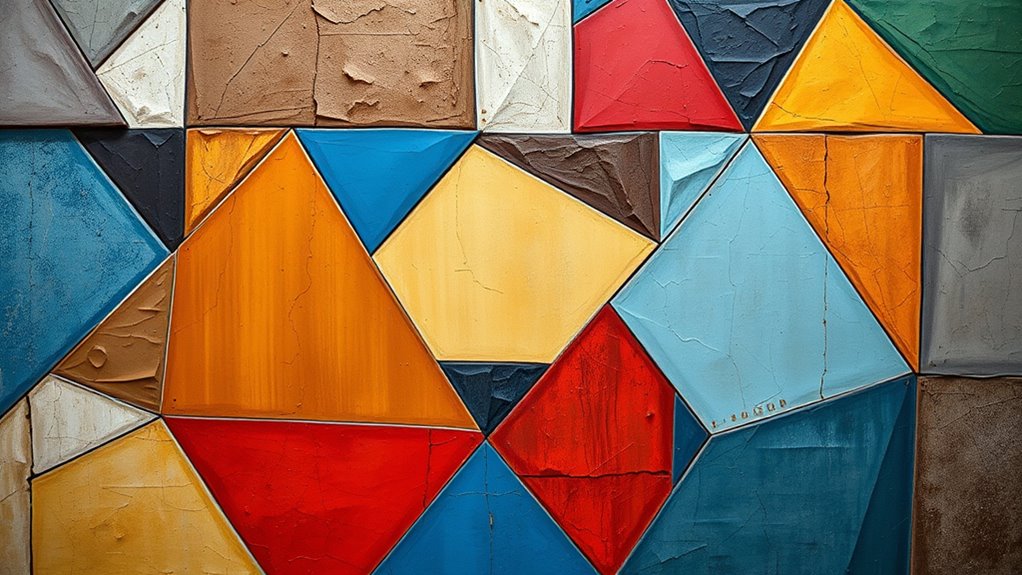
Have you ever wondered how Cubism challenged traditional perspectives in art? It’s a revolutionary movement that redefined how you see the world by breaking down objects into geometric forms. At its core, Cubism uses analytical techniques to dissect subjects from multiple angles simultaneously. Instead of viewing a scene from a single perspective, you’re presented with a collage of viewpoints, forcing you to piece together the fragmented images. This approach isn’t just about creating abstract art; it’s about capturing the complexity of reality in a new way. The process involves artistic fragmentation, where the familiar contours of objects are broken apart into geometric shapes, overlapping and intersecting in a way that challenges your perception. This fragmentation compels you to actively interpret the artwork, engaging your mind in reconstructing the scene from disjointed fragments. Through these analytical techniques, Cubist artists like Picasso and Braque move away from realistic depictions, emphasizing form and structure over traditional perspective. They use muted color palettes and sharp angles to focus your attention on the underlying geometric principles rather than superficial details. This method allows you to see objects not as whole entities but as a combination of facets, each revealing a different aspect of the subject. Cubism’s artistic fragmentation also highlights the fluidity of perception—how your view of reality constantly shifts depending on your angle and context. The movement’s influence extends beyond painting; it impacts sculpture, architecture, and even literature, encouraging artists worldwide to experiment with form and perspective. The analytical techniques employed help you appreciate the complex thought process behind each piece, where every fragment serves a purpose in constructing a new visual language. By deconstructing traditional techniques of representation, Cubism invites you to question how you perceive reality itself. Its roots in early 20th-century innovation reflect a desire to portray modern life’s dynamism and multiplicity. As Cubism spread across Europe and beyond, you notice how its principles inspire countless artists and movements that challenge conventional art norms. Understanding the artistic fragmentation involved can deepen your appreciation of how perception influences art. Today, the legacy of Cubism’s analytical techniques and artistic fragmentation continues to influence contemporary art, urging you to see beyond the surface and explore multiple facets of any subject. This movement’s bold approach transforms your understanding of visual representation, making you realize that reality can be viewed from many angles—sometimes all at once—forever changing how you experience art.
Frequently Asked Questions
How Did Cubism Influence Contemporary Digital Art Techniques?
Cubism influences your digital art through digital fragmentation, breaking images into geometric shapes that resemble cubist styles. You use geometric layering to create depth and complexity, mirroring how cubists reassembled perspectives. This approach encourages innovative compositions, blending traditional cubist ideas with modern technology. As a result, contemporary digital artists explore new visual languages, pushing boundaries by integrating cubist principles into interactive and multimedia artworks.
What Are the Key Differences Between Cubism and Other Modernist Movements?
You’ll notice that cubism differs from other modernist movements through its focus on fragmentation and abstraction, breaking objects into geometric perspectives. Unlike expressionism or surrealism, which emphasize emotion or dream imagery, cubism emphasizes multiple viewpoints simultaneously. Its use of geometric perspectives creates a fractured, layered look, challenging traditional representation, whereas other movements often pursue more emotional or symbolic expression.
Who Were the Lesser-Known Artists Contributing to Cubism’s Development?
You might not know all the lesser-known artists who contributed to Cubism’s development, such as Juan Gris, Albert Gleizes, and Jean Metzinger. They explored abstract sculptures and employed experimental techniques, pushing the movement’s boundaries. These artists worked alongside Picasso and Braque, adding unique perspectives and innovations that helped shape Cubism’s evolution. Their contributions often remain overshadowed but were vital to the movement’s rich, diverse growth.
How Has Cubism Been Interpreted Across Different Cultures Globally?
Cubism acts like a mirror reflecting diverse cultural adaptations and regional expressions worldwide. You see it interpreted through unique lenses—African masks influencing Cubist forms, Latin American vibrant colors, or Asian philosophies shaping abstract geometries. These variations show how artists adapt core ideas, blending local traditions with Cubist principles. As a result, Cubism becomes a global dialogue, echoing different cultural voices and enriching its visual language across borders.
Are There Modern Artists Directly Inspired by Cubism’s Principles Today?
Yes, many modern artists draw directly from cubism’s principles today. You’ll see digital reinterpretations and contemporary adaptations that break objects into geometric shapes and multiple perspectives. These artists use technology to explore cubist ideas in new ways, blending traditional techniques with digital media. By doing so, they keep cubism alive, pushing its boundaries and inspiring fresh, innovative artwork that resonates with today’s visual culture.
Conclusion
You now see how Cubism’s mesmerizing chaos challenged conventions and changed canvases worldwide. Its fragmented forms, fearless fantasies, and fearless futures forge a fascinating fusion of art and innovation. By breaking boundaries and blending perspectives, Cubism continues to carve its mark on the global gallery. Embrace this bold brilliance, and let its revolutionary rhythm resonate within your own creative reflections. Remember, in art’s adventure, it’s the daring deconstruction that delivers the deepest delight.