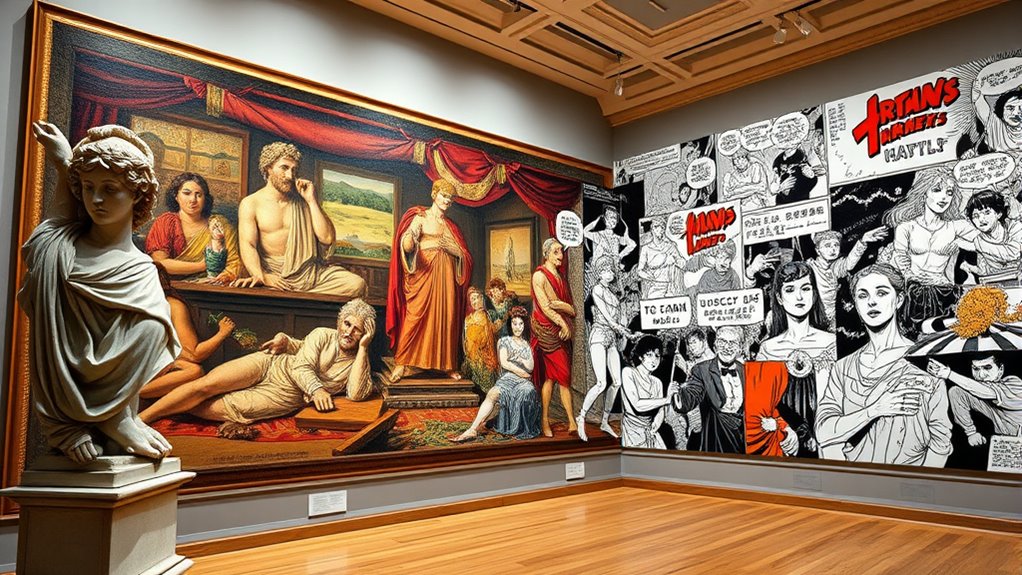

The evolution of perspective shows how artists have mastered creating depth and realism, starting with Renaissance masters like da Vinci using linear perspective to turn flat surfaces into three-dimensional spaces. As styles shifted, manga artists like to exaggerate perspectives with dynamic angles and stylized backgrounds to heighten emotion and drama. Today, digital media and virtual reality expand these techniques, blending realism with imagination. If you keep exploring, you’ll uncover how perception continues to shape visual storytelling across eras and cultures.
Key Takeaways
- Renaissance artists like da Vinci developed linear perspective, creating realistic depth on flat surfaces.
- These techniques transformed art perception, establishing a foundation for realistic spatial representation.
- Modern media, including manga and anime, manipulate perspective with exaggerated angles and stylized backgrounds.
- Artistic styles adapt spatial cues—such as shading and foreshortening—to convey emotion and action.
- The evolution reflects a continuous blending of scientific understanding and cultural influences on visual perception.
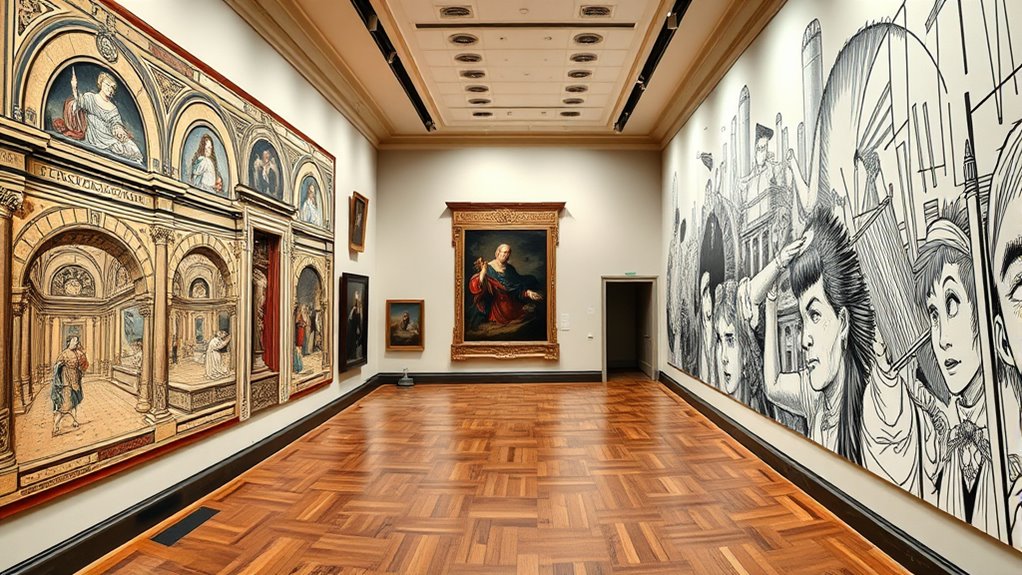
Throughout history, our perspective has constantly evolved, shaped by new experiences, knowledge,, and cultural shifts. As you examine the development of visual perception, you notice how artists and thinkers have continually refined their understanding of spatial depth to create more realistic and immersive images. During the Renaissance, a pivotal moment in art history, artists like Leonardo da Vinci and Michelangelo pioneered techniques such as linear perspective, which transformed flat surfaces into convincing representations of three-dimensional space. They discovered how to manipulate converging lines and vanishing points to evoke a sense of depth, making viewers feel as if they could step into the scene. This breakthrough fundamentally changed how people perceived the visual world, making artworks more engaging and lifelike.
Artists like Leonardo da Vinci revolutionized visual perception with linear perspective, transforming flat surfaces into immersive three-dimensional worlds.
Your gaze shifts from these classical innovations to modern interpretations, where the concept of spatial depth extends beyond traditional realism. In contemporary art and digital media, you’re often exposed to layered images and complex visual arrangements that challenge your perception of space. This evolution reflects a deeper understanding of how our visual perception works—how your brain interprets cues like shading, perspective, and relative size to decipher spatial relationships. Artists and designers now harness this knowledge to craft visuals that play with depth and dimension, drawing you into worlds that feel both familiar and surreal. These techniques influence everything from video games to virtual reality, where creating convincing spatial depth is vital to immersion. Your experience of space becomes more nuanced, as your brain learns to interpret multiple cues that add richness and complexity to visual perception.
Looking at manga and anime, you see a distinct approach to perspective and spatial depth. Unlike the realistic realism of Renaissance art, manga often employs exaggerated angles, dynamic foreshortening, and stylized backgrounds that emphasize emotion and action. Here, the focus isn’t solely on replicating reality but on conveying energy and mood through visual cues. Your eyes are drawn to how manga artists manipulate spatial depth to heighten drama—characters leap out of the page, and backgrounds stretch or flatten to enhance storytelling. This shift demonstrates how perspective can be a flexible tool, shaped by cultural preferences and narrative goals. It shows that your perception of space isn’t fixed but adaptable, influenced by artistic intent and cultural context.
As you reflect on this evolution, you realize that the core of visual perception has always been about making sense of spatial depth. Whether through realistic techniques during the Renaissance or stylized expressions in manga, your mind continuously adapts to interpret and engage with visual cues. This ongoing evolution reveals that perspective is not just a matter of visual trickery but a dynamic relationship between your senses and cultural expressions—one that keeps transforming as your experiences and technologies advance. Additionally, modern research into visual perception mechanisms helps explain how your brain processes complex spatial information, further illustrating the relationship between science and art.
Frequently Asked Questions
How Did Perspective Influence Architectural Design During the Renaissance?
During the Renaissance, you see perspective revolutionize architectural design by emphasizing architectural realism and visual depth. You notice that architects began using linear perspective to create buildings that appear more three-dimensional and lifelike. This shift allows you to better understand spatial relationships and proportions, leading to more harmonious and realistic structures. As a result, architectural innovation flourished, and designs became more immersive, reflecting a deeper appreciation for how humans perceive space.
What Role Did Perspective Play in Early Comic Book Art?
You see that perspective in early comic book art, especially through foreshortening techniques, which create depth and drama. It shapes panel composition, guiding your eye and emphasizing action or emotion. By mastering these tools, artists make characters and scenes appear more dynamic and realistic. This use of perspective transforms simple drawings into immersive storytelling, engaging you more deeply in the narrative and heightening the visual impact of each panel.
How Do Digital Tools Affect Perspective Drawing Today?
Digital tools like virtual reality and augmented reality revolutionize your perspective drawing by offering immersive experiences and real-time adjustments. You can explore complex angles and spatial relationships effortlessly, enhancing depth and realism. These technologies allow you to simulate environments and view your artwork from multiple viewpoints instantly. Consequently, your understanding of perspective deepens, enabling you to create more dynamic and accurate compositions that push traditional boundaries.
Are There Cultural Differences in Perspective Styles Across Art History?
You’ll notice that cultural interpretation shapes perspective styles profoundly, leading to stylistic divergence across art history. In Western art, linear perspective emphasizes depth and realism, while Asian traditions often favor flatness and symbolic representation. These differences aren’t just stylistic choices—they reflect distinct worldviews and artistic philosophies. Recognizing this, you see how cultural context influences perspective, making each style uniquely expressive and rooted in its cultural narrative.
How Is Perspective Taught in Modern Art Education?
In modern art education, you learn perspective through hands-on practice with compositional techniques like one-point and two-point perspective. Your instructors emphasize developing visual literacy by analyzing how perspective guides viewers’ focus and emotional response. You’re encouraged to experiment with different methods, understanding how perspective changes the meaning of your work, blending traditional principles with contemporary approaches to create depth and engagement.
Conclusion
As you look back from the detailed realism of the Renaissance to the dynamic exaggeration of manga, you realize perspective isn’t just about visuals—it’s about worldview. While the Renaissance seeks to mirror reality, manga stretches it into imagination. Both reflect how you see and interpret the world around you, proving that perspective evolves with society’s hopes, fears, and dreams. Ultimately, your perception is a canvas continuously reshaped, blending history’s precision with fantasy’s freedom.