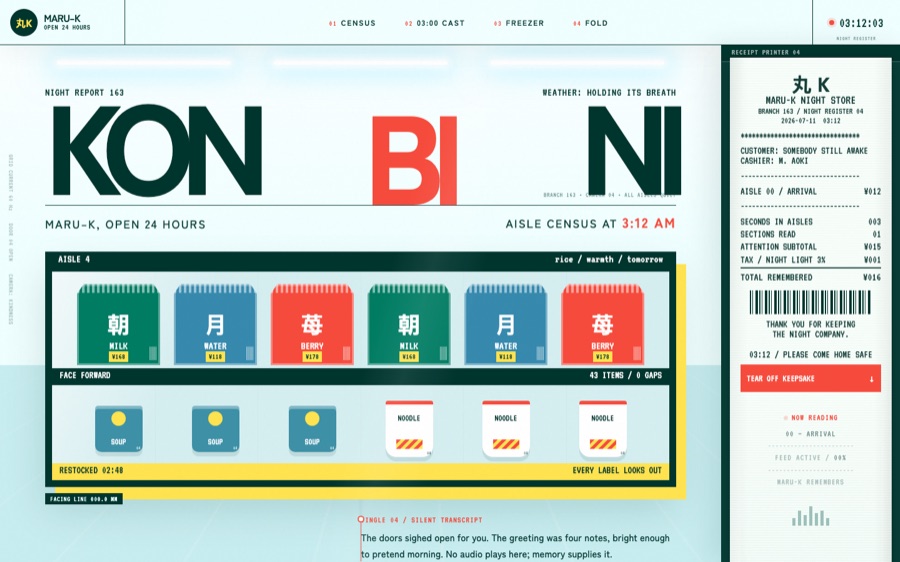
Most interfaces treat a receipt as proof that something happened. MARU-K treats it as a way to remember what happened—and, more unusually, what was skipped. In this after-hours corner of the store, an aisle census becomes the starting point for a design that turns small observations into a persistent record.

Get the latest gadgets delivered free with Prime
- Fast, free delivery on millions of items
- Prime Video, Amazon Music and more included
- Member-only deals all year
The case study follows how the experience is built with pure HTML, CSS, and JavaScript, and why its visual details feel less like decoration than evidence. Light, timing, and the familiar shape of a receipt give the system a distinct point of view: part field note, part interface, part memory aid. It’s an intriguing example of how everyday technology can tell a story without leaning on dashboards or conventional app patterns.
For readers interested in the craft behind digital experiences, MARU-K offers a closer look at how a single design choice can organize both the interface and its narrative. The receipt seems straightforward at first—but what it chooses to keep is where the case study gets interesting.
Read the full design teardown → · Visit the live room
As an affiliate, we earn on qualifying purchases.
As an affiliate, we earn on qualifying purchases.
As an affiliate, we earn on qualifying purchases.
HTML CSS JavaScript coding books
As an affiliate, we earn on qualifying purchases.
As an affiliate, we earn on qualifying purchases.
Halloween Picks
halloween
As an affiliate, we earn on qualifying purchases.