TL;DR

Get the latest gadgets delivered free — and shop member deals
- Fast, free delivery on millions of items
- Access to Prime Big Deal Days deals on October 6–7
- Prime Video, Amazon Music and more included
IdeaClyst is a local-first, AI-powered war room designed for founders to validate, discover, and plan their ideas. It combines structured debate, real-time research, and a founder-centric workspace—saving time and money while boosting confidence.
Imagine sitting in your cluttered office, staring at three different startup ideas, each tugging at your attention. Your stomach tightens. The fear of wasting six months building something no one wants is real. Yet, traditional validation feels slow, expensive, and often unreliable.
What if you had a digital war room—an environment where your ideas face rigorous debate, grounded in real research, all while staying securely on your own machine? That’s the promise of IdeaClyst. It’s more than just a tool; it’s a strategic battlefield for your next big idea, designed to cut through noise and give you clarity in a crowded market.
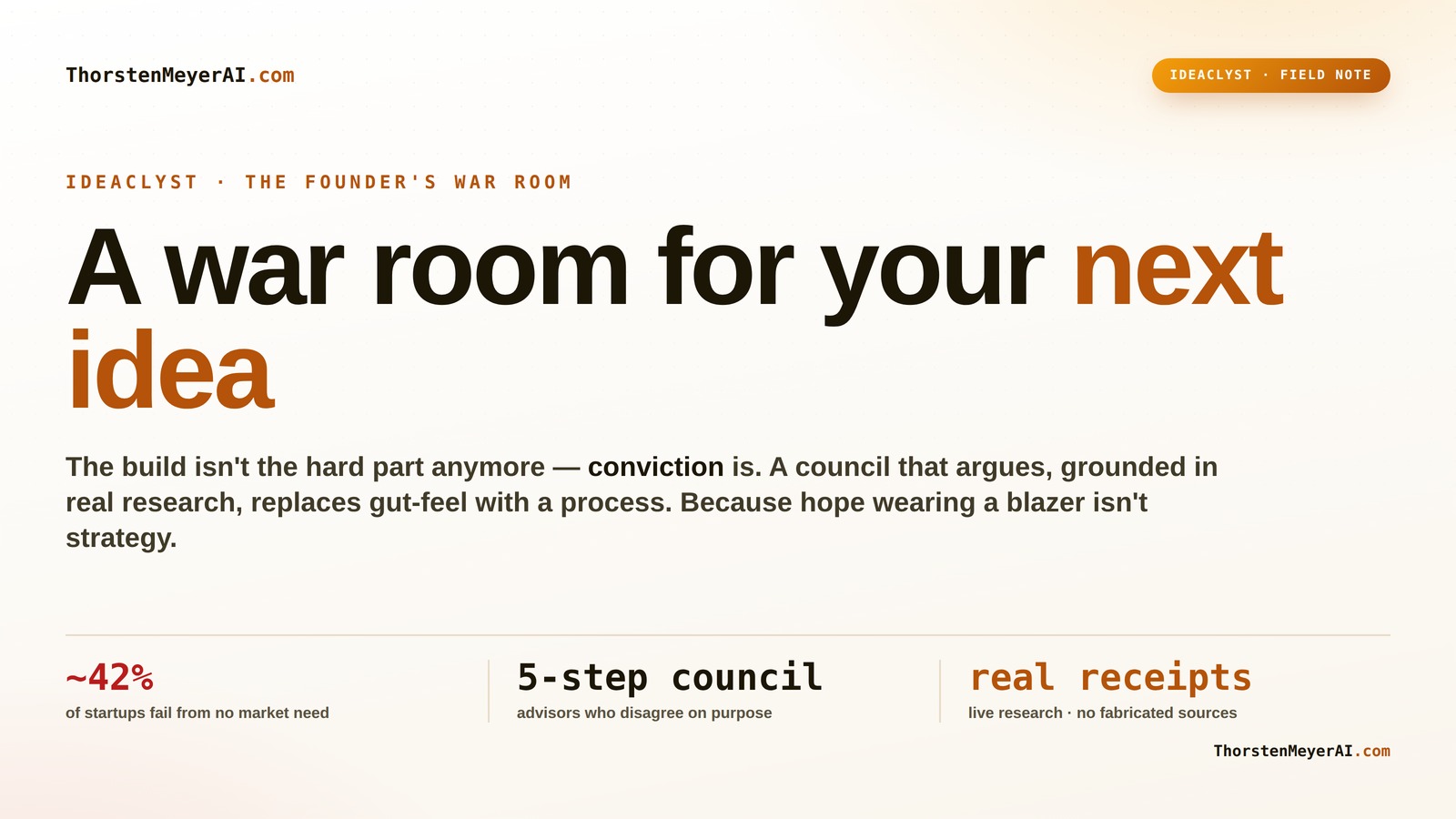
A war room for your next idea
The build isn’t the hard part anymore — conviction is. Knowing which idea deserves the next six months, and being able to defend it. Most founders answer with gut feel and optimistic math. That’s hope wearing a blazer. IdeaClyst replaces it with a process.
The most expensive decision is what to build
The single most valuable thing a tool can do is talk you out of the wrong six months. The numbers make the case better than any pitch.
Three tools in one — on your own machine
Strip away the framing and IdeaClyst is three things at once, all running locally with nothing leaving your laptop.
An AI council
Pressure-tests an idea you bring it — advisors who argue on purpose.
A discovery engine
Finds ideas you didn’t know to look for by hunting real demand signals.
A founder’s workspace
Carries winners from “interesting” all the way to “ready to build.”
Advisors who disagree on purpose
Not one confident, agreeable answer — a structured five-step deliberation where models play different roles and turn on their own work. The disagreement is the feature.
The five-step deliberation
A council that leads with the bad news surfaces the objections you’d otherwise find the expensive way, on month five.
Product strategy
Who’s it for, what’s the wedge, why now, what’s the business model.
Technical architecture
What would it actually take to build — and where’s the risk.
Critique pass
The council turns on its own work. Where’s the hand-waving? What kills this?
Second, independent critique
A different voice, a different angle — so blind spots don’t survive.
Final synthesis
Everything into one coherent founder packet: strategy, architecture, validation, plan.
When IdeaClyst cites a source, it actually fetched it
The hard departure from “ask an AI what it thinks of my startup.” It runs in a strict, real-data-only mode — if it can’t gather genuine evidence, it says so plainly rather than inventing a plausible paragraph.
Confidence with receipts
No fabricated statistics, no imaginary competitors, no made-up citations. The packet survives a skeptical co-founder or a sharp investor because the reasoning has receipts.
Market research first
Scouts the landscape before the council reasons about anything.
Competitor read
Real positioning, pricing signals, feature claims — differentiation vs. reality.
Validation with links
Not “talk to customers” — concrete signals & sources you can click.
From the blank page to build-ready
Evaluation is half the problem; the blank page is the other half. And a plan is worthless if it dies in a tab you never reopen.
Bring a space, not an idea
“AI for accountants,” “tools for indie game studios” — plus your goal and real capacity. It hunts demand signals across HN, Reddit, Product Hunt, GitHub, pricing pages.
- An honest market read — leads with the bad news when a space is hard
- An opportunity map — high pain, thin competition
- Ranked candidates — wedge, who pays, effort, risk, confidence
- each with KILL CRITERIA — when to walk away
A home and a forward path
Every promising idea gets carried forward, with every artifact in plain files on your disk.
- Validation tooling — sprint board, interview list, evidence browser
- Founder profile — a personal-fit lens; same discovery, different advice
- Build workspaces — funnel, personas, landing draft, version history
- “Build this idea” → a PRD + task queue, ready for a coding agent
Key Takeaways
- IdeaClyst transforms vague ideas into validated plans through structured debate, grounded research, and local control.
- Its five-step process converts chaos into clarity faster than traditional methods—saving founders weeks and thousands of dollars.
- The platform’s disagreement-driven council uncovers risks and opportunities most founders miss, making decisions smarter.
- Grounded in real-time web data, it prevents costly market missteps by anchoring ideas in current facts.
- Being local-first means your ideas remain private and owned by you, with no cloud dependencies.
AI-powered idea validation software
As an affiliate, we earn on qualifying purchases.
As an affiliate, we earn on qualifying purchases.
What Exactly Is IdeaClyst and Why Should You Care?
IdeaClyst is a local-first platform that acts as your personal war room. It is developed privately and is not publicly available. It’s built for founders, creators, and teams who want to rigorously test their ideas without handing their data over to third parties. Think of it as a digital boardroom, where every idea is scrutinized through structured debate and grounded research.
Its significance lies in how it empowers founders to make better decisions by fostering a culture of rigorous questioning and evidence-based validation. Unlike traditional brainstorming tools that often lead to superficial consensus or unchecked optimism, IdeaClyst encourages critical thinking through a multi-layered process that challenges assumptions and surfaces hidden risks. This approach reduces the likelihood of costly product pivots or market missteps, thereby increasing the chances of success. The tradeoff, however, is that it requires a mindset shift from casual ideation to disciplined analysis—meaning founders need to be willing to engage in honest critique and embrace uncertainty as part of the process.
For example, a SaaS founder might bring a rough idea for a new feature. The council debates its market fit, technical risks, and competitor landscape. Meanwhile, the discovery engine surfaces similar startups or emerging trends, giving a broader context. This layered exploration ensures that decisions are not based on gut feeling or incomplete data but are instead grounded in a nuanced understanding of the landscape.
As an affiliate, we earn on qualifying purchases.
How IdeaClyst’s War Room Turns Chaos Into Clarity in 5 Simple Steps
- Present Your Idea: Write a quick summary or paragraph about your concept, no matter how rough.
- Form the Council: The platform’s AI models take on roles—product strategist, tech architect, critic—each giving their perspective.
- Debate & Disagree: The council argues, pointing out risks, assumptions, or gaps. Think of it as a structured courtroom.
- Discover & Broaden: The engine surfaces related ideas, market trends, or emerging competitors you might have missed.
- Synthesize & Plan: All insights are compiled into a clear, Markdown-based plan—ready for your next step.
This process transforms guesswork into a data-backed, debate-driven strategy, saving weeks of trial and error. The value here is in how it systematically exposes blind spots and challenges biases, which are often overlooked in informal validation. For more insights into innovative startup strategies, visit A War Room for Your Next Idea: Inside IdeaClyst.
structured debate collaboration software
As an affiliate, we earn on qualifying purchases.
As an affiliate, we earn on qualifying purchases.
Comparison Table: IdeaClyst vs. Traditional Brainstorming Tools
| Feature | IdeaClyst |
|---|---|
| Local-First Data | Yes, everything stays on your machine, secure and private |
| Structured Debate | Yes, five-step council with conflicting models for rigorous validation |
| Grounded Research | Real-time web research integrated into the process |
| Data Ownership | Yes, all data written as Markdown, owned by you |
| Disagreement & Critique | Built-in, structured disagreement for better decision-making |
| Discovery Engine | Yes, surfaces related ideas and trends automatically |
As an affiliate, we earn on qualifying purchases.
Why Grounded Research Is Your Secret Weapon
Many founders rely on gut feeling or vague market vibes. But IdeaClyst refuses to accept opinions without proof. Instead, it pulls real-time data from the web—market growth figures, competitor activities, customer feedback—so your decisions are anchored in reality. Learn more about how grounded research can improve decision-making at EnergyLast.
This is crucial because relying solely on intuition or anecdotal evidence can lead to costly missteps. Grounded research acts as a reality check, ensuring that your ideas are validated against current market conditions. The implications are significant: founders can avoid investing in features or markets that are oversaturated or declining, and instead focus on opportunities with real potential. The tradeoff is that gathering and interpreting this data requires effort and skill, but the payoff is much more reliable decision-making that reduces risk of failure.
For instance, a founder considering a new vertical can ask IdeaClyst to scan recent news, funding rounds, or user reviews, giving a fact-based snapshot. This grounding prevents expensive mistakes, like building a feature that isn’t needed or entering a saturated market. Ultimately, grounded research enhances confidence, fosters strategic agility, and saves resources—making it a core advantage for data-driven founders.
Who Uses IdeaClyst and How They Win
Early-stage founders, product teams, and even nonprofit leaders use IdeaClyst to validate ideas faster and more confidently. A SaaS startup might use it to test a new feature, while a nonprofit could evaluate a community project idea. Its local-first approach appeals to those who value privacy and control.
Take Sarah, a startup founder, who used IdeaClyst to debate her app’s core feature. The structured critique revealed a flaw she hadn’t seen—a risk of alienating her target audience. Armed with that insight, she pivoted before wasting months and thousands of dollars.
The platform’s ability to surface overlooked opportunities and identify hidden risks makes it invaluable for anyone who needs to decide quickly but thoroughly. By fostering a culture of rigorous validation, IdeaClyst helps users avoid costly mistakes, accelerate decision-making, and ultimately increase their chances of success. The tradeoff is that it requires active engagement and honest critique, but the payoff is a significantly stronger, more resilient idea pipeline.
What Makes IdeaClyst Different from Other Idea Tools?
Unlike simple mind-mapping apps or basic project boards, IdeaClyst emphasizes structured disagreement, grounding in real-time web data, and local ownership. It’s a war room, not just a note-taking app.
Think of it as a courtroom for ideas, where each suggestion faces scrutiny from conflicting models and evidence. This setup forces users to confront assumptions and consider alternative perspectives, which often leads to more robust, well-rounded plans. The local-first design ensures your data remains private and under your control, avoiding the pitfalls of cloud dependency and data breaches. The tradeoff is that this approach demands more discipline and active participation, but the resulting decisions are typically more reliable and defensible.
This focus on rigorous debate and grounded evidence helps founders make smarter, faster decisions—reducing the risk of costly missteps while fostering a mindset of continuous critical evaluation.
What Results Can You Expect From Using IdeaClyst?
Founders report making faster, more confident decisions. Instead of months of guesswork, they get actionable plans in days or weeks. A SaaS founder, for example, cut their product validation time from 3 months to 2 weeks, saving thousands in engineering and research costs.
Beyond speed, the structured debate surfaces hidden risks—such as technical complexity or market saturation—that might have otherwise gone unnoticed. This proactive risk identification leads to better resource allocation and reduces the chances of costly pivots later. The long-term benefit is a growing library of vetted ideas and strategies, which streamlines future decision-making. Essentially, it transforms a chaotic idea pipeline into a disciplined, evidence-based process that continually improves with each cycle.
The implication is that teams can iterate faster, reduce wasted effort, and increase their odds of market success. The tradeoff involves investing time upfront in debate and research, but the payoff is a much more resilient, data-backed strategic foundation.
Is It Free? How to Get Started with IdeaClyst
IdeaClyst is developed privately and is not publicly available.
Getting started is straightforward—clone the repo, run a simple setup script, and begin entering ideas into your personal war room. It’s designed for founders comfortable with command line and local development environments.
Once set up, you’ll have a private, customizable space to debate, research, and plan your next move—without ever uploading your raw ideas to a third-party server.
Frequently Asked Questions
Is IdeaClyst suitable for non-technical founders?
Yes. While setup may require some technical comfort, the core process of debating and planning ideas can be done with minimal technical skills. Plus, the community and documentation support onboarding.Can I use IdeaClyst for nonprofit or community projects?
Absolutely. Its structured debate, grounded research, and private workspace make it ideal for any organization needing rigorous decision-making—be it social impact, nonprofit, or community initiatives.How does IdeaClyst find related ideas or trends?
The discovery engine scans the web for relevant news, startups, or trends related to your idea. It surfaces these insights directly within your workspace, broadening your understanding and spotting opportunities you might miss.Is there a cost to use IdeaClyst?
IdeaClyst is developed privately and is not publicly available.Conclusion
In a world flooded with ideas, the real challenge is picking the right one and knowing it’s worth your time. IdeaClyst doesn’t just suggest— it challenges, debates, and grounds each idea in reality. It’s your personal war room, where every decision is fought for and won with clarity.
Start treating your ideas like strategic battles, not guesses. With IdeaClyst, you’re arming yourself with the most rigorous, private, and data-backed decision-making tool available today. Your next big idea deserves that kind of champion.
Halloween Picks
halloween
As an affiliate, we earn on qualifying purchases.