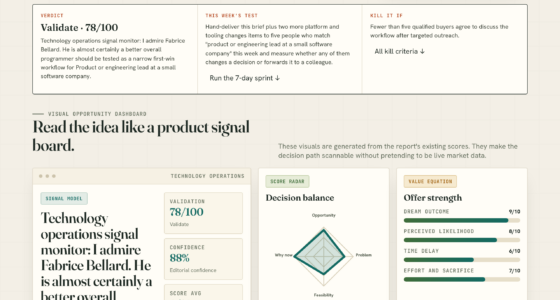

📊 Full opportunity report: The Model Is Only 10%: The Real Lesson of the New SDLC on ThorstenMeyerAI.com — validation score, market gap, and execution plan.

Get the latest gadgets delivered free with Prime
- Fast, free delivery on millions of items
- Prime Video, Amazon Music and more included
- Member-only deals all year
TL;DR
A recent whitepaper from Google reveals that 85% of developers use AI coding tools, but the real value lies in configuring the surrounding system, not the AI model itself. The paper advocates focusing on harness and context engineering over chasing the latest models.
The model is only 10%
A Google whitepaper argues software’s biggest shift is from writing code to expressing intent. Its sharpest claim: the model you obsess over is the smallest part of the system — the scaffolding around it does the real work.
The clearest map yet of how serious AI development works — and mostly tool-agnostic. But it’s a Google funnel: the concepts are neutral, the on-ramps point to Gemini, Jules & the ADK. If the harness is 90% and it’s yours, your moat and your costs both live there — so own your scaffolding, route across models, and remember: AI amplifies whatever engineering culture it lands in.
Implications for AI Development Strategies
This whitepaper challenges the common narrative that the AI model itself is the primary driver of system performance. Instead, it highlights that configuration, harness design, and context management are the key factors. Organizations that focus on improving these areas can achieve greater reliability and cost efficiency than those merely upgrading to newer models. This insight encourages a strategic shift towards system engineering in AI projects, emphasizing verification, tooling, and context architecture. As a result, companies can reduce costs, improve security, and enhance AI reliability by investing in these areas instead of solely chasing model improvements.As an affiliate, we earn on qualifying purchases.
Background on AI System Design and Evolving Practices
Historically, AI development emphasized model innovation, with organizations racing to adopt the latest architectures and training techniques. However, recent trends show widespread adoption of AI coding agents—by early 2026, 85% of professional developers use them regularly, and 41% generate most code with AI. The whitepaper builds on this trend, arguing that the focus should shift from model performance to how AI systems are configured via prompts, tools, and rules. Previous approaches, like vibe coding, relied on minimal oversight, leading to inefficiencies and higher costs over time. The new paradigm, called agentic engineering, integrates formal verification, testing, and context management, making AI development more disciplined and cost-effective.“The biggest shift in software engineering isn’t a new language or framework; it’s moving from writing code to expressing intent and trusting machines to interpret that intent.”
— Addy Osmani
As an affiliate, we earn on qualifying purchases.
Unclear Aspects of Implementation and Industry Adoption
It remains unclear how quickly organizations will adopt the recommended focus on harness and context engineering over model chasing. The long-term impact on AI development costs and security practices is still being evaluated, and some industry players may resist shifting away from model-centric strategies.AI development system engineering tools
As an affiliate, we earn on qualifying purchases.
As an affiliate, we earn on qualifying purchases.
Next Steps for Organizations and Developers
Organizations should prioritize building and refining their harnesses, including prompts, tools, and verification processes. Future research and industry practice are likely to focus on developing standardized frameworks for context engineering and cost-effective system design. Monitoring how these strategies influence AI reliability, security, and operational costs will be essential over the coming months.AI testing and verification software
As an affiliate, we earn on qualifying purchases.
As an affiliate, we earn on qualifying purchases.
Key Questions
Why is the model only 10% of the system behavior?
According to the whitepaper, the model’s output is heavily influenced by how it is configured—through prompts, tools, and rules—making the surrounding system the dominant factor.How can organizations improve their AI systems based on this insight?
Focusing on designing better harnesses, including prompts, context management, and verification processes, can lead to more reliable and cost-effective AI outcomes.Does this mean AI models are less important?
No, but the whitepaper emphasizes that the value of models is limited without proper system configuration. The real gains come from how models are integrated and controlled.What are the risks of focusing less on models?
While shifting focus can reduce costs and improve security, it requires investment in system engineering and may slow down rapid model updates or innovations.Will this change how AI tools are developed and sold?
Potentially, as companies may prioritize developing better harnesses, tooling, and verification frameworks rather than solely pushing new models.Source: ThorstenMeyerAI.com
Halloween Picks
halloween
As an affiliate, we earn on qualifying purchases.