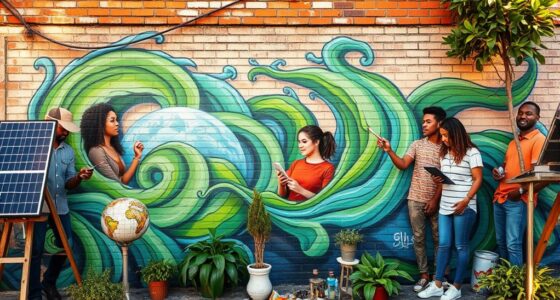
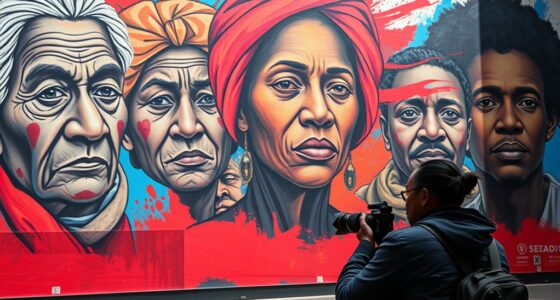
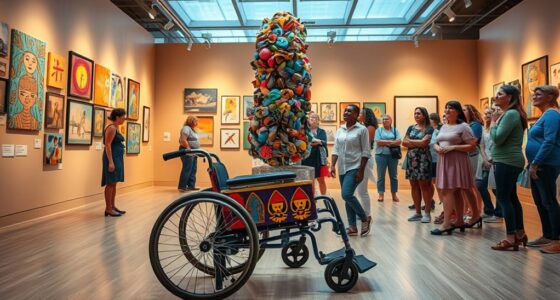
Artists respond to economic inequality through powerful visual activism that highlights disparities and challenges the status quo. They create murals, installations, and digital art that transform public spaces into platforms for dialogue and social change. Their imagery vividly exposes wealth concentration and systemic financial burdens, aiming to inspire support for redistribution and policy reform. If you explore further, you’ll discover how these creative efforts foster awareness and motivate collective action for a more equitable society.
Key Takeaways
- Artists use murals, installations, and digital art to expose disparities in wealth and challenge societal norms.
- Visual symbolism highlights economic imbalances and advocates for redistributive policies.
- Artwork serves as a form of activism, aiming to influence public opinion and motivate social change.
- Artistic responses address systemic financial burdens like debt, linking them to broader wealth inequality.
- The emotional impact of visual activism inspires community engagement and pushes for societal reevaluation of economic priorities.

Economic inequality has become a pressing issue that deeply influences societies worldwide, prompting artists to respond in powerful and meaningful ways. You might notice how many artists are using their work to spotlight disparities in wealth and challenge the status quo through acts of visual activism. These creative efforts aim to provoke thought, inspire action, and push for tangible change, often highlighting the need for wealth redistribution. Visual activism, in particular, serves as a compelling tool for communicating complex issues about inequality in accessible ways. Artists create murals, installations, and digital art that directly confront viewers, urging them to reconsider how resources are distributed and who benefits from economic systems. By doing so, they transform public spaces into platforms for dialogue, making the invisible visible and forcing passersby to confront uncomfortable truths about wealth concentration.
You can see how these works often incorporate symbolism and bold imagery that underscore the imbalance of economic power. For example, murals depicting overflowing coffers contrasted with impoverished communities serve as stark visual statements on wealth disparity. These pieces don’t just beautify neighborhoods—they hold a mirror to society’s priorities, illustrating the urgent need for redistributive policies. Many artists view their work as a form of activism, believing that art has the power to influence public opinion and policy. Through visual activism, they aim to motivate viewers to support initiatives like progressive taxation or social welfare programs that promote wealth redistribution. The immediacy and emotional impact of visual art make it especially effective at rallying communities and raising awareness about economic injustice.
Moreover, understanding the role of credit card debt and other financial burdens faced by individuals can deepen the viewer’s awareness of economic inequality, as these issues are often interconnected with systemic wealth disparities. These artistic responses often challenge viewers to think critically about the systems that perpetuate inequality. You might find yourself reflecting on the role of capitalism and the concentration of wealth within a small elite. Artists don’t shy away from provocative imagery—sometimes creating confrontational pieces that demand attention and spark debate. The goal is to move beyond passive viewing and inspire active engagement. When art becomes a form of visual activism, it encourages collective action by making the issues tangible and urgent. It’s not just about aesthetic appeal; it’s about creating a visual language that advocates for a fairer distribution of wealth. Ultimately, these artworks serve as a call to arms, urging society to rethink economic priorities and work toward a more equitable future.
Frequently Asked Questions
How Do Artists Choose Their Mediums to Address Economic Inequality?
You choose your mediums based on how effectively they can convey symbolism and meaning related to economic inequality. You consider how the medium’s strengths, like visual impact or interactivity, can highlight disparities or challenge perceptions. By selecting appropriate materials—such as murals, installations, or digital art—you guarantee your message resonates. Your medium selection becomes a strategic tool to provoke thought, evoke emotion, and inspire change around economic inequality.
What Historical Art Movements Have Most Influenced This Theme?
Imagine a world where art shouts louder than words—that’s social realism’s impact. You see, it’s a movement that’s heavily influenced by political expression, highlighting struggles of the working class with raw honesty. Movements like the early 20th-century social realism and the Mexican Muralists shape how artists confront economic inequality. They use bold visuals to challenge viewers, making social issues impossible to ignore.
Can Art Truly Effect Policy Change Regarding Inequality?
Yes, art can truly effect policy change through art activism and policy influence. When you use powerful visuals and messages, you raise awareness and inspire public debate. Artists and activists can sway policymakers by highlighting inequalities and mobilizing communities. Your creative efforts can shift perspectives, pressure leaders, and promote social justice, demonstrating that art’s emotional impact and reach make it an essential tool for fostering meaningful change in policies addressing economic inequality.
How Do Diverse Cultures Interpret Economic Disparity Through Art?
You see that in Brazil, artists use cultural symbolism like favela murals to highlight economic disparity, transforming personal struggles into powerful artistic narratives. Different cultures interpret economic disparity uniquely—some emphasize community resilience, others focus on social injustice. Through diverse artistic expressions, such as storytelling, visual art, or performance, you can explore these varied perspectives, fostering understanding and empathy across cultural boundaries while revealing deep-rooted societal issues.
What Are Examples of Grassroots Art Initiatives Fighting Inequality?
You can get involved in grassroots art initiatives like community murals and participatory theater that fight inequality. Community murals transform public spaces, giving communities a voice and visually highlighting economic disparities. Participatory theater engages residents directly, sparking conversations about social issues and inspiring change. By supporting or creating these projects, you help foster awareness, unity, and action against economic inequality, making a tangible difference in your community.
Conclusion
As you explore these artistic responses, you become a bridge spanning the chasm of economic inequality. Art transforms empty spaces into vibrant murals, whispering stories of hope and struggle. It’s like a beacon shining through thick fog, guiding us toward awareness and change. Through your engagement, these creative expressions ignite a spark that can ignite a wildfire of empathy and action, turning silent suffering into a chorus of collective voice and renewal.