In the realm of wide-area motion imagery (WAMI), accurately tracking multiple moving objects is critical for surveillance and intelligence applications. Corvus ISR has published a detailed public tracker benchmark comparing two models’ performance on identical synthetic scenes with perfect ground truth. This transparency highlights the challenges and progress in multi-object tracking where even the best systems make thousands of errors per minute under stress.

Get the latest gadgets delivered free — and shop member deals
- Fast, free delivery on millions of items
- Access to Prime Big Deal Days deals on October 6–7
- Prime Video, Amazon Music and more included
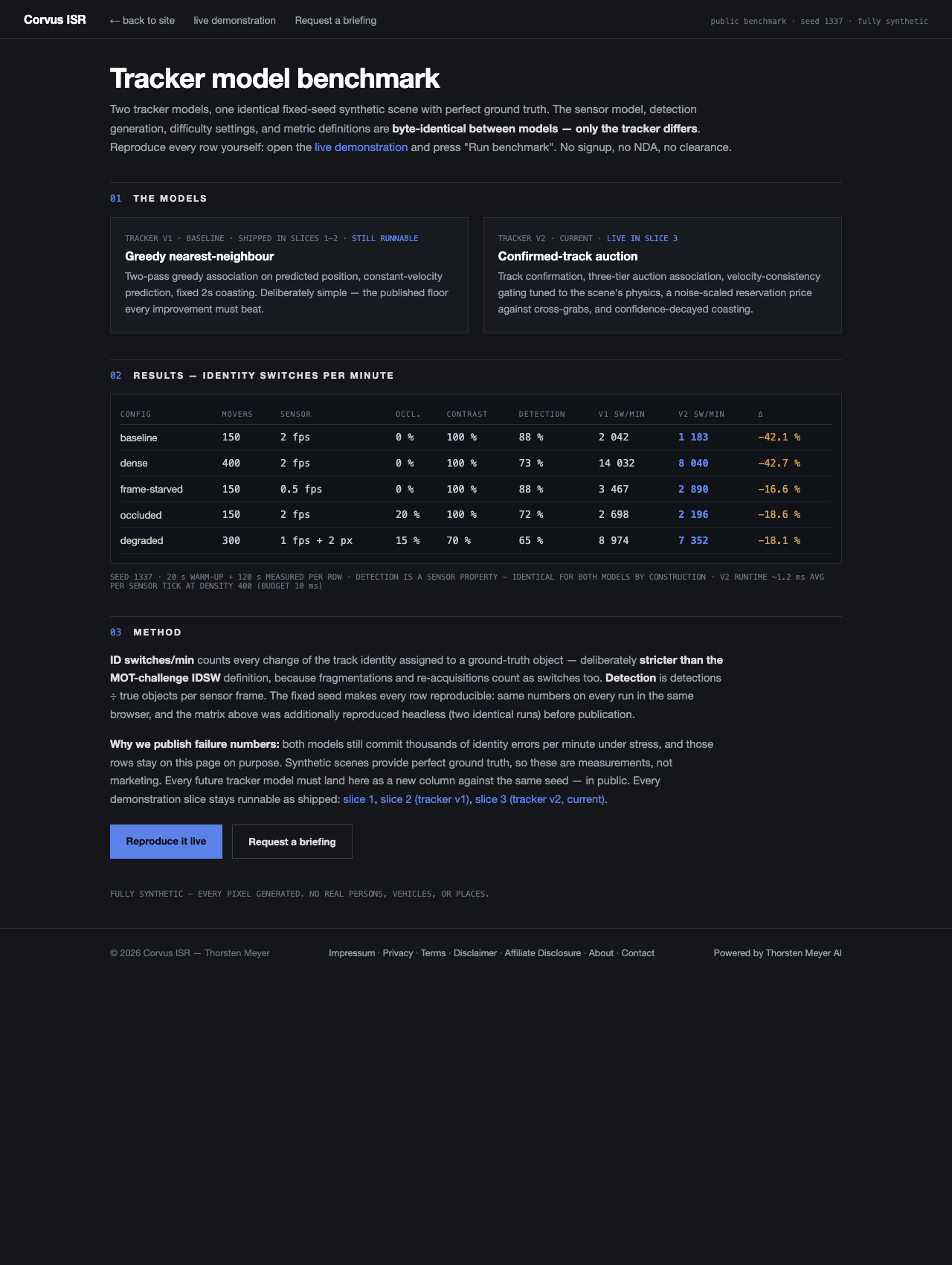
At the heart of the comparison is the evolution from a simple baseline model — the v1 “greedy nearest-neighbour” — to the advanced v2 “confirmed-track auction”. The baseline employs a straightforward two-pass greedy association with constant-velocity prediction and fixed 2-second coasting, serving as a solid floor for tracking performance. Meanwhile, the v2 model introduces a three-tier auction association, velocity-consistency gating, and noise-scaled reservation pricing, all designed to improve ID continuity amid challenging scenes.
Results are impressive: in a typical scenario with 150 movers at 2 frames per second, the ID switches per minute dropped from 2,042 to 1,183 — a 42.1% reduction. Similar gains appear in dense scenes with 400 movers, where switches decreased from 14,032 to 8,040, a 42.7% improvement. These metrics are especially significant because the benchmark’s strict counting method considers every identity change, including fragmentations and re-acquisitions, making the gains all the more meaningful.
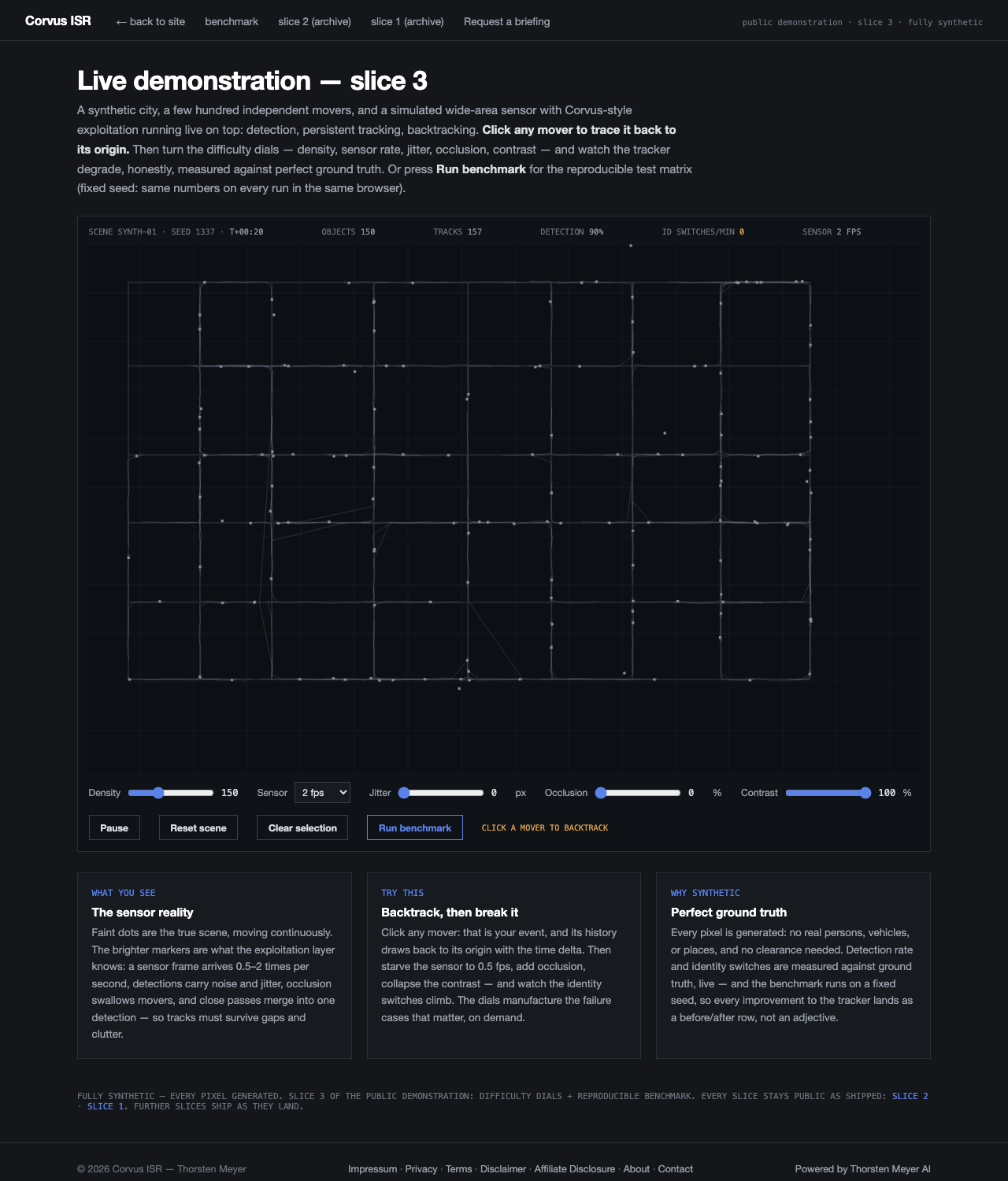
In addition to the accuracy gains, the v2 tracker maintains real-time performance — averaging approximately 1.2 milliseconds per sensor tick at high density, with a worst-case of around 5 milliseconds against a 10-millisecond budget. This means anyone can open the live demo and press “Run benchmark” to reproduce these results firsthand, with no signup or NDA required. Built by an AI executor and independently reviewed, the v2 model demonstrates that advanced multi-object tracking can be both robust and accessible in a browser environment.
It’s important to note that these are fully synthetic scenes, generated pixel-by-pixel without real-world entities, ensuring perfect ground truth for measurement. Corvus ISR openly publishes failure numbers to emphasize that even the best systems make thousands of identity errors per minute, reinforcing the need for continual innovation and transparency in the field. Curious to see how well your own tracker stacks up? Run the benchmark yourself and explore the capabilities firsthand.
multi-object tracking AI software
As an affiliate, we earn on qualifying purchases.
As an affiliate, we earn on qualifying purchases.
wide-area motion imagery surveillance system
As an affiliate, we earn on qualifying purchases.
As an affiliate, we earn on qualifying purchases.
real-time object tracker for security
As an affiliate, we earn on qualifying purchases.
As an affiliate, we earn on qualifying purchases.
synthetic scene tracking benchmark tool
As an affiliate, we earn on qualifying purchases.
As an affiliate, we earn on qualifying purchases.
Evergreen bestsellers Picks
bestsellers
As an affiliate, we earn on qualifying purchases.