
TL;DR

Get the latest gadgets delivered free with Prime
- Fast, free delivery on millions of items
- Prime Video, Amazon Music and more included
- Member-only deals all year
Hugging Face has introduced Grabette, an open-source handheld system that captures human manipulation demonstrations without needing a robot during recording. Its browser-based pipeline converts recordings into datasets for training robots, potentially transforming data collection practices.
Hugging Face has unveiled Grabette, an open, handheld system designed to record human manipulation demonstrations without requiring a robot during data collection. The device aims to simplify and democratize the process of gathering training data for robot learning, which has traditionally been costly and equipment-intensive. For more context, see the original analysis. This development could impact how researchers and organizations build large, diverse manipulation datasets.
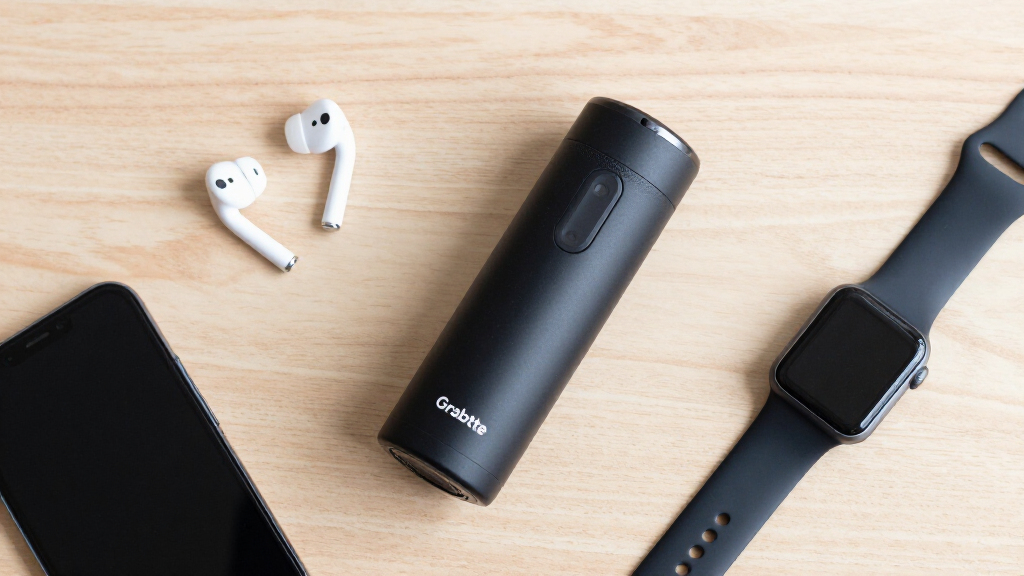
Grabette is a portable, low-cost device that combines two cameras, an inertial measurement unit, magnetic encoders, and a Raspberry Pi to record human demonstrations. Users press a button to start and stop recordings, which are then uploaded via a browser-based dashboard to the Hugging Face Hub. The system converts these recordings into LeRobot datasets suitable for training robot policies, using a pipeline that employs RTAB-MAP for trajectory recovery. Such data processing pipelines are crucial in advancing robot learning, as detailed in the original analysis.
According to the developers, the estimated cost of hardware materials is about €490 for Grabette, with an additional €120 for a motorized end effector called Gripette, which attaches to a robot arm for policy deployment. The project’s open-source components include hardware files, software, and processing pipelines, aiming to lower barriers to large-scale data collection outside laboratory environments. This approach aligns with the principles discussed in this analysis.
While the system is inspired by Stanford’s UMI project and similar commercial devices, its main distinction is the open hardware and software approach, along with its browser-based data processing and distribution through Hugging Face. The project team states that the system has been functional for several months and is now ready for public testing and contributions.
Potential to Transform Robot Data Collection Practices
Grabette could significantly lower the costs and technical barriers associated with collecting manipulation datasets, enabling more researchers and organizations to contribute and access diverse data. Its ability to record demonstrations without a robot during collection allows for more flexible and scalable data gathering, potentially accelerating advances in robot learning and manipulation capabilities. However, the system’s performance, reliability, and dataset quality are still under evaluation, and broader adoption will depend on validation results and community contributions.
handheld robot demonstration recording device
As an affiliate, we earn on qualifying purchases.
As an affiliate, we earn on qualifying purchases.
Background on Human Demonstration Data Collection for Robots
Traditional robot manipulation data collection relies heavily on robotic arms, teleoperation systems, and laboratory setups, which are costly and limit the scale and diversity of datasets. The Stanford UMI project previously demonstrated the feasibility of handheld collection devices, inspiring recent efforts like Grabette. Commercial devices from companies like Agibot, Genrobot, and Sunday Robotics also exist but tend to be closed-source and expensive. Hugging Face’s approach with Grabette emphasizes open hardware and software, aiming to foster collaborative growth and reduce costs.
Prior research has shown that large, varied datasets are critical for training robust manipulation policies. The challenge has been acquiring such data at scale, especially outside controlled environments. Grabette’s design seeks to address this gap by enabling easy, low-cost recording of human demonstrations that can be shared and reused across different platforms and institutions.
“The bottleneck isn’t the model. It’s the data.”
— Hugging Face project team
As an affiliate, we earn on qualifying purchases.
Performance and Validation of Grabette Still Unclear
There are no published independent tests or peer-reviewed studies evaluating Grabette’s accuracy, reliability, or robustness in various scenarios. It is unclear how well the system handles fast movements, occlusions, reflective surfaces, or scene changes that challenge visual SLAM. The quantity and diversity of collected demonstrations, as well as the transferability of trained policies across different robot platforms, have not yet been demonstrated. Licensing, contribution rules, and quality control measures are also not specified, leaving questions about dataset quality and governance.
portable manipulation demo recorder
As an affiliate, we earn on qualifying purchases.
As an affiliate, we earn on qualifying purchases.
Community Testing and Dataset Growth Will Determine Impact
Next steps include community members reproducing the hardware setup, contributing demonstrations, and testing the system’s reliability and dataset usefulness. Validation results, benchmark comparisons, and policy transfer experiments will be critical to assess Grabette’s practical value. The project team plans to update documentation, licensing terms, and validation procedures based on early user feedback and emerging data quality metrics.
As an affiliate, we earn on qualifying purchases.
Key Questions
What is Grabette?
Grabette is a portable, open-source handheld device that records human demonstrations of manipulation tasks, capturing camera, depth, motion, and gripper data for later use in robot training datasets.
Does Grabette require a robot during recording?
No, it does not require a robot during data collection. The system records human demonstrations, which can later be transferred to a robot for policy deployment.
How does Grabette convert recordings into datasets?
The device’s browser-based pipeline uses RTAB-MAP to recover device trajectories and converts the data into LeRobot format, suitable for training manipulation policies.
What are the current limitations of Grabette?
Performance validation is still pending. It is unclear how reliably it captures fast movements or handles challenging visual conditions. Dataset size and transferability are also unverified.
How might Grabette impact robot learning research?
If validated, Grabette could democratize access to manipulation data, reduce collection costs, and enable larger, more diverse datasets, accelerating progress in robot autonomy and manipulation skills.
Source: ThorstenMeyerAI.com
Columbus Day / Indigenous Peoples' Day Picks
long weekend sales
As an affiliate, we earn on qualifying purchases.