
🔍 Read the full analysis: The AI That Paints Worlds: Genie 4’S Possible Step Toward AGI on ThorstenMeyerAI.com

Get the latest gadgets delivered free with Prime
- Fast, free delivery on millions of items
- Prime Video, Amazon Music and more included
- Member-only deals all year
TL;DR
Google DeepMind says exploring realistic environments with Genie 4 could be a step toward AGI, because generated worlds may help train and test agents. That is a research direction, not a measured result: Genie 4 has not been evaluated on the cited physics benchmark, and existing video models still score well below real videos.
Google DeepMind describes exploring realistic environments generated by Genie 4 as a “key stepping stone” toward artificial general intelligence, but the company has published no benchmark showing that Genie 4 understands physical rules. The distinction matters because a world model that produces convincing scenes could help train agents and robots, yet visual realism alone does not show that those systems can predict what will happen in the real world.
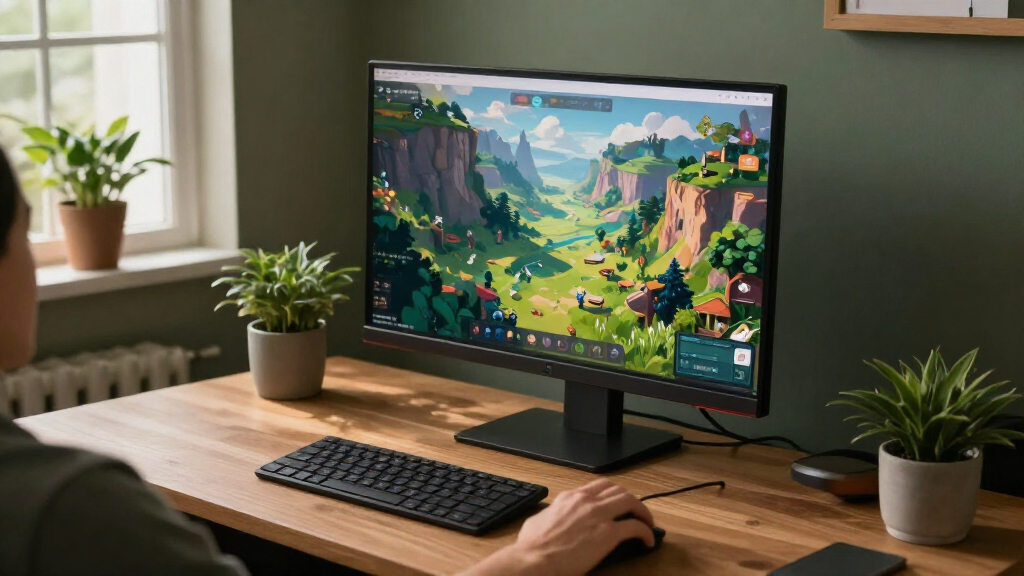
In its Genie 4 model materials, Google DeepMind argues that agents need broad, realistic environments in which to practice, and that simulation can support safer training before deployment. The claim is about the potential role of generated worlds in a larger research program; it is not a finding that Genie 4 is close to AGI. The November 1 report says the model page provides no benchmark numbers measuring progress toward AGI or physical understanding.
The report describes Genie 4 as a system that predicts video frames based on earlier frames and user input, rather than rendering scenes through a conventional game engine with a stored 3D map. That can produce worlds that appear plausible, but appearance does not establish that a model has learned the rules behind motion, collisions or weight. A ball rolling down a hill can look right without the model reliably understanding why it accelerates or bounces.
Evidence cited in the report points to a persistent gap. A 2025 Physics-IQ benchmark by Google researchers found that video models’ physical understanding was “severely limited, and unrelated to visual realism,” according to the report. On Physics-IQ Verified, where real videos score 100, the strongest image-to-video result cited is 55.1, the best of eight tries. Gemini Omni 1.1 Flash, described as part of the family DeepMind says anchors Genie 4, scored 35.3. Genie 4 itself has not been tested on that benchmark, so those scores cannot establish its performance.
THE AGI CLAIM, VERSION BY VERSION
Three Genies, one promise
Google DeepMind has tied every recent Genie to the path to AGI. Here is what each version could do, what was claimed, and who said it.
- 4 Dec 2024Genie 23D worlds from one image, consistent for up to about a minute.“…the breadth and generality required to progress towards AGI.”Company claim
- 5 Aug 2025Genie 3First real-time Genie: 720p, 24 frames per second, a few minutes of consistency.“World models are also a key stepping stone on the path to AGI…”Company claim
- 13 Nov 2025SIMA 2 in Genie 3 worldsDeepMind's game agent orients itself and self-improves in newly generated worlds.“…a major milestone toward training general agents across diverse, generated worlds.”Company report
- 6 Feb 2026Waymo World ModelWaymo says its driving simulator is built on Genie 3 and can generate rare events.“…from a tornado to a casual encounter with an elephant.”Company report
- 27 Oct 2026Genie 4Photorealism, native sound, live text steering, Gemini in the loop. Trusted testers only.“…a key stepping stone on the path to AGI.”Company claim
- 31 Oct 2026TechRadar pushes backColumnist Eric Hal Schwartz: realism is not understanding.“Faking plausibility is easier than grasping the underlying rules…”Opinion
The Genie 2 and Genie 3 capability notes are DeepMind’s own descriptions. No Genie post measures progress toward AGI; DeepMind published no benchmark numbers for Genie 4.
Sources: Google DeepMind, Genie 2 (4 Dec 2024), Genie 3 (5 Aug 2025), SIMA 2 (13 Nov 2025), Genie 4 model page (read 1 Nov 2026); Waymo (6 Feb 2026); TechRadar (31 Oct 2026, opinion).
Powered by Thorsten Meyer AI
Why Simulation Could Help Agents
Generated practice environments could address a practical constraint in robotics and autonomous driving: real-world testing can be slow, expensive and risky, while rare hazards are difficult to stage repeatedly. A simulator could let developers create unusual scenarios on demand and test how an agent responds before placing equipment or people in danger. That makes world models relevant to companies even if they do not, by themselves, establish progress toward AGI.
The report points to early examples, while noting that they do not settle the question of physical understanding. DeepMind reported in November 2025 that its SIMA 2 agent could follow instructions and find its way in worlds generated by Genie 3, and could improve in newly created environments. Waymo said in February 2026 that its driving simulator was built on Genie 3 and could generate rare events, including a tornado or an encounter with an elephant. These are company-reported applications, not independent proof that simulated behavior transfers reliably to every real-world situation.
For businesses evaluating such systems, the distinction affects how results should be used. Generated worlds may be useful for sketching scenarios and stress-testing ideas, but a persuasive demonstration is not proof that a robot, vehicle or operational plan will work outside the simulation. The report advises asking vendors for physics and transfer tests, not relying only on attractive video clips.
Products Worth Considering

Apple AirPods Pro (2nd Generation) Wireless Earbuds with USB-C MagSafe Charging Case

Anker SOLIX S2000 Portable Power Station, 2,010Wh, 1,500W

Bose QuietComfort Wireless Noise Cancelling Headphones – Petal Pink Limited Edition
As an affiliate, we earn on qualifying purchases.
Three Meanings of World Model
The term “world model” covers systems with different aims, which can make claims about AGI difficult to compare. One research idea is for an agent to learn an internal model, imagine what might happen and practice in that imagined environment. In 2018, David Ha and Jürgen Schmidhuber described training an agent inside a learned “dream” of a simple video game, then transferring the skill back to the game.
Genie 4 is presented in the report as a video-generating approach: it predicts subsequent frames from existing frames and an instruction or input. A different category uses structured data and known rules to model a domain. The report gives construction start-up Dream as an example, citing TechCrunch’s October 29 coverage of a model trained on more than 100 million square feet of U.S. building data from permit archives. Such systems may calculate aspects of a structure without generating a visual world; a video model may depict a bridge without calculating how much weight it can hold.
Google has linked successive Genie versions to AGI in similar language. DeepMind described Genie 3 in August 2025 as a “key stepping stone on the path to AGI,” and in December 2024 said Genie 2 pointed toward the breadth and generality needed to progress toward AGI. The November 1 report says this continuity should be read as a research bet about training environments, not a claim that Genie 4 has demonstrated general intelligence.
“The ability to explore an unlimited range of realistic environments is a key stepping stone on the path to AGI.”
— Google DeepMind, Genie 4 model page, as quoted in the November 1 report
Genie 4’s Physics Remains Untested
The key unanswered question is whether Genie 4 can represent physical cause and effect, rather than produce frames that look convincing. The cited Physics-IQ results concern other models; Genie 4 has no reported score on that benchmark in the source material. It is also unclear how consistently skills learned in generated environments transfer to real robots or vehicles, and how performance changes in unusual situations.
The source describes Genie 4 as a hybrid system in which a Gemini model plans scenes and checks frames while Genie generates them. DeepMind’s broader position, as presented in the report, is that “hybrid world models” are a promising direction. But the report provides no test results that isolate what each component contributes or show that the combination resolves the realism-understanding gap. The AGI language therefore remains a stated goal, not an independently verified assessment.
The Tests That Would Clarify Progress
The next useful evidence would be published evaluations of Genie 4 on physical-reasoning tests, including the conditions and comparison baseline, alongside tests of whether agents trained in its environments perform better in real settings. Until such results are available, the cited benchmark scores describe other systems and should not be attributed to Genie 4.
For now, Google DeepMind’s claim is best read as an argument for why realistic simulation may help train agents, while the degree of physical understanding remains unsettled. Developers and customers will need measurable results beyond generated video to judge whether Genie 4 environments improve real-world performance. The source material does not give a date for a Genie 4 benchmark release or a specific next evaluation.
Key Questions
Has Genie 4 been shown to achieve AGI?
No. Google DeepMind describes realistic environments as a step toward AGI, but the source reports no Genie 4 result measuring progress toward AGI.
Does realistic video prove that Genie 4 understands physics?
No. A scene can look plausible without the model reliably representing the rules behind motion or collisions. The cited Physics-IQ research found a gap between visual realism and physical understanding, and Genie 4 itself has not been tested on that benchmark.
What evidence supports using generated worlds for training?
DeepMind reported that SIMA 2 operated and improved in Genie 3-generated environments, while Waymo said its driving simulator uses Genie 3 to create rare events. These are reported applications; they do not alone prove reliable transfer to all real-world conditions.
What should companies ask when evaluating world models?
Ask for physics benchmarks, clear comparison baselines and evidence that performance in simulation transfers to real tasks. The report cautions against treating demo clips as proof that a robot or plan will work in practice.
Source: ThorstenMeyerAI.com