
📊 Full opportunity report: Rehearse, Refine, Repeat: IEP Negotiation Practice For Parents on IdeaNavigator AI — validation score, market gap, and execution plan.

Get the latest gadgets delivered free with Prime
- Fast, free delivery on millions of items
- Prime Video, Amazon Music and more included
- Member-only deals all year
TL;DR
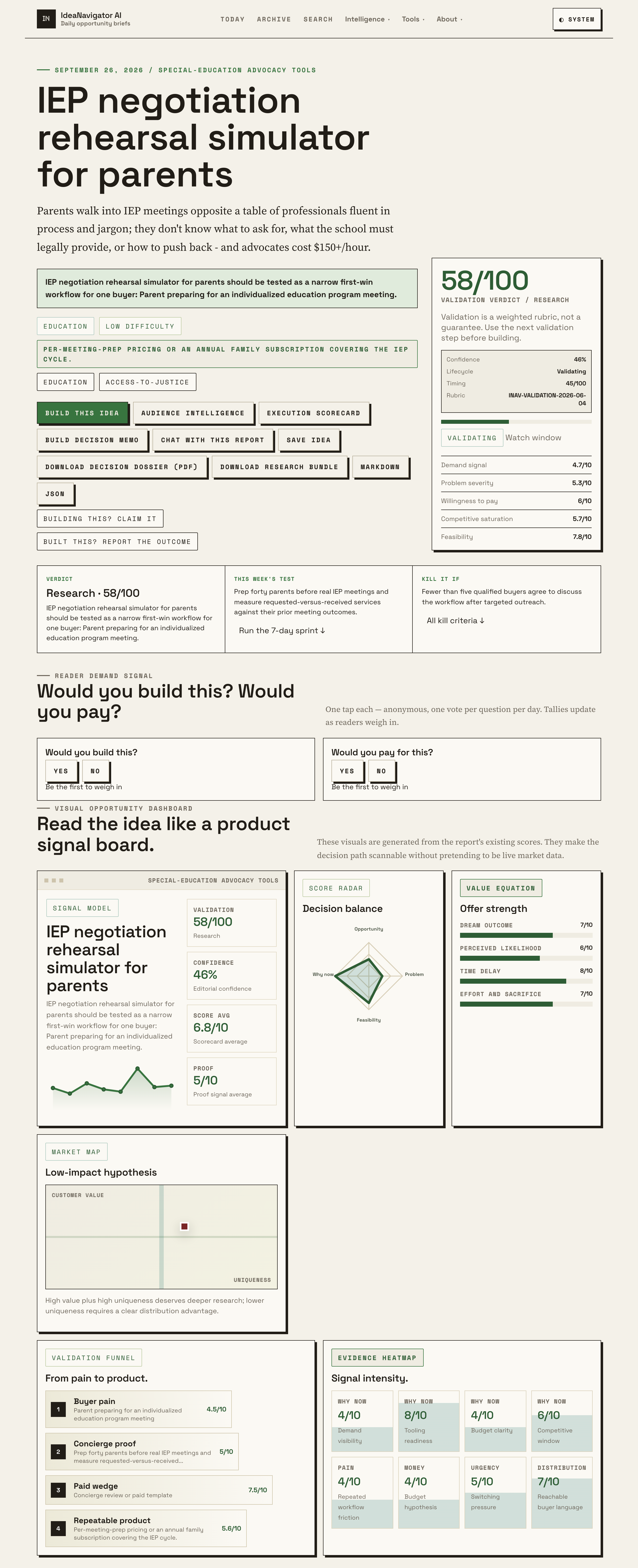
IdeaNavigator AI has outlined a proposed rehearsal simulator to help parents prepare for individualized education program meetings. The concept would turn uploaded school documents into plain-language guidance and practice conversations, but it remains an idea: no product, trial results or measured impact are reported.
IdeaNavigator AI has proposed testing a rehearsal simulator for parents preparing for individualized education program (IEP) meetings, a concept that would combine document review, plain-language guidance and role-play. The proposal identifies a specific first use case, but it does not report that a product has been built or tested with families.
The proposed tool would let a parent upload a child’s current IEP and evaluation reports. It would explain the documents in plain language, generate a list of possible requests with legal grounding, and simulate a meeting with realistic objections from school staff. Parents could repeat the role-play to practice expressing and defending their positions.
The proposal frames the service as preparation for a meeting, rather than representation during one. It suggests charging per meeting or offering an annual family subscription covering an IEP cycle. Those are possible business models, not reported prices or established plans.
For an initial test, IdeaNavigator AI proposes preparing 40 parents ahead of real IEP meetings and comparing the services they request with those they receive, using each family’s prior meeting outcomes as a reference. The proposal does not provide results from such a test, describe how participants would be recruited, or specify how differences between cases would be accounted for.
Testing Support Before IEP Meetings
The concept targets a practical gap: parents may need to make specific requests in meetings where school personnel know the process and terminology better. Rehearsal could help families organize questions and explain their priorities. The proposal also points to advocacy services costing $150 or more per hour, suggesting a lower-cost preparation tool could appeal to families who cannot hire an advocate. That figure is part of the proposal; no pricing comparison for a simulator is supplied.
Whether practice changes outcomes is the central question. A parent asking for a service does not establish whether it is appropriate, legally required, or agreed to by the school. A comparison of requested and received services could provide an initial signal, but it would not by itself show that a simulator caused any change. Family circumstances, evaluations, school resources and the details of each IEP all shape decisions.
The legal guidance feature also carries weight. IEP rights and obligations depend on applicable law and a child’s individual circumstances. Plain-language explanations may make documents easier to discuss, but inaccurate or overconfident guidance could mislead families. The proposal does not describe a legal review process or how it would handle uncertainty in an individual case.
Top picks for "rehearse refine repeat"
As an affiliate, we earn on qualifying purchases.
The Proposed First Use Case
An IEP is a plan for special education and related services for an eligible student. Meetings can involve parents, educators and other professionals discussing the student’s needs and services. The proposal focuses on the preparation stage, when a parent reviews existing documents and decides what to raise.
IdeaNavigator AI argues that language-model role-play has reached a point where it could imitate a realistic meeting. It also cites rising special-education identification and tightening district resources as reasons the moment may be favorable. Those points are presented as the rationale for the idea; the proposal gives no supporting figures, time series or independent assessment of meeting conditions.
The suggested workflow is deliberately limited to one user and one occasion: a parent preparing for an IEP meeting. That focus would allow an early trial to examine document explanations, generated requests and role-play usefulness before a broader service is considered. No development schedule, partner districts or deployment plan is included.
Product and Trial Details Pending
It is not yet clear whether the simulator will be built, when it might be available, or whether parents, schools or advocates will help test it. The proposal contains no working demonstration, participant feedback, accuracy results or evidence that rehearsal changes services received.
Other unanswered questions include how the tool would protect sensitive education records, check legal explanations, distinguish general information from advice for a specific case, and respond when a document is incomplete or ambiguous. The proposal does not set out safeguards for those issues. Its claims about language-model readiness, identification trends, district resources and advocate costs are not accompanied by cited data.
A Forty-Family Pilot Is Proposed
The next step described is a pilot with 40 parents preparing for actual IEP meetings. A meaningful account of that test would need to explain how families are selected, what counts as a request and a received service, how prior outcomes are documented, and how the simulator handles legal and privacy questions. IdeaNavigator AI has not reported a start date or said that recruitment is underway.
Until a pilot is conducted and its methods and findings are made available, the simulator should be understood as a product proposal rather than a demonstrated service. Any subsequent announcement would need to clarify whether the tool launched, what guidance it provides, and what evidence supports its use.
Source: IdeaNavigator AI
Key Questions
Has the IEP meeting simulator launched?
No launch is reported. The proposal describes a possible product and a suggested trial.
What would the proposed simulator do?
It would review an uploaded IEP and evaluation reports, explain them in plain language, suggest requests with legal grounding and let parents rehearse a meeting through role-play.
Would it replace an IEP advocate?
The proposal positions the tool as meeting preparation. It does not establish that the simulator could provide representation or replace an advocate’s judgment.
How would the idea be evaluated?
IdeaNavigator AI proposes preparing 40 parents and comparing requested with received services against their previous meeting outcomes. No results or detailed study methods are available.
Source: IdeaNavigator AI
Fall Picks
fall essentials
As an affiliate, we earn on qualifying purchases.