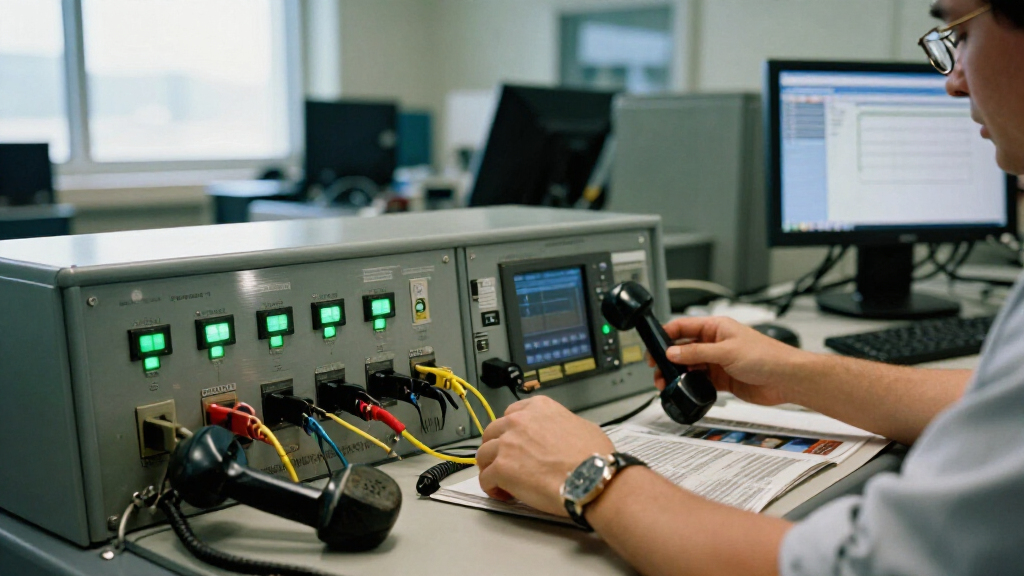

🔍 Read the full analysis: How Telephone Operators Gave Way To Modern Call Systems on ThorstenMeyerAI.com

Get the latest gadgets delivered free with Prime
- Fast, free delivery on millions of items
- Prime Video, Amazon Music and more included
- Member-only deals all year
TL;DR
A November 19, 2026, account from ThorstenMeyerAI.com examines how automatic telephone exchanges replaced much of the manual work done by women operators. It describes losses for incumbent workers alongside new jobs for younger women, while drawing a comparison with clerical work exposed to generative AI.
ThorstenMeyerAI.com published a historical account on November 19, 2026, describing how automatic telephone exchanges displaced much of the manual work performed by women operators. The article says operator numbers among young women fell by 50% to 80% after cities switched to dial systems, while younger women moved into other occupations; it uses the history to examine current concerns about automation and clerical work.
The account follows the Bell System’s move from switchboards, where operators connected calls by plugging cords into jacks, to automatic exchanges that routed calls through mechanical switches. It says the Bell System began converting in 1919, after earlier experiments, and that preparing a city took two to three years. The physical cutover from switchboards to machines could take only a few minutes.
The change unfolded over decades rather than in a single nationwide event. The source reports that 32% of Bell telephones were on dial service by 1930 and 60% by 1940. Wartime copper rationing halted conversions, and the dial system reached the whole Bell network in 1978.
Drawing on estimates by economists James Feigenbaum and Daniel Gross, the article says about 13.7% of white, American-born women born around 1900 worked as operators at some point between 1910 and 1940—roughly one in seven. The account emphasizes that this estimate does not represent all women: AT&T did not hire Black operators until after 1940, according to the source.
Infographic 01 · Rise and fall
The switchboard job: 70 years up, half a century down
The dial arrived city by city from 1919. Yet the number of telephone operators kept growing until 1970, because calls, long distance and office switchboards grew too.
All telephone operators in the US census · thousands
Share of Bell System telephones on dial
Census counts: persons 14 and over, economically active (1950 in the 1950 classification); they include operators at private switchboards. After 1970: −75,000 telephone operator jobs in 1972-1980 (BLS), all of them held by women. 2025: wage and salary jobs (BLS survey), split into telephone operators (3,430) and switchboard operators incl. answering services (34,280). Definitions differ: compare orders of magnitude only.
Sources: US Census Bureau, Historical Statistics of the United States (1975), series D 351; J. Feigenbaum & D. P. Gross, Quarterly Journal of Economics 139(3), 2024 (AT&T archive data, 1930 count, 1 in 7 estimate); C. B. Leon, Monthly Labor Review (June 1982); BLS, Occupational Employment and Wage Statistics, May 2025.
Powered by Thorsten Meyer AI
The Costs Fell Unevenly
The account distinguishes what happened to women already in the occupation from what happened to younger women entering the labor market. It reports that incumbent operators were less likely to be working ten years after a city converted, and that those still employed more often held lower-paid jobs. For young women, however, employment overall did not fall, according to the source; many found work as typists, secretaries and food-service workers.
That distinction matters in current debates about automation. The article points to the International Labour Organization’s assessment that clerical occupations are the job category most exposed to generative AI, with exposure in high-income countries falling more heavily on women’s work than men’s. The historical comparison shows that automation can remove particular tasks and occupations while workers move elsewhere—but it does not establish that today’s effects will follow the same pattern.
Products Worth Considering

LG 27GS60QC-B Ultragear 27-inch Curved Gaming Monitor (QHD, 180Hz, 1ms, 1000R)

Logitech MX Creative Console with 9 Customizable Keys, Graphite

LG UltraGear 27-inch QHD OLED Gaming Monitor, 240Hz, 0.03ms, G-SYNC Compatible, FreeSync Premium Pro, HDR True Black 400
As an affiliate, we earn on qualifying purchases.
From Switchboards to Dial Service
The first telephone exchange opened in New Haven, Connecticut, in 1878, a year after the Bell telephone company was founded, according to the source. Calls initially passed through human operators. Telephone networks required more operators as they expanded because each subscriber added potential connections that had to be made by hand.
Early operators were mostly boys and young men, but telephone companies came to hire predominantly young women. A 1946 US Women’s Bureau report listed employer expectations including a high school diploma, good eyesight and hearing, a “pleasing voice” and a disposition able to handle difficult customers. The source describes the work as better paid and more social than factory employment for some women, while also noting high turnover: internal AT&T memoranda reportedly put annual turnover as high as 40%.
Almon Strowger received a US patent for an automatic telephone exchange in 1891. The familiar story that he invented it after an operator diverted his customers is not confirmed by a primary source, the account says, and should be treated as legend. AT&T began experimenting with automatic switching in 1902, but the source says manual systems remained cheaper and more effective for a time.
“About 13.7% of white, American-born women born around 1900 were telephone operators at some point between 1910 and 1940.”
— ThorstenMeyerAI.com, citing James Feigenbaum and Daniel Gross
Limits of the Historical Estimate
The source’s one-in-seven estimate applies specifically to white, American-born women born around 1900; it should not be read as a figure for all women. The account notes that AT&T did not hire Black operators until after 1940, but does not provide a comparable estimate covering Black workers or other groups.
The account also does not give a full breakdown of how many displaced operators found other work, left the labor force or moved into lower-paid positions. Its comparison with generative AI is an analogy, not evidence that AI will produce the same employment outcomes. The Strowger story about an operator diverting calls is explicitly unverified, and the source’s supplied material gives no detailed figures for the later adoption of automatic switching outside the Bell System.
The AI Comparison Remains Open
The historical conversion is complete: the source dates the dial system’s arrival across the Bell network to 1978. The next question raised by the account is how current AI exposure will affect clerical workers, especially women in high-income countries. The source identifies the ILO assessment but provides no specific forecast for job losses, a timeline for those effects or a measured comparison with the telephone transition.
Readers looking for a direct comparison should watch for evidence about which tasks change, whether jobs disappear or are reorganized, and what replacement work is available to affected workers. The account offers a historical case for asking those questions, not a prediction of their answers.
Key Questions
When did automatic telephone switching begin?
The Bell System began converting to automatic switching in 1919, according to the source. Earlier experiments had taken place, and the process reached the whole Bell network in 1978.
How quickly did operators’ numbers fall after a city converted?
The account reports a 50% to 80% decline among young operators after a city switched to dial service. It does not provide a single figure for every city or for all operators.
What happened to younger women who might have become operators?
The source says young women’s employment did not fall overall. It reports that many moved into work such as typing, secretarial jobs and food service, including industries that had not previously hired many such workers.
Does the account prove that AI will have the same effects?
No. The account draws a comparison between telephone automation and today’s exposure of clerical work to generative AI, but it does not show that their employment effects will be identical.
Source: ThorstenMeyerAI.com