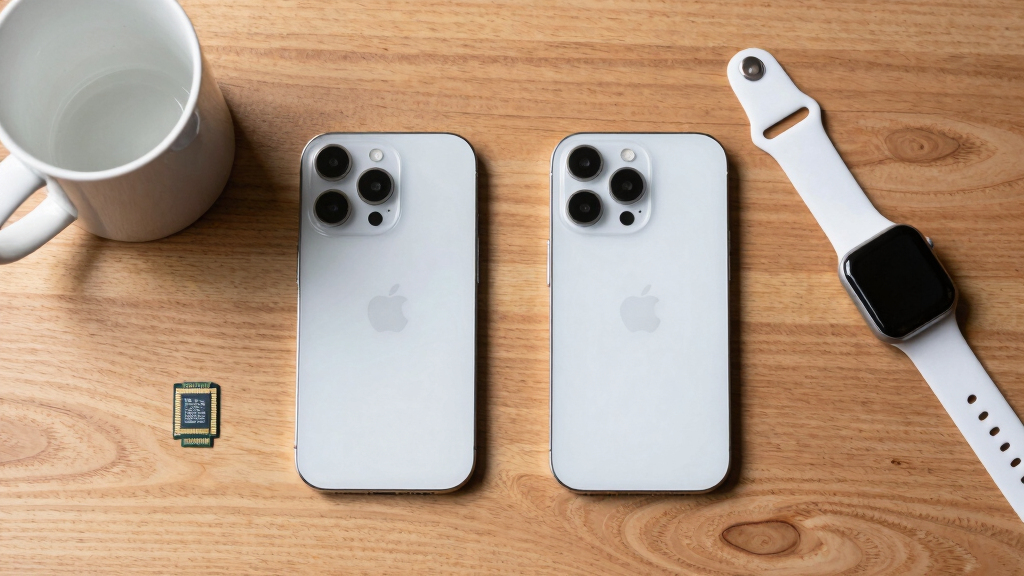

📊 Full opportunity report: Apple Is Reaching for Chinese Memory. Europe Doesn’t Even Have That Option. on ThorstenMeyerAI.com — validation score, market gap, and execution plan.

Get the latest gadgets delivered free with Prime
- Fast, free delivery on millions of items
- Prime Video, Amazon Music and more included
- Member-only deals all year
TL;DR
Apple is requesting U.S. approval to purchase memory chips from China’s CXMT, exposing its dependence on Chinese and American suppliers. Europe, lacking its own memory industry, faces greater vulnerability in supply chain disruptions.
Apple is actively lobbying Washington for permission to purchase memory chips from Chinese manufacturer CXMT, a company on the Pentagon’s blacklist. This move comes shortly after Apple raised prices on Macs and iPads, citing a global memory shortage. The development underscores Apple’s dependence on Chinese memory suppliers, despite ongoing geopolitical tensions and U.S. restrictions.
According to sources, Apple’s request aims to circumvent U.S. export controls that restrict sales of certain advanced chips to Chinese firms. Apple’s lobbying efforts follow a recent surge in memory prices, which have increased roughly fourfold over the past three quarters, affecting global supply chains.
Meanwhile, Europe faces a stark contrast: it has no domestic memory chip industry and relies heavily on imports from East Asia and the U.S. Europe’s major memory manufacturers—Samsung, SK Hynix, and Micron—are all outside the continent, making it vulnerable to supply disruptions and price fluctuations.
This situation highlights Europe’s limited leverage in the global semiconductor market, with its share of manufacturing less than 12 percent and almost no capacity for high-performance memory like HBM. The EU’s tools—subsidies, regulation, and public procurement—are insufficient to create a competitive memory industry or to secure supply chains, especially given that key fabrication capacity is fully booked by U.S. hyperscalers and AI labs.
Apple is reaching for Chinese memory. Europe doesn’t even have that option.
The shortage exposes America’s dependence — and Europe’s far more brutally. Apple has a domestic supplier, political weight, and the China option. Europe has no memory of its own, no seat at the table, no leverage on what counts.
- EU makes < 10% of the world’s semiconductors
- Effectively no DRAM, no HBM from Europe
- 3–4 memory makers worldwide — none European
- Pure price-taker: memory ~4× in 3 quarters
- ASML: EUV monopoly — no leading-edge chip without it
- Zeiss: precision optics, unrivalled worldwide
- imec · CEA-Leti · Fraunhofer: world-class research
- Infineon, NXP, STMicro: automotive · power · SiC
The shortage is a sovereignty test — Europe fails on supply but still holds the leverage in its hand. If even Apple can’t buy its way out, Europe’s answer isn’t to buy its way in, but to run two tracks: press the unique chokepoints as real leverage — and cut dependence wherever it can without Brussels: local-first, open weights, quantization, right-sized hardware. Bury the 20% dream, defend what’s yours, need less.
Implications of Europe’s Memory Industry Gap
This development matters because it exposes Europe’s lack of strategic independence in critical technology sectors. Europe’s inability to produce or secure sufficient memory supplies leaves it dependent on external sources, increasing vulnerability during geopolitical tensions or supply chain disruptions. Apple’s move underscores the risks of reliance on Chinese memory chips, especially as U.S. restrictions tighten.
For consumers and industries relying on semiconductors, this dependence could mean higher prices and greater supply instability. Politically, it emphasizes the urgency for Europe to build resilient, upstream capabilities or accept continued dependency on global suppliers controlled by non-European entities.
As an affiliate, we earn on qualifying purchases.
Europe’s Semiconductor Manufacturing Limitations
Europe produces less than 12 percent of the world’s semiconductors, with memory manufacturing almost nonexistent within the continent. The number of European memory chip makers has dwindled from over twenty in the 1990s to just a handful today, none of which produce the high-performance memory critical for AI and advanced computing.
Major fabrication facilities are located in East Asia, with design and R&D concentrated mainly in the U.S. Europe’s existing industry is focused on automotive chips and power semiconductors, not cutting-edge memory. The EU’s ambitious Chips Act aimed to double Europe’s market share to 20 percent by 2030 but has fallen short, with current estimates around 11.7 percent and projections indicating even less.
Recent projects like Intel’s Magdeburg plant and the STMicro/GlobalFoundries fab in Crolles have faced delays or cancellations, highlighting the continent’s challenges in establishing independent fabrication capacity. Meanwhile, the global memory market is dominated by a few players with entrenched supply chains, making Europe a price-taker without significant influence.
“Our tools are limited in addressing the fundamental lack of domestic manufacturing capacity for advanced memory chips.”
— European Commission official
As an affiliate, we earn on qualifying purchases.
Uncertainties in Europe’s Semiconductor Future
It remains unclear whether Europe will significantly accelerate its efforts to build domestic memory fabrication capacity or continue relying on chokepoints like ASML. The feasibility of achieving the 20 percent market share target by 2030 appears increasingly unlikely, given current investments and technological hurdles. Additionally, the long-term impact of U.S. export controls and Chinese supply chain developments on global memory markets is still evolving.
As an affiliate, we earn on qualifying purchases.
Next Steps in Europe’s Semiconductor Strategy
Europe is expected to focus on strengthening its existing chokepoints, such as ASML and research institutions, to build strategic leverage and resilience. The EU’s upcoming policy initiatives, including the next phase of the Chips Act and increased investment in advanced packaging and new memory architectures, aim to address these gaps. Meanwhile, Apple’s lobbying efforts in Washington will continue to influence U.S.-China semiconductor policies, affecting global supply chains.
As an affiliate, we earn on qualifying purchases.
Key Questions
Why is Apple seeking Chinese memory chips despite U.S. restrictions?
Apple is lobbying for permission to buy chips from CXMT, a Chinese manufacturer on the Pentagon’s blacklist, due to the global memory shortage and the need to maintain supply for its products.
What does Europe’s lack of memory manufacturing mean for its tech industry?
Europe’s absence of domestic memory chip production makes its tech industry highly dependent on external suppliers, increasing vulnerability to supply disruptions and price volatility.
Can Europe develop its own memory industry quickly?
Current estimates suggest that building a competitive memory industry in Europe would require over €250 billion and decades of development, which is unlikely to be achieved by 2030.
What strategic options does Europe have to improve its position?
Europe can focus on strengthening its existing chokepoints, like ASML, and investing in research and partnerships, rather than attempting full autarky, which remains unrealistic in the near term.
How might U.S.-China tensions impact global memory supply chains?
U.S. export controls and Chinese efforts to develop independent supply chains could further fragment the market, complicate supply security, and influence prices worldwide.
Source: ThorstenMeyerAI.com
Fall Picks
fall essentials
As an affiliate, we earn on qualifying purchases.