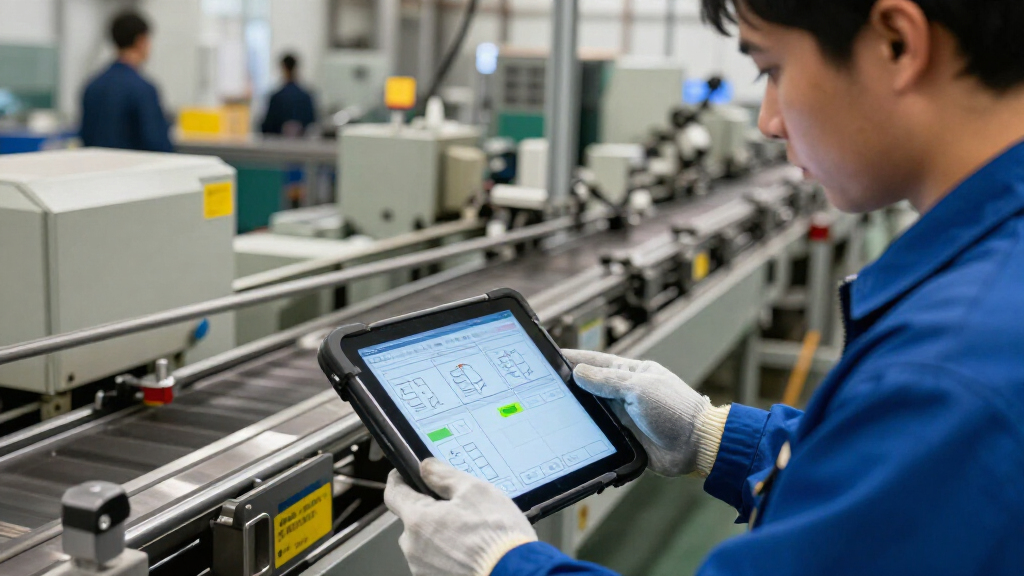

🔍 Read the full analysis: How AI Is Becoming Part Of The Factory Work Conversation on ThorstenMeyerAI.com

Get the latest gadgets delivered free with Prime
- Fast, free delivery on millions of items
- Prime Video, Amazon Music and more included
- Member-only deals all year
TL;DR
A November 8, 2026, episode from ThorstenMeyerAI.com examines the long decline in factory employment alongside rising US manufacturing output, and the different trajectories of Germany and China. It does not provide evidence that AI caused those changes or quantify AI’s effect on factory jobs; that impact remains unclear.
ThorstenMeyerAI.com published a report on November 8 tracing how factory employment has changed in the United States, Germany and China, against a broader conversation about AI and work. Its figures show that US manufacturing employment fell from a June 1979 peak of 19.6 million to 12.7 million in October 2026, while inflation-adjusted factory output was nearly twice its 1979 level in September. The report does not measure AI’s role in those trends, so it cannot establish how much AI is changing factory jobs today.
The episode, identified as “Work After Work,” Episode 6, draws on US Bureau of Labor Statistics payroll data and a Federal Reserve manufacturing production index. The BLS series counts payroll jobs at employers outside farming; it excludes self-employed people and private household workers. Its monthly record begins in January 1939. The report says manufacturing accounted for 8.0% of US payroll jobs in October 2026, compared with 21.7% at the 1979 employment peak and a high of 38.8% in November 1943.
The decline accelerated in the 2000s. US factory employment fell from 17.3 million in January 2000 to 11.4 million in February 2010, a loss of almost six million jobs, according to the report. Employment later recovered somewhat, but the October 2026 estimate of 12.7 million is preliminary. Meanwhile, the Federal Reserve index cited in the episode puts manufacturing output at 98.4 in September 2026, compared with 50.4 in June 1979, using a 2017 index base. The report calculates that output per factory job was roughly three times the 1979 level, while cautioning that this is a jobs-based comparison, not a measure of hours worked.
The account also describes different national timelines. In Germany, industry and construction accounted for 22.9% of workers in 2025, down from 49.2% in West Germany in 1965, using figures from the Federal Statistical Office. For China, the report says industry and construction employment peaked at 232 million in 2012. It presents these figures as part of a history of structural economic change, not as evidence that AI produced the employment declines.
Factory Output and Jobs Diverge
The figures matter because factory employment and factory production do not move in lockstep. The US has fewer manufacturing jobs than at its 1979 peak, yet the cited production index was nearly twice its 1979 level in September 2026. That difference helps explain why a discussion of factory work and AI cannot rely on job totals alone: production, employment, hours, occupations and working conditions are distinct measures.
The report also puts a limit on the familiar claim that manufacturing jobs simply went overseas. It says the US decline began 22 years before China joined the World Trade Organization. Citing economists’ estimates, it says rising Chinese imports cost up to about one million US factory jobs from 1999 to 2011, out of almost six million lost over that period. The wording matters: trade is presented as one contributing factor, not the sole explanation.
For workers and policymakers, the key distinction is between a historical pattern and a current cause. Employment and output data document long-term changes, but they do not show which tasks were automated, what technologies firms adopted, or whether AI is creating, replacing or changing particular jobs. Those questions require evidence beyond broad sector-level totals.
Products Worth Considering

Bose QuietComfort Headphones (2nd Gen), Wireless Over-Ear Noise-Cancelling Headphones, Eucalyptus Green

DJI Mic 3 (2 TX + 1 RX + Charging Case) Wireless Microphone

LG UltraGear 27-inch QHD OLED Gaming Monitor, 240Hz
As an affiliate, we earn on qualifying purchases.
Decades of Industrial Change
The report separates two milestones often blurred together: the peak in manufacturing’s share of US jobs and the peak in the number of factory workers. The share reached 38.8% in November 1943 during World War II, then declined. The headcount continued climbing as the economy expanded, reaching a seasonally adjusted 19,553,000 in June 1979. In other words, the share peaked 36 years before the job count.
After the 1979 high, employment dropped during the early-1980s recessions, partially recovered, and fell again during the 2000s. The episode also notes that the US manufacturing output index reached a high of 108.6 in December 2007. By September 2026, it remained about 9% below that level. The long-run comparison with 1979 therefore does not mean output kept rising continuously: the report says it has been flat since the 2007 high.
Comparisons across countries require care. The German figures cover the producing sector, including construction, energy, water and mining, not manufacturing alone. Destatis notes classification changes in 1970 and 1991, and the report compares West Germany in 1965 with unified Germany in later years. These definitions differ from the US factory-job series and the Chinese industry-and-construction count.
“The number to remember is 19.6 million.”
— Thorsten Meyer, ThorstenMeyerAI.com
AI’s Role Is Not Measured
The report’s headline theme concerns AI and factory work, but the supplied material does not identify specific AI systems, factory deployments, affected occupations or measured employment effects. It offers historical employment and output statistics rather than a study of AI adoption. It is not clear from this report how many factory jobs, if any, have been changed or eliminated by AI.
The latest US employment figure is preliminary, and the output comparison uses an index rather than a direct count of products. The report’s rough output-per-job calculation does not account for hours worked, changes in the kinds of goods produced, or other differences between the periods. The cited estimates on trade also do not account for all causes of job losses. The supplied source text ends during its discussion of Germany, so further details about its China analysis and any specific AI evidence are not available here.
Evidence Needed on AI Adoption
The next useful evidence would be firm-level or workplace data showing where factories have adopted AI, what tasks the systems perform, and how employment, hours, output and working conditions changed afterward. Comparisons over time would also need to distinguish AI from robotics, other automation, trade, economic cycles and shifts in demand.
For now, the episode provides a historical baseline, not a forecast of AI’s effects. Readers can treat the employment and production figures as a record of industrial change while waiting for more specific, attributable evidence on AI deployments and their outcomes. The October 2026 US employment estimate may also be revised as official data are updated.
Key Questions
What is the main development in the report?
ThorstenMeyerAI.com published an episode on November 8, 2026, examining long-term factory employment and output trends in the United States, Germany and China, alongside the broader discussion of AI and work.
How many people worked in US factories at the 1979 peak?
The report cites a seasonally adjusted total of 19,553,000 in June 1979, commonly rounded to 19.6 million. It says the preliminary October 2026 count was 12.7 million.
Does the report show that AI caused factory job losses?
No. It presents historical employment and output statistics but does not measure AI adoption or attribute job losses to AI. Its figures cannot establish AI’s current effect on factory employment.
Did US factory output also fall after 1979?
Not across the whole period. The cited Federal Reserve index was nearly twice its June 1979 level in September 2026, but the report says output peaked in December 2007 and remained about 9% below that high in September 2026.
Were US manufacturing job losses all caused by imports from China?
The report says no. It cites economists’ estimates that rising Chinese imports cost up to about one million US factory jobs from 1999 to 2011, out of almost six million lost. It also notes that the US decline began 22 years before China joined the WTO.
Source: ThorstenMeyerAI.com