
TL;DR

Get the latest gadgets delivered free with Prime
- Fast, free delivery on millions of items
- Prime Video, Amazon Music and more included
- Member-only deals all year
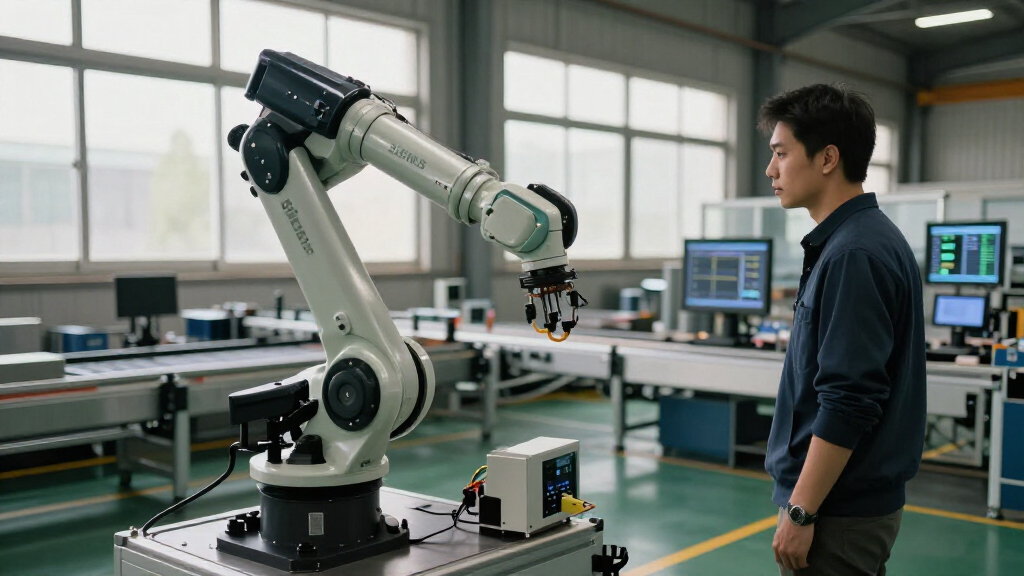
Siemens is advancing its industrial AI strategy by developing the Industrial Foundation Model and partnering with NVIDIA to embed AI across manufacturing. The focus is on physical, domain-specific AI rather than chatbots, aiming to reshape factory operations.
Siemens has revealed a strategic roadmap to embed artificial intelligence across its industrial operations, emphasizing physical AI over language-based models. The company’s plans include launching a new Industrial Foundation Model and expanding its partnership with NVIDIA to develop an ‘Industrial AI Operating System’ that aims to transform manufacturing and engineering processes.
At CES 2026, Siemens announced the development of the Industrial Foundation Model (IFM), designed to process and contextualize 3D models, 2D drawings, and operational data to optimize engineering and automation. This model is tailored specifically for industrial modalities, contrasting with general-purpose large language models (LLMs) that focus on text.
The company is also expanding its collaboration with NVIDIA to build the Industrial AI Operating System, a platform intended to embed AI throughout the entire industrial lifecycle—from design and engineering to manufacturing and supply chains. Key features include GPU-accelerated simulation, generative digital twins, and real-time optimization, with the first fully AI-driven factory expected to launch in Erlangen, Germany, in 2026.
Siemens claims its proprietary industrial data—derived from decades of operational telemetry, engineering models, and automation logic—provides a significant advantage over startups and research labs. The company emphasizes that domain expertise and existing customer relationships position it uniquely to lead this transformation.
Implications of Siemens’ Industrial AI Strategy
This shift signals a major evolution in factory automation, moving toward AI systems that actively engineer and optimize physical processes rather than just simulate or monitor them. Siemens’ focus on domain-specific models and proprietary data could accelerate the adoption of AI in manufacturing, potentially increasing efficiency, reducing costs, and enabling new levels of customization. However, the heavy reliance on NVIDIA’s infrastructure and the lengthy industrial adoption cycle mean widespread impact will unfold gradually.
As an affiliate, we earn on qualifying purchases.
Background of Siemens’ Industrial AI Initiatives
Since announcing the Industrial Foundation Model at Hannover Messe 2025, Siemens has positioned itself as a leader in applying AI to manufacturing. Its partnership with NVIDIA, announced in late 2024, aims to develop a comprehensive AI platform tailored for industrial use cases, emphasizing GPU acceleration and physics-based simulation. The company’s existing customer base includes major manufacturers like PepsiCo and Audi, which are already integrating Siemens’ automation tools, providing a foundation for AI-driven upgrades.
This approach marks a departure from the broader, language-focused AI trends that dominate consumer tech, instead targeting the physical world where domain knowledge and proprietary data are critical. The strategy aligns with Siemens’ long-standing expertise in industrial automation and engineering.
“Industrial AI is no longer a feature; it’s a force that will reshape the next century.”
— Roland Busch, Siemens CEO
GPU-accelerated simulation tools for manufacturing
As an affiliate, we earn on qualifying purchases.
As an affiliate, we earn on qualifying purchases.
Uncertainties Surrounding Siemens’ Industrial AI Roadmap
While Siemens has announced ambitious plans, specific details about the deployment timelines, hardware configurations, and performance metrics of the Industrial AI Operating System remain undisclosed. The effectiveness of the models and the speed of adoption across industrial customers are still unproven at scale. Additionally, the reliance on NVIDIA’s infrastructure raises questions about sovereignty and dependency, especially for European clients.
As an affiliate, we earn on qualifying purchases.
Next Steps for Siemens’ Industrial AI Deployment
Siemens plans to launch its first fully AI-driven factory in Erlangen in 2026, serving as a blueprint for future projects. The company will also introduce Digital Twin Composer and nine industrial copilots, with pilot programs involving clients like PepsiCo. Monitoring the performance of these initiatives and their integration into existing manufacturing processes will be critical over the coming year.
3D CAD modeling software for manufacturing
As an affiliate, we earn on qualifying purchases.
As an affiliate, we earn on qualifying purchases.
Key Questions
What is the Industrial Foundation Model?
The Industrial Foundation Model (IFM) is Siemens’ custom AI model designed to process and interpret industrial data such as 3D models, drawings, and sensor telemetry to optimize engineering and automation tasks.
How does Siemens’ partnership with NVIDIA enhance its AI capabilities?
The partnership provides GPU-accelerated simulation, physics-based AI models, and a shared platform—the Industrial AI Operating System—that enables real-time digital twin optimization and active manufacturing intelligence.
What are the main advantages Siemens claims in this AI approach?
Siemens benefits from proprietary, domain-specific data, deep industrial expertise, and existing customer relationships, giving it an edge over startups in deploying physical AI solutions.
When will the first AI-driven factory be operational?
The Siemens Electronics Factory in Erlangen is expected to become fully AI-driven in 2026, serving as a model for future implementations globally.
What are the main risks or challenges Siemens faces?
Dependence on NVIDIA’s infrastructure, the slow pace of industrial adoption, and the lack of publicly validated performance data pose significant challenges to Siemens’ roadmap.
Source: ThorstenMeyerAI.com
Halloween Picks
halloween
As an affiliate, we earn on qualifying purchases.