📊 Full opportunity report: TRT Symptom And Lab Tracking: A Patient-Friendly Guide on IdeaNavigator AI — validation score, market gap, and execution plan.

Get the latest gadgets delivered free — and shop member deals
- Fast, free delivery on millions of items
- Access to Prime Big Deal Days deals on October 6–7
- Prime Video, Amazon Music and more included
TL;DR
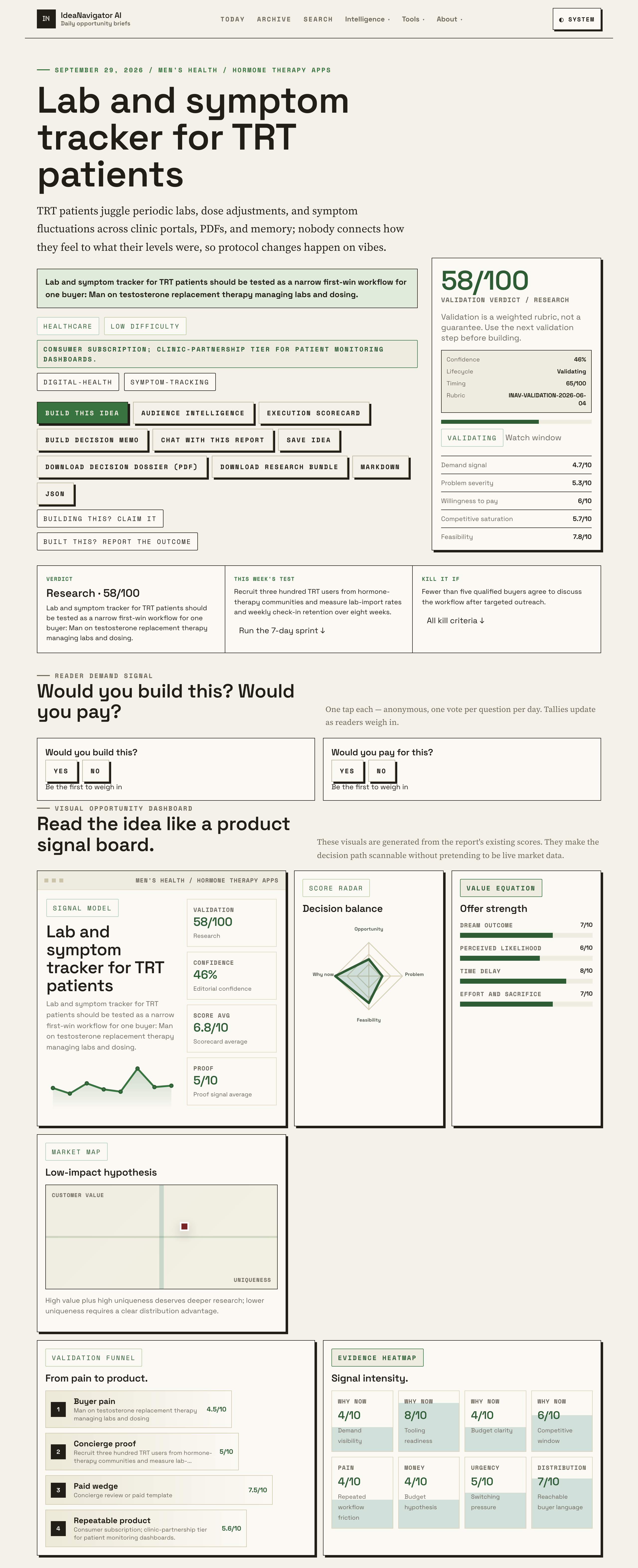
An analysis by IdeaNavigator AI proposes a subscription app that imports lab PDFs for men on testosterone replacement therapy and charts hormone panels against dose changes and daily symptom check-ins. The proposal argues TRT care is fragmented across telehealth clinics, and lays out an eight-week validation plan targeting 300 users. No product has been built or tested yet.
A new product analysis from IdeaNavigator AI proposes a dedicated tracking app for men on testosterone replacement therapy (TRT), arguing that a fast-growing population of self-managing patients currently juggles lab results, dose adjustments, and symptom fluctuations across disconnected clinic portals, PDF files, and memory. The concept, outlined in detail on the firm’s site, targets a single buyer: a man on TRT managing his own labs and dosing, and calls for the tool to be tested as a narrow first-win workflow rather than a broad men’s health platform.
The core problem the analysis identifies is a disconnect between how TRT patients feel and what their bloodwork shows. Patients on TRT undergo periodic hormone panels, receive dose adjustments from clinics, and experience day-to-day symptom changes — but, according to IdeaNavigator AI, nobody connects subjective symptoms to objective lab values. The result, the analysis states, is that protocol changes happen “on vibes” rather than on correlated data.
The proposed minimum viable product has four functions: import lab PDFs, chart hormone panels over time against dose changes and daily symptom check-ins, generate trend summaries for clinic visits, and flag values drifting outside target ranges. The app would sit in the men’s health and hormone therapy app market, monetizing through a consumer subscription plus a clinic-partnership tier offering patient monitoring dashboards for providers.
The analysis also specifies a validation path before any build: recruit 300 TRT users from hormone-therapy communities and measure two metrics over eight weeks — lab-import rates and weekly check-in retention. This is a concept document, not a launched product; no app, company, or clinical partnership exists yet.
Why Fragmented TRT Care Creates an Opening
The analysis rests on a structural claim about why now: TRT prescriptions and telehealth clinics have surged, producing what IdeaNavigator AI describes as a large self-managing patient population whose care is fragmented across providers by design. Men may switch clinics, use multiple telehealth services, or supplement clinic care with their own research, leaving no single longitudinal record linking symptoms, doses, and lab values.
If the validation metrics bear out — meaningful lab-import rates and sustained weekly check-ins — the concept would demonstrate that patients will consolidate their own hormone data even without a provider mandating it. That would matter both for consumers, who gain a clearer basis for clinic conversations, and for clinics, which could use aggregated dashboards to monitor patients between visits. The clinic-tier revenue model also signals that the opportunity is not purely consumer software but potentially B2B healthcare tooling.
The stakes are health-related: TRT dosing decisions affect hormone levels that influence mood, energy, fertility, and cardiovascular markers. A tool that makes drift visible earlier could change how patients and clinicians time interventions — though the analysis itself makes no clinical claims and frames the app purely as a tracking and summary aid, not a diagnostic device.
TRT, Telehealth, and the Tracking Gap
Testosterone replacement therapy involves regular bloodwork — typically hormone panels measuring total and free testosterone, estradiol, hematocrit, and related markers — with doses adjusted in response. Telehealth platforms have lowered the barrier to obtaining TRT prescriptions, and online hormone-therapy communities have grown into active discussion hubs where patients compare protocols and lab results.
Against that backdrop, the analysis positions symptom-and-lab correlation as the missing layer. Existing tools generally handle one side or the other: clinic portals store lab results but rarely link them to patient-reported symptoms, while general symptom trackers have no concept of hormone panels or dose timelines. The proposed MVP would bridge the two by anchoring daily check-ins to the same timeline as dose changes and imported panel results.
The recommendation to build for one narrow buyer — the self-managing TRT patient — reflects a deliberate sequencing choice in the analysis: prove a focused workflow works before expanding into broader men’s health features or additional conditions.
Unproven Demand and Clinical Boundaries
Several things remain untested. The market-timing claim about surging TRT prescriptions is presented by IdeaNavigator AI without cited figures, and the size of the addressable population is not quantified. Whether patients will actually complete daily symptom check-ins over months — a known retention challenge for health apps — is precisely what the eight-week validation is designed to answer, and it has not been run.
The technical feasibility of reliable lab PDF import across different clinics’ report formats is also unverified, since lab PDFs vary widely in structure. On the clinical side, the analysis does not address how the app’s out-of-range flags would be defined, whether they would require regulatory review as decision-support software, or what liability clinics would accept in a monitoring dashboard. No medical or regulatory claims appear in the concept, and none should be inferred.
Finally, no pricing, competitive analysis against existing hormone-tracking apps, or clinic partner interest has been disclosed.
From Concept to Validation Run
According to the analysis’s own roadmap, the immediate next step is validation rather than building: recruiting 300 TRT users from hormone-therapy communities and running the eight-week measurement of lab-import rates and weekly check-in retention. Those two numbers would determine whether the workflow earns an MVP build.
If validation succeeds, the sequence the concept implies is building the PDF-import and charting MVP, then testing consumer subscription willingness to pay, and only afterward approaching clinics about the monitoring-dashboard tier. If retention or import rates fall short, the analysis’s framing suggests narrowing further or rethinking the check-in burden. It remains to be seen whether any team takes up the concept, since IdeaNavigator AI presents it as an opportunity assessment rather than an announced venture.
Source: IdeaNavigator AI
Key Questions
Does a TRT lab and symptom tracking app exist yet?
No. This is a published product concept and validation plan from IdeaNavigator AI. No app, company, or clinic partnership has been announced or built.
What would the proposed app actually do?
Its four core functions would be importing lab PDFs, charting hormone panels against dose changes and daily symptom check-ins, generating trend summaries for clinic visits, and flagging values drifting outside target ranges.
How would the concept be validated?
By recruiting 300 TRT users from hormone-therapy communities and measuring two metrics over eight weeks: how often users import lab results and how well weekly symptom check-ins retain users.
Is the app meant to replace clinic decisions on TRT dosing?
No. The concept frames the app as a tracking and summary aid that gives patients and clinicians better-organized data. It makes no diagnostic or treatment claims, and dosing decisions would remain with clinicians.
How would the product make money?
Per the analysis, through a consumer subscription for individual users and a clinic-partnership tier offering patient monitoring dashboards for providers.
Source: IdeaNavigator AI
Fall Picks
fall essentials
As an affiliate, we earn on qualifying purchases.