For most paint and finish matching, I would start with the Nix Spectro 2 for its portable, app-oriented workflow; the Spectro 1 Pro is another paint-focused option, while the multi-aperture instrument suits buyers who need broader measurement flexibility. The right handheld spectrophotometer for color matching depends on more than a stated accuracy figure: sample size, surface texture, aperture, software, and color-difference reporting all affect whether readings help you make a reliable match. Dedicated paint tools can be easier to use, while configurable instruments may suit production or quality-control work better. I compare the tradeoffs, limits, and best-fit users across all 13 options below.

Get the latest gadgets delivered free — and shop member deals
- Fast, free delivery on millions of items
- Access to Prime Big Deal Days deals on October 6–7
- Prime Video, Amazon Music and more included
Complete the kit



Key Takeaways
- Paint matching and measurement flexibility are different priorities: the Spectro 1 Pro and Spectro 3 are paint-oriented choices, while multi-aperture and D/8 instruments offer a more measurement-focused approach.
- Aperture choice affects practical usefulness: the VTSYIQI model with 8 mm and 11 mm apertures offers more size flexibility than the single-aperture listings, but a larger aperture still needs a sufficiently flat, even sample.
- Stated precision alone does not settle the ranking: a specification such as ΔE*ab ≤ 0.02 is only useful when the device’s measurement conditions, calibration, and software suit the buyer’s matching workflow.
- Display and locating features can reduce friction: models with an onboard display or camera locating may appeal to users who need readings away from a phone-led workflow or have trouble positioning small samples.
- Data handling separates casual matching from repeatable work: storage, densitometry, standards, and parameter options matter more when users need records or quality checks than when they only need occasional paint comparisons.
| Spectro 1 Pro Portable Paint Color Matching Spectrophotometer |  | Best for Paint Matching | Manufacturer: Variable, Inc. | Model: 9200SCI | Weight: 8 ounces | VIEW ON AMAZON | See Our Full Breakdown |
| Nix Spectro L Spectrophotometer and Densitometer |  | Best for Print and Cross-Media Work | Brand: Nix | Model: NIXSPECTROL | Measurement modes: M0, M1, M2 | VIEW ON AMAZON | See Our Full Breakdown |
| Digital Spectrocolorimeter Multi-Aperture Handheld Spectrophotometer with ΔE*ab ≤ 0.02 Accuracy, Camera Locating and 30 Parameters (D/8 SCI ASTM ISO Standard) |  | Best for High-Precision Color Control | Manufacturer: VTSYIQI | Optical structure: D/8 diffused illumination | Repeatability: ΔE*ab ≤ 0.02 | VIEW ON AMAZON | See Our Full Breakdown |
| CNYST Handheld Spectrophotometer Colorimeter with 8 mm Measuring Aperture |  | Best for App-Based Color Records | Measuring aperture: 8 mm | L range: 0–120 | Light source: Full-band balanced LED | VIEW ON AMAZON | See Our Full Breakdown |
| VTSYIQI Handheld Spectrophotometer with 8 mm and 11 mm Apertures |  | Best for Flexible Sample Sizes | Apertures: 8 mm and 11 mm | Repeatability accuracy: dE*ab ≤ 0.04 | Measurement parameters: Over 30 | VIEW ON AMAZON | See Our Full Breakdown |
| Handheld Spectrophotometer Color Meter with 10 mm Aperture and Data Storage |  | Best for Flexible Lighting and Record Keeping | Measuring aperture: 10 mm | Color spaces: CIE-L*a*b, L*C*h, L*u*v, XYZ, Yxy, reflectance | Color difference formulas: ΔE*ab, ΔE*CH, ΔE*uv, ΔE*cmc (2:1 and 1:1), ΔE*94, ΔE*00 | VIEW ON AMAZON | See Our Full Breakdown |
| Spectro 3 Mobile Spectrophotometer and Paint Color Matching Tool | 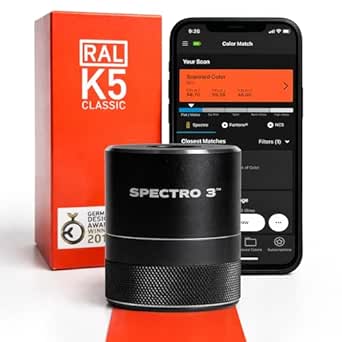 | Best for Color-and-Gloss Checks Across Materials | Measurement functions: Color and 60° gloss | Optical geometries: 45/0° and d/8° | UV detection: Built-in UV illumination for fluorescence detection | VIEW ON AMAZON | See Our Full Breakdown |
| VTSYIQI Portable D/8 Spectrophotometer with Auto Calibration |  | Best for High-Volume Lab Color Management | Measurement geometry: D/8 | Stated accuracy: dE*ab ≤ 0.04 | Apertures: 8 mm and 11 mm | VIEW ON AMAZON | See Our Full Breakdown |
| CNYST Handheld Spectrophotometer with Display |  | Best for App-and-PC Color Management | Measurement repeatability: ΔE*ab ≤ 0.03 | Measurement parameters: More than 30 | Light source: LED | VIEW ON AMAZON | See Our Full Breakdown |
| Nix Spectro 2 Portable Spectrophotometer |  | Best for App-Led Paint and Print Matching | Scan rate: 1 scan per second | Channels: 31 UV-visible channels | Supported color formats: CMYK, ink density, RGB, HEX | VIEW ON AMAZON | See Our Full Breakdown |
| GOYOJO TS7600 Handheld Spectrophotometer |  | Best for Fluorescent Materials | Detector: Silicon photodiode array | Grating: 1000-line blazed grating | Visible-range accuracy: Within 10 nm | VIEW ON AMAZON | See Our Full Breakdown |
| VTSYIQI Handheld Spectrophotometer with Visual Observation |  | Best for Parameter-Rich Lab Workflows | Measurement repeatability: dE*ab ≤ 0.04 | Measurement parameters: Over 30 | Evaluation light sources: Nearly 40 | VIEW ON AMAZON | See Our Full Breakdown |
| HOJILA LS176 Handheld Spectrophotometer Colorimeter |  | Best for Self-Contained Color Matching | Illumination geometry: D/8, specular component included (SCI) | Light source and spectral range: Full-spectrum LED; 400–700 nm | Spectral interval: 10 nm | VIEW ON AMAZON | See Our Full Breakdown |
| handheld spectrophotometer for color matching | Weight |
|---|---|
| Spectro 1 Pro Portable Paint C | 8 ounces |
| Nix Spectro L Spectrophotomete | 110 g |
| Digital Spectrocolorimeter Mul | — |
| CNYST Handheld Spectrophotomet | 4.4 pounds |
| VTSYIQI Handheld Spectrophotom | 11.02 pounds |
| Handheld Spectrophotometer Col | — |
| Spectro 3 Mobile Spectrophotom | 11.7 ounces |
| VTSYIQI Portable D/8 Spectroph | — |
| CNYST Handheld Spectrophotomet | — |
| Nix Spectro 2 Portable Spectro | — |
| GOYOJO TS7600 Handheld Spectro | — |
| VTSYIQI Handheld Spectrophotom | 11.02 pounds |
| HOJILA LS176 Handheld Spectrop | About 325 g |
More Details on Our Top Picks
Spectro 1 Pro Portable Paint Color Matching Spectrophotometer
The Spectro 1 Pro is the clearest fit here for buyers whose main job is matching paint rather than managing print production data. Its wireless link to an iOS or Android app and support for major paint-brand fan deck libraries make it easier to move from a surface reading to a usable paint reference. Compared with the Nix Spectro L, which adds CMYK, ink density, and multiple measurement modes, this model keeps its appeal focused on paint selection. That narrower scope is a benefit for decorators and paint professionals who do not need print metrics, but a limitation for labs working across materials. It is lightweight and includes a carrying pouch, though the app is required for use, so buyers without a compatible phone should choose a standalone-oriented option instead.
Pros:- Supports fan deck libraries from major paint brands
- Wireless connection to the Spectro app on iOS and Android
- Portable 8-ounce design with a protective carrying pouch
- USB charging cable is included
Cons:- Requires a compatible iOS or Android device to use
- Its stated feature set is more paint-focused than the Nix Spectro L’s print and spectral analysis tools
Best for: Decorators, painters, and paint-counter staff who want to compare scanned colors with major paint-brand fan decks using a phone.
Not ideal for: Print and packaging teams that need CMYK, ink-density, or M0/M1/M2 measurements, or buyers who do not want to rely on a mobile app.
- Manufacturer:Variable, Inc.
- Model:9200SCI
- Weight:8 ounces
- Dimensions:8 x 2.5 x 2 inches
- Connectivity:Wireless
- Battery:1 included lithium-ion battery
- Included accessories:USB charging cable and protective carrying pouch
Our verdict“Choose the Spectro 1 Pro if paint-library matching through a phone matters more than print-oriented measurement features.”
Nix Spectro L Spectrophotometer and Densitometer
The Nix Spectro L earns its place for buyers who need color matching to bridge print, packaging, and paint tasks. Its readings include CMYK, RGB, and HEX, while M0, M1, and M2 modes and Delta-E analysis give production teams more ways to compare color than the paint-centered Spectro 1 Pro. The app’s library of more than 200,000 paint shades adds useful crossover for teams that also specify coatings. Its metal body and USB-C charging suit frequent professional handling, and the compact 110 g build is easy to carry between workstations. The tradeoff is that enhanced Pantone, RAL, and NCS library compatibility requires a subscription; buyers focused only on paint matching may find the extra print tools unnecessary.
Pros:- Reports CMYK, ink density, RGB, and HEX values
- M0, M1, and M2 measurement modes support varied production workflows
- Delta-E analysis helps quantify differences between color readings
- App library includes more than 200,000 paint shades
Cons:- Enhanced Pantone, RAL, and NCS library compatibility requires a subscription
- Its broad print and spectral feature set may be unnecessary for paint-only matching
Best for: Print, packaging, and graphic-arts professionals who also need access to a broad paint-shade library for cross-media color work.
Not ideal for: Homeowners or paint-only users who want a simple paint match and have no use for CMYK, ink-density, spectral modes, or subscription-based library access.
- Brand:Nix
- Model:NIXSPECTROL
- Measurement modes:M0, M1, M2
- Sensor:31-channel expanded sensor
- Dimensions:1.77 x 2.36 x 2.36 inches
- Weight:110 g
- Power:USB-C rechargeable
- Material:Metal
Our verdict“Pick the Nix Spectro L when your color-matching work crosses print and paint, rather than centering on paint alone.”
Digital Spectrocolorimeter Multi-Aperture Handheld Spectrophotometer with ΔE*ab ≤ 0.02 Accuracy, Camera Locating and 30 Parameters (D/8 SCI ASTM ISO Standard)
This VTSYIQI model is aimed at buyers who value repeatable measurement and broad color analysis over an easy field kit. Its stated ΔE*ab ≤ 0.02 repeatability, D/8 optical structure, and support for multiple color spaces and illuminants position it for controlled matching and quality work. The built-in camera helps locate the target area, a useful distinction from the CNYST 8 mm model, whose listing emphasizes app-based data management rather than camera targeting. Cloud storage can also help teams share larger color records. The drawback is practical: listed package dimensions are large and the weight is 11.02 pounds, far heavier than the compact Nix Spectro L. Buyers seeking frequent handheld use on job sites should weigh that burden against the precision-focused feature set.
Pros:- Stated repeatability of ΔE*ab ≤ 0.02
- D/8 structure with full-waveband LED and UV light source
- Integrated camera assists with measurement positioning
- Cloud-based color database supports sharing and record management
Cons:- Listed weight of 11.02 pounds is burdensome for extended field use
- Large package dimensions make storage and tight-space work less convenient
- Its extensive measurement capabilities may be more than paint-only buyers need
Best for: Quality-control teams and color technicians who need fine repeatability, varied illuminants, camera-assisted positioning, and shared color records.
Not ideal for: Painters or field inspectors who need a lightweight device for repeated scans in tight spaces; its listed 11.02-pound weight and package size work against easy portability.
- Manufacturer:VTSYIQI
- Optical structure:D/8 diffused illumination
- Repeatability:ΔE*ab ≤ 0.02
- Sensor:CMOS dual-beam sensor
- Light source:Full-waveband LED and UV
- Package dimensions:18.11 x 17.32 x 14.17 inches
- Item weight:11.02 pounds
- Date first available:April 17, 2026
Our verdict“Choose this VTSYIQI when controlled, repeatable color analysis takes priority over a genuinely lightweight handheld workflow.”
CNYST Handheld Spectrophotometer Colorimeter with 8 mm Measuring Aperture
The CNYST 8 mm suits buyers who want readings tied to a color-card database and an app-supported quality workflow. Its full-band balanced LED and dual 32-array silicon photodiode sensor provide the measurement hardware, while multiple display modes let users view data in different ways. Compared with the Spectro 1 Pro, which is oriented toward matching readings to paint-brand fan decks, this CNYST model places more emphasis on color-data management and monitoring. That distinction favors production or inspection teams keeping records across jobs, but the supplied details do not identify particular paint libraries or color standards. At 4.4 pounds, it is also much heavier than the 8-ounce Spectro 1 Pro. Some management features require the companion app or SQCX software, adding a dependency for users who prefer a self-contained tool.
Pros:- 8 mm measuring aperture for routine surface readings
- Portable color-card database supports reference matching
- App synchronization aids color-data management and quality monitoring
- Multiple data display modes give users alternative views of readings
Cons:- Weighs 4.4 pounds, considerably more than the Spectro 1 Pro
- Some data-management features require a companion app or SQCX software
- Product details do not specify named paint libraries or measurement standards
Best for: Small production and inspection teams that need an 8 mm handheld reader with synchronized color records and quality-monitoring workflows.
Not ideal for: Mobile painters who prioritize low weight and direct access to named paint-brand fan decks, or users who want all data features without software.
- Measuring aperture:8 mm
- L range:0–120
- Light source:Full-band balanced LED
- Sensor:Dual 32-array silicon photodiode
- Dimensions:3.19 x 2.8 x 8.43 inches
- Weight:4.4 pounds
- Battery:1 included lithium-ion battery
Our verdict“Choose the CNYST if synchronized color records matter more than lightweight portability or clearly specified paint-brand libraries.”
VTSYIQI Handheld Spectrophotometer with 8 mm and 11 mm Apertures
The dual-aperture VTSYIQI handheld spectrophotometer is the most adaptable pick here for teams measuring samples of different sizes. Its 8 mm and 11 mm apertures let users choose a measurement area to suit the target, while more than 30 parameters and nearly 40 evaluation light sources support varied evaluation needs. The stated dE*ab ≤ 0.04 repeatability is less stringent than the precision claim on the other VTSYIQI model, but this one adds two aperture sizes and a zirconium reference with calibration base. That package may suit repeatable shop-floor checks better than the CNYST 8 mm reader, which lists app-based record tools but only one aperture. The 11.02-pound weight and PC-based software workflow make it less appealing for mobile paint matching or phone-first users.
Pros:- 8 mm and 11 mm apertures accommodate different target sizes
- More than 30 measurement parameters support varied color checks
- Nearly 40 evaluation light sources broaden assessment conditions
- Calibration base and Mohs 9 zirconium reference support instrument calibration
Cons:- At 11.02 pounds, it is cumbersome for frequent field use
- Stated repeatability of dE*ab ≤ 0.04 is less stringent than the other VTSYIQI model’s claim
- Requires a PC-based color-management system for the stated software workflow
Best for: Materials and quality-control teams that measure both small and larger color areas and can use a PC-based color-management workflow.
Not ideal for: Home painters or field technicians who need a light, phone-connected reader; the device is heavy and its stated workflow requires a PC system.
- Apertures:8 mm and 11 mm
- Repeatability accuracy:dE*ab ≤ 0.04
- Measurement parameters:Over 30
- Evaluation light sources:Nearly 40
- Calibration reference hardness:Mohs 9
- Dimensions:11.81 x 3.94 x 7.87 inches
- Weight:11.02 pounds
- Standards:ASTM and ISO
Our verdict“Choose this model if aperture flexibility and calibration equipment matter more than light carry weight or phone-based operation.”
Handheld Spectrophotometer Color Meter with 10 mm Aperture and Data Storage
I’d choose this CNYST model when matching work needs to account for different lighting conditions and retain a substantial measurement history. Its 10 mm aperture samples a broader area than a small-aperture instrument, which can help when checking materials with mild surface variation. A wide selection of illuminant settings and color-difference formulas gives it more flexibility than the Nix Spectro 2, whose workflow leans on app-based color formats and paint references. It also supports SCI and SCE, so users can compare readings with specular reflection included or excluded. The tradeoff is substantial: the listed 6.6-pound weight is unusually high for a handheld tool, and its stored records do not replace a connected team workflow. I’d favor it for stationary or bench-side matching, not frequent all-day scanning.
Pros:- 10 mm aperture covers a relatively broad measurement area
- Supports SCI and SCE measurement modes
- Offers numerous color spaces, difference formulas, and illuminant settings
- Stores up to 100 standard samples with as many as 200 records per sample
Cons:- Listed weight of 6.6 pounds is heavy for frequent handheld use
- No app or PC connectivity is specified for sharing measurement records
- The extensive settings may be more than a simple paint-matching workflow needs
Best for: Paint, plastics, or textile quality teams that need multiple illuminant and color-difference settings plus on-device sample history.
Not ideal for: Field technicians who scan many locations by hand; the listed 6.6-pound weight may make repeated handheld measurements cumbersome.
- Measuring aperture:10 mm
- Color spaces:CIE-L*a*b, L*C*h, L*u*v, XYZ, Yxy, reflectance
- Color difference formulas:ΔE*ab, ΔE*CH, ΔE*uv, ΔE*cmc (2:1 and 1:1), ΔE*94, ΔE*00
- Measurement light sources:A, C, D50, D55, D65, D75, F1–F12, CWF, U30, DLF, NBF, TL83, TL84
- Measurement modes:SCI and SCE
- Storage capacity:100 standard samples; up to 200 measurement records per sample
- Battery and light source:Rechargeable lithium-ion battery; LED light source
- Dimensions and listed weight:7.13 × 2.87 × 4.41 inches; 6.6 pounds
Our verdict“Pick this CNYST when broad measurement options and stored records matter more than comfortable, frequent handheld scanning.”
Spectro 3 Mobile Spectrophotometer and Paint Color Matching Tool
The Spectro 3 earns its place for buyers who need more than a color reading: it also measures 60° gloss, helping teams spot finish differences alongside color variation. Its 45/0° and d/8° geometries provide options for assessing materials with different surface characteristics, while built-in UV illumination supports fluorescence detection. That makes it a broader material-inspection tool than the Nix Spectro 2, which emphasizes fast app-connected color identification and paint references. The Spectro 3 is also comparatively portable at 11.7 ounces and is specified for more than 1,000 measurements per charge. Its main compromise is workflow dependence: connected capture and comparison require a mobile app, and the advanced QC module is optional. I’d pick it for mixed-material quality checks, but skip it if I only need straightforward paint matching without app-based work.
Pros:- Measures both color and 60° gloss
- Offers 45/0° and d/8° optical geometries
- Built-in UV illumination can detect fluorescence
- Lightweight design and more than 1,000 measurements per charge support mobile work
Cons:- Connected data capture and comparison require a mobile app
- Advanced QC Module is optional
- The added gloss and fluorescence functions may be unnecessary for basic paint matching
Best for: Coatings and manufacturing teams checking color, gloss, and fluorescence across paint, plastic, fabric, leather, or printed surfaces.
Not ideal for: Buyers seeking a stand-alone paint matcher or a complete quality-control workflow without optional modules and mobile-app reliance.
- Measurement functions:Color and 60° gloss
- Optical geometries:45/0° and d/8°
- UV detection:Built-in UV illumination for fluorescence detection
- Battery life:More than 1,000 measurements per charge
- Connectivity:Wireless app connectivity
- Materials:Paint, plastics, fabrics, leather, and printed materials
- Weight:11.7 ounces
- Battery:One included lithium-ion battery
Our verdict“Choose the Spectro 3 if your matching process also needs gloss and fluorescence checks across varied materials.”
VTSYIQI Portable D/8 Spectrophotometer with Auto Calibration
For a lab or production team building a large reference set, this VTSYIQI pairs 10,000-measurement storage with more than 30 measurement parameters and nearly 40 evaluation light sources. Its two apertures, 8 mm and 11 mm, let operators choose between sampling smaller details and covering a broader surface area. Automatic calibration and PC-based color-management software also make it better suited to organized quality-control work than the more app-centered Nix Spectro 2. The stated ΔE*ab accuracy of 0.04 is a useful specification, though it should not be treated as a guarantee for every material or setup. The major drawback is mobility: the listed 11.02-pound item weight and large package dimensions make it a poor match for frequent handheld rounds. I’d reserve it for a stable bench or controlled production station.
Pros:- Stores up to 10,000 measurements
- Two aperture sizes support different sample areas
- More than 30 measurement parameters and nearly 40 evaluation light sources
- Automatic calibration and PC-based color-management software are specified
Cons:- Listed item weight of 11.02 pounds limits practical handheld portability
- Large package dimensions suggest transport is less convenient
- The stated accuracy figure alone does not describe performance across every material and measurement setup
Best for: Color laboratories and manufacturing quality teams that need extensive stored readings, multiple aperture sizes, and PC-based management.
Not ideal for: Mobile painters or inspectors who need a light instrument for repeated measurements across job sites.
- Measurement geometry:D/8
- Stated accuracy:dE*ab ≤ 0.04
- Apertures:8 mm and 11 mm
- Data storage:10,000 measurements
- Measurement parameters:More than 30
- Evaluation light sources:Nearly 40
- Calibration:Automatic; zirconium reference with Mohs hardness 9
- Item weight:11.02 pounds
Our verdict“Choose this VTSYIQI for high-volume, bench-oriented color management, not for lightweight field matching.”
CNYST Handheld Spectrophotometer with Display
This CNYST is the stronger fit for buyers who want a stated repeatability figure alongside several ways to manage color data. It lists ΔE*ab ≤ 0.03 repeatability, automatic calibration, more than 30 measurement parameters, and support for mobile platforms plus ColorExpert PC software. Compared with the Handheld Spectrophotometer Color Meter with 10 mm Aperture and Data Storage, this model emphasizes connected software rather than a specified on-device library of standard samples and records. That distinction matters if measurements need to move into a broader color-management workflow. The available details do not specify an aperture or measurement geometry, so buyers cannot judge sample coverage from the listing alone. Its listed 6.6-pound weight is another concern for a device described as handheld. I’d shortlist it for software-led workflows, but seek clarification on measurement setup before relying on it for a tightly standardized process.
Pros:- Stated measurement repeatability of ΔE*ab ≤ 0.03
- Automatic calibration is included
- More than 30 measurement parameters are specified
- Supports mobile platforms and ColorExpert PC software
Cons:- Listed weight of 6.6 pounds may hinder frequent handheld scanning
- Aperture and measurement geometry are not specified in the supplied product data
- The listing does not state a built-in measurement-record storage capacity
Best for: Color-control teams that use mobile devices or PC software to organize measurements and compare results across a workflow.
Not ideal for: Field users prioritizing a light instrument, or labs that need clearly specified aperture and geometry before choosing a measurement device.
- Measurement repeatability:ΔE*ab ≤ 0.03
- Measurement parameters:More than 30
- Light source:LED
- Calibration:Automatic
- Mobile app support:WeChat mini program, Android, Apple, and Hongmeng
- PC software:ColorExpert
- Dimensions:7.31 × 2.09 × 3.06 inches
- Weight and battery:6.6 pounds; one included lithium-ion battery
Our verdict“Consider this CNYST when connected color management and stated repeatability matter, but verify its measurement geometry and handling before buying.”
Nix Spectro 2 Portable Spectrophotometer
The Nix Spectro 2 makes the most sense for buyers who want quick readings tied to familiar color formats and paint references. It scans at one measurement per second across 31 UV-visible channels, while the free Nix Toolkit app provides Delta-E insights and a library of more than 200,000 paint colors. That gives it a more direct paint-identification path than the VTSYIQI Portable D/8 Spectrophotometer, which is built around extensive parameters, storage, and PC-based management. The Nix also supports CMYK, ink density, RGB, and HEX, giving print and graphics users useful ways to carry readings into their work. The catch is that some integrations are not included: Nix Print Pro is separate, and Pantone, RAL, and NCS libraries require a subscription. I’d favor it for app-based paint and print tasks, not buyers seeking a self-contained lab instrument.
Pros:- Scans at one measurement per second across 31 UV-visible channels
- Free app includes a library of more than 200,000 paint colors
- Provides Delta-E insights through the Nix Toolkit app
- Recognizes CMYK, ink density, RGB, and HEX formats
Cons:- Nix Print Pro software is available separately
- Pantone, RAL, and NCS library compatibility requires a subscription
- The app-centered workflow may not suit users seeking stand-alone color management
Best for: Painters, print professionals, and graphic artists who want rapid app-linked readings, Delta-E guidance, and paint-color identification.
Not ideal for: Buyers who require Pantone, RAL, or NCS matching without a subscription, or who want advanced print software included in the base workflow.
- Scan rate:1 scan per second
- Channels:31 UV-visible channels
- Supported color formats:CMYK, ink density, RGB, HEX
- App:Free Nix Toolkit app with Delta-E insights
- Paint color library:More than 200,000 colors in the app
- Separate software and libraries:Nix Print Pro is separate; Pantone, RAL, and NCS compatibility requires a subscription
- Item weight:3.45 pounds
- Battery:One included lithium polymer battery
Our verdict“Pick the Nix Spectro 2 for quick, app-guided paint and graphics matching if its separate software and library requirements fit your workflow.”
GOYOJO TS7600 Handheld Spectrophotometer
The TS7600 is a strong fit for buyers matching colors on textiles or plastics that may contain fluorescent colorants. Its ability to measure standard and fluorescent samples gives it a useful edge over the HOJILA LS176, whose listed strengths focus on full-spectrum LED measurement and electronic color-card matching. Results take about 1.5 seconds, so it suits routine checks without making each reading a lengthy step. Several output spaces, including CIE LAB and LCh, support different workflows, while its compact body and Li-ion battery make moving between samples practical. The tradeoff is that the supplied details do not specify an onboard display, software, aperture sizes, or battery endurance. I’d choose it for portable fluorescent-sample work, but buyers needing a clearly described touchscreen workflow may prefer the LS176.
Pros:- Measures standard and fluorescent samples
- Supports CIE LAB, XYZ, Yxy, and LCh color spaces
- Measurement time is approximately 1.5 seconds
- Compact design and Li-ion battery support portable work
Cons:- The supplied product details do not state battery runtime
- No display, connectivity, or software details are specified
Best for: Textile and plastics quality-control teams that need portable readings on both standard and fluorescent samples.
Not ideal for: Buyers who need documented battery runtime, aperture options, or a specified onboard display before choosing an instrument.
- Detector:Silicon photodiode array
- Grating:1000-line blazed grating
- Visible-range accuracy:Within 10 nm
- Measurement time:Approximately 1.5 seconds
- Supported color spaces:CIE LAB, XYZ, Yxy, LCh
- Sample types:Standard and fluorescent samples
- Applications:Plastics, textiles, and other color analysis tasks
- Battery:Li-ion
Our verdict“Choose the TS7600 for portable matching of fluorescent plastics or textiles, but favor the HOJILA LS176 if a specified touchscreen and battery capacity matter more.”
VTSYIQI Handheld Spectrophotometer with Visual Observation
The VTSYIQI stands apart for buyers who need many evaluation choices and repeatable readings more than an especially light instrument. Its dual optical path is designed for repeatability, with a stated dE*ab value of ≤ 0.04; that gives color-control teams a more explicit precision benchmark than the GOYOJO TS7600 listing provides. More than 30 measurement parameters and nearly 40 evaluation light sources allow a lab to adapt assessments to varied standards, and the visual-observation feature helps users inspect the target area. The included PC-based ColorExpert software adds a management workflow absent from the TS7600’s supplied details. The tradeoff is substantial: at 11.02 pounds, it is much less convenient for frequent site visits, and display, battery, and connectivity details are not stated. This is the most lab-oriented pick here, not the easiest carry-around option.
Pros:- Dual optical path is designed to support repeatability, with stated dE*ab ≤ 0.04
- Offers over 30 measurement parameters and nearly 40 evaluation light sources
- Visual observation helps users see the measured area
- Includes PC-based ColorExpert color management software
Cons:- Listed weight of 11.02 pounds limits practical portability
- Display, battery life, and connectivity details are not specified
Best for: Color-control laboratories and production teams that need broad evaluation settings, PC-based color management, and repeatability-focused measurements.
Not ideal for: Field technicians or mobile inspectors who carry an instrument between work areas and need a clearly specified screen, battery, and connection setup.
- Measurement repeatability:dE*ab ≤ 0.04
- Measurement parameters:Over 30
- Evaluation light sources:Nearly 40
- Apertures:Φ8 mm / Φ11 mm
- Calibration reference:Zirconium, Mohs hardness 9
- Dimensions:11.81 × 3.94 × 7.87 inches
- Weight:11.02 pounds
- Software:PC-based ColorExpert color management software
Our verdict“Pick this VTSYIQI for parameter-heavy, software-supported lab work, but choose the lighter GOYOJO TS7600 for routine measurements across multiple locations.”
HOJILA LS176 Handheld Spectrophotometer Colorimeter
The HOJILA LS176 is the most clearly specified choice for buyers who want to take readings and review matching information directly on the instrument. Its 3.5-inch IPS touchscreen and electronic color-card matching offer a more self-contained workflow than the VTSYIQI model, whose listed package emphasizes PC software but does not specify an onboard display. At about one second per measurement, it is also the quickest option in this trio by stated measurement time. The 8 mm aperture and D/8 SCI geometry suit routine surface checks, while repeatability is listed at ΔE*ab within 0.03. That specification is tighter than the GOYOJO TS7600’s listed wavelength accuracy, though those figures describe different measurement properties and should not be treated as a direct head-to-head score. Color-card matches are stated as over 90% accurate, so a match still needs verification when exact reproduction is required.
Pros:- 3.5-inch IPS touchscreen supports on-device viewing
- About one-second measurements and electronic color-card matching
- Listed repeatability is standard deviation ΔE*ab within 0.03
- Rechargeable battery is rated for up to 10,000 continuous measurements per charge
Cons:- Color-card matching accuracy is stated as over 90%, so matches may not be exact
- Specified operating range is 0–45°C, with humidity limits for non-condensing conditions
Best for: Production inspectors and color-matching staff who want a touchscreen instrument for quick surface readings and electronic color-card comparisons.
Not ideal for: Buyers who need guaranteed exact color-card matches, operation outside the specified temperature range, or a device with a larger measuring aperture.
- Illumination geometry:D/8, specular component included (SCI)
- Light source and spectral range:Full-spectrum LED; 400–700 nm
- Spectral interval:10 nm
- Measuring aperture:8 mm
- Measurement time:About 1 second
- Repeatability:Standard deviation ΔE*ab within 0.03
- Display:3.5-inch IPS touchscreen, 480 × 320 pixels
- Weight:About 325 g
- Battery:Rechargeable 3.7 V, 4000 mAh lithium battery; up to 10,000 continuous measurements per charge
Our verdict“Choose the LS176 for fast, screen-based matching and inspection, while treating its color-card result as a starting point rather than a guarantee of an exact match.”
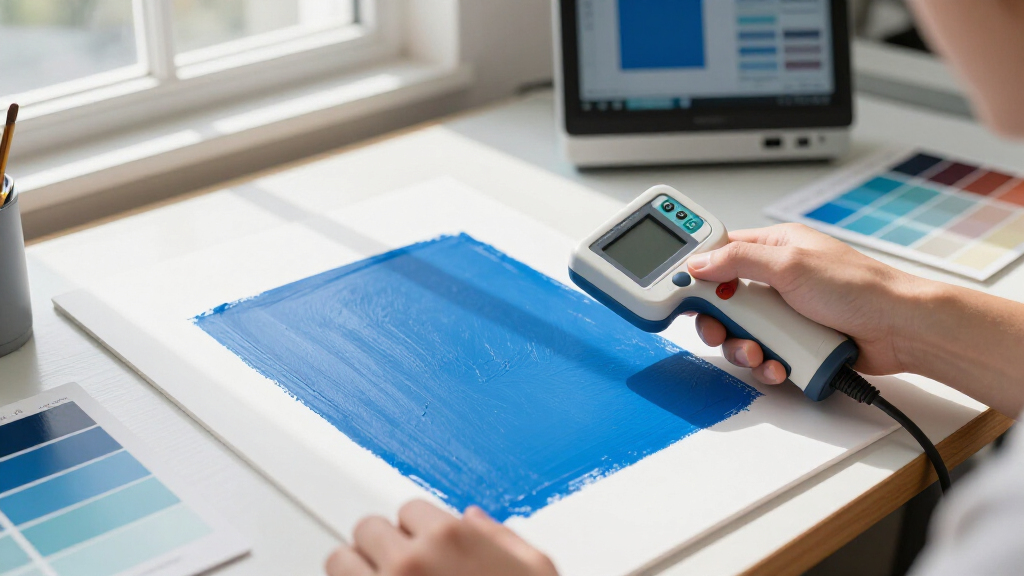
How We Picked
I ranked these instruments by how well their described capabilities map to real color-matching tasks: finding a usable match, taking repeatable readings, and interpreting the result. I weighed the intended workflow, aperture options, measurement geometry and standards where specified, display or app dependence, data storage, and practical positioning aids. I also treated claims such as high accuracy as one part of the picture, not a guarantee that readings will agree across devices or materials.
The ranking favors tools with a clear fit for common matching work and a manageable workflow, then distinguishes specialized and less-documented options by the tasks they appear suited to. Paint-focused models rise for paint users; configurable D/8 or multi-aperture units may suit technical work but can demand more setup and know-how. Because the product information does not establish comparable independent test results, I avoid treating unlike specifications as directly equivalent and call out where buyers should verify compatibility, software, calibration, and sample limits before choosing.
Factors to Consider When Choosing Handheld Spectrophotometer For Color Matching
I would choose a color meter by starting with the samples and decisions it must support, not by sorting models on a single accuracy claim. These factors help reveal when a simpler paint-oriented tool is enough and when a more configurable instrument earns its added complexity.
Match the aperture to the sample, not the label
Aperture size determines how much of a sample contributes to a reading, so it matters when the target is small, patterned, curved, or uneven. A larger opening can average a broader area, but it cannot make an irregular surface representative or fit into a tight location. Before buying, measure the smallest color area you regularly need to read and check the instrument’s contact footprint, not just its aperture specification. For textured materials, take repeated readings at several positions and compare the spread rather than trusting one result. Multi-aperture options can be useful across mixed sample sizes, though they add choices that operators must apply consistently. If you mostly match broad, smooth paint patches, flexibility may matter less than a simple, repeatable placement routine.
Check measurement conditions and color-difference settings
Two instruments can report different values for the same object when their geometry, illuminant, observer, or included specular treatment differs. D/8 and SCI references describe parts of a measurement approach; they do not by themselves prove that a device is suitable for every material or workflow. Ask whether the instrument can use the standards and settings required by your supplier, lab, or customer, then confirm that results can be compared on the same basis. Also check which color-difference formula the software reports and whether your team already uses a specific tolerance. A highly precise figure is not a substitute for matching the same settings from measurement to measurement. For occasional matching, compatible color libraries and clear guidance may be more useful than advanced controls you will rarely use.
Decide whether matching happens in an app or on the instrument
A phone-connected workflow can make it convenient to save readings, compare colors, and share results, but it ties daily use to compatible hardware, software, and connectivity. An onboard display can make a meter easier to use on a shop floor or at a customer site without opening a phone for every measurement. Neither format automatically provides better matching; the key question is how results move from reading to a usable formula, reference, or decision. Check supported operating systems, account requirements, library access, export formats, and whether the device still performs its main task when offline. If several people will use the meter, favor a workflow that keeps naming and saving consistent. Buyers who need traceable records should verify export and backup options before purchase rather than assuming data storage means easy reporting.
Treat calibration and repeatability as routine work
Calibration helps maintain readings against a reference, but it does not correct poor positioning, a dirty measurement port, or changing sample conditions. Look for clear calibration instructions, a supplied reference standard, and a practical schedule that fits how often the instrument will be used. Auto calibration can reduce operator steps, yet users still need to know when to run it and how to care for the reference surface. For repeat work, build a short procedure covering sample preparation, measurement location, number of readings, and instrument settings. This is especially helpful when multiple operators share a meter, since inconsistent technique can look like a color change. If a supplier or customer sets a tolerance, ask how the device’s repeatability and calibration process relate to that tolerance.
Pay for capabilities your workflow can actually use
Extra parameters, densitometry, visual observation, or camera locating can be valuable when they answer a defined measurement problem. They add less value if your main task is comparing a paint sample with a known reference and the software already provides a clear match. Before paying for more capability, list the materials, decisions, and records you need the instrument to handle in a typical week. Then check whether the feature is available in the included software or requires another device, subscription, or workflow. A more advanced meter can be the right choice for quality control, but it may slow down a small team that wants straightforward readings. Conversely, a basic color tool may leave a production user without the measurement settings or records needed to resolve disputes.
Test sample compatibility before committing
Color meters are easiest to use on stable, opaque, flat surfaces; translucent, glossy, metallic, fluorescent, or strongly textured samples can call for different methods. A device’s listed measurement geometry and aperture do not answer every question about those materials. Ask the manufacturer which sample types and measurement conditions it supports, and whether accessories or backing standards are needed. If color matching is tied to a particular paint system, verify that the relevant library or formula output is accessible in the software you plan to use. When possible, request a demonstration using your own sample rather than a smooth, idealized chip. That small check can prevent a mismatch between the instrument’s advertised capabilities and the materials you actually measure.
Frequently Asked Questions
Will readings from different handheld spectrophotometers match?
Not necessarily. Different geometry, aperture, calibration state, illuminant, observer, and software settings can produce readings that are not directly interchangeable. Even two units of the same model may need consistent calibration and measurement technique for close comparisons. If several locations or suppliers will share results, agree on settings and a reference procedure before collecting data. For a purchasing decision, ask whether the instrument can use the same conditions and color-difference method as the people who will act on its readings.
Is a high stated accuracy enough to choose a color-matching meter?
No: an accuracy figure describes only part of what matters in a working match. It does not tell you whether the aperture fits your sample, whether the meter uses the settings your process requires, or whether its software can turn a reading into a useful match. Precision, repeatability, calibration, and agreement with a reference workflow are related but distinct questions. Ask for the measurement conditions behind the claim and test the device on representative materials. For many buyers, dependable placement and compatible color libraries matter more than a headline number.
Should I choose a paint-focused tool or a configurable D/8 instrument?
Choose around the work you need the instrument to do. A paint-focused option may offer a more direct route from sample reading to a paint match, which can suit decorators, retailers, or occasional users. A configurable D/8 instrument may be a better fit when measurement settings, multiple parameters, or repeatable quality checks are part of a broader process. More controls can also bring more setup and training, so they are not an automatic upgrade for casual matching. Check software access and required standards before deciding, since those can matter as much as the handheld unit.
When is a multi-aperture meter worth choosing?
It can make sense if your work regularly spans small color targets and larger surfaces, or if sample size varies enough that one opening causes avoidable placement problems. The VTSYIQI model listed with 8 mm and 11 mm apertures illustrates that flexibility, while single-aperture units may be simpler for a consistent task. A larger aperture is not always better: the sample must be large and even enough to cover it, and the measurement area should represent the color you want to match. Confirm how the device changes apertures and whether each setting suits your materials. If all your targets are similar in size, multiple apertures may add little practical value.
What should I verify before using a handheld spectrophotometer for glossy or textured samples?
First confirm that the instrument is intended for that surface type and learn whether its measurement geometry includes or excludes specular reflection. Gloss, texture, curvature, and small color variation can all affect readings, so a single measurement may not represent the whole sample. Ask whether the maker recommends a particular orientation, backing, or number of readings. For textured or patterned materials, compare multiple locations and follow the same procedure each time. If a close match is business-critical, test the meter on your actual surface before relying on it for approval or production decisions.
Conclusion
For a straightforward paint-matching workflow, I would choose the Nix Spectro 2 as the best overall starting point, with the Spectro 1 Pro as a strong alternative for buyers focused on portable paint matching. The VTSYIQI 8 mm/11 mm model is my best fit for users who need aperture flexibility, while the multi-aperture D/8 instrument is the premium-style choice for technical users who need more measurement options and can verify the workflow requirements. Beginners should favor a clear paint-oriented process over a long list of settings; value-minded buyers should compare included software, storage, and support rather than choosing on a specification alone. For display-led or field work, consider the CNYST model with a display, and for data-heavy tasks, investigate options such as the Nix Spectro L or models with explicit storage and parameter features. Before committing, confirm sample compatibility, calibration steps, color libraries, and data export with the seller.
Halloween Picks
halloween
As an affiliate, we earn on qualifying purchases.