
🔍 Read the full analysis: How NVIDIA Cosmos3-H-Dreams Uses Generative Simulation For Clinical Surgery on ThorstenMeyerAI.com

Get the latest gadgets delivered free with Prime
- Fast, free delivery on millions of items
- Prime Video, Amazon Music and more included
- Member-only deals all year
TL;DR
NVIDIA has introduced Cosmos3-H-Dreams, a generative simulator trained on clinical gallbladder-removal video and robot-control data from CMR Surgical’s Versius platform. NVIDIA says it supports live instrument control on one RTX PRO 6000 GPU, but the supplied announcement reports no independent validation, clinical evaluation, or measured latency.
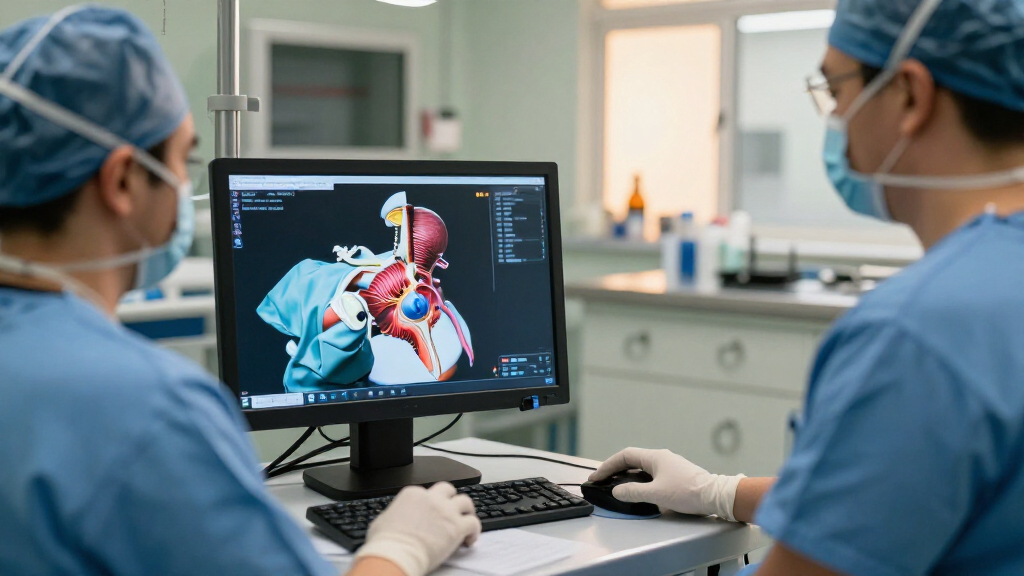
NVIDIA has introduced Cosmos3-H-Dreams, a generative simulator that produces surgical video in response to instrument controls, using recordings of clinical cholecystectomy procedures performed with CMR Surgical’s Versius platform. NVIDIA says it runs interactively on a single RTX PRO 6000 GPU, but the announcement does not establish that its generated scenes accurately model tissue or are suitable for clinical training or decision-making.
The model learns from synchronized surgical video and robot kinematics. Rather than explicitly calculating anatomy, tissue deformation and physical interactions through a numerical model, it generates subsequent video frames based on learned visual patterns and supplied instrument actions. NVIDIA says this setup supports live kinematic control, allowing a user to change controls and see generated scene continuations.
Cosmos3-H-Dreams is built on Cosmos3-H-Embodied-Nano, a 16-billion-parameter model pretrained on Open-H-Embodiment and then adapted with selected cholecystectomy footage and control data. The training samples focus on a left Cadiere grasper and a right monopolar hook. The action representation has 28 dimensions, covering both arms’ poses and gripper information, energy controls and thumbstick inputs. Training video is 832 by 480 pixels, with actions aligned at 10 Hz; that figure describes data alignment, not the model’s generation speed.
NVIDIA describes two released student checkpoints: one uses four denoising steps per video block, while another was trained with a two-step schedule intended to generate faster at a cost to visual quality. The system uses FlashDreams for streaming inference and an adapted FadeMem module to consolidate attention history during longer rollouts. NVIDIA says the combination runs interactively on one GPU, but provides no measured latency or frame-rate figure in the supplied material.
From Suturing Demos to Clinical Scenes
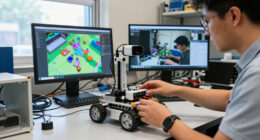
The development extends NVIDIA’s earlier Cosmos-H-Dreams work, which used tabletop suturing demonstrations from a dVRK setup, to video drawn from clinical gallbladder-removal procedures. Clinical scenes can include moving tissue, reflections, occlusion and smoke, creating visual conditions that differ from a controlled tabletop demonstration. A model that generates video in response to instrument actions could offer researchers and developers another way to examine possible surgical trajectories.
That possibility is not evidence of clinical readiness. A convincing-looking frame may still depict tissue movement or anatomy incorrectly, and the model’s output is generated from learned patterns rather than a demonstrated, validated calculation of tissue mechanics. For researchers considering simulation tools, the distinction matters: visual plausibility is not the same as biomechanical accuracy. The supplied material does not show that the simulator can safely support education, robot development, preoperative planning or patient care.
As an affiliate, we earn on qualifying purchases.
How the Simulator Generates Scenes
Cosmos3-H-Dreams follows an approach in which the model is trained on paired video and control data, then generates future video conditioned on actions. This differs from conventional numerical simulation, which typically represents geometry and physical interactions through explicit calculations. The generative approach may avoid building every scene detail into a hand-authored physical model, but it also makes validation of the model’s outputs central to judging its usefulness.
For longer sequences, NVIDIA says it first adapted a bidirectional teacher model on 24 future frames, then extended training to 72 frames, equivalent to 7.2 seconds at the 10 Hz action-alignment rate. It then distilled the teacher into a causal student that generates video in short blocks as new actions arrive. NVIDIA describes using causal teacher forcing and Self-Forcing, which exposes the model during training to its own generated context. FadeMem is intended to manage attention history as a rollout grows.
NVIDIA calls Cosmos3-H-Dreams, to its knowledge, the first real-time generative surgical simulator trained on clinical cholecystectomy recordings with live kinematic control. That is NVIDIA’s priority claim; the supplied source offers no independent comparison establishing it.
“Visual realism is therefore a starting point for validation, not proof of biomechanical accuracy.”
— NVIDIA, in the Cosmos3-H-Dreams announcement
medical training simulator for surgery
As an affiliate, we earn on qualifying purchases.
As an affiliate, we earn on qualifying purchases.
Accuracy and Evaluation Remain Open
The supplied announcement reports no independent validation study, clinical evaluation, measured generation latency, frame rate or failure rate. It also does not quantify how closely simulated tissue motion matches biomechanical measurements, whether anatomy remains stable across longer sessions, or how the system responds to actions outside its training distribution.
NVIDIA’s source describes physically accurate tissue deformation, but the supplied material includes no cited evaluation supporting that description. It is also unclear what safeguards would prevent a plausible but incorrect continuation from being mistaken for a reliable simulation. The announcement does not say whether the model has been assessed for surgical education, robot development, preoperative planning or patient-facing use. The single-GPU hardware claim does not, without latency figures, establish responsiveness for any particular workflow.
As an affiliate, we earn on qualifying purchases.
Validation Will Determine Its Use
The next evidence needed is independent testing that compares generated scenes with real surgical recordings and relevant measures of tissue behavior. Such work would need to report how well the model responds to controlled instrument actions, how often it produces errors, and whether performance holds across longer sequences and cases that differ from its training data. No such evaluation or timeline is included in the supplied announcement.
Until those results are available, Cosmos3-H-Dreams is best described as a research-oriented generative simulator with a stated single-GPU runtime, not as a validated clinical tool. Further technical reporting could clarify its measured speed, limitations and intended use; whether NVIDIA or independent researchers will publish those results remains unclear.
As an affiliate, we earn on qualifying purchases.
Key Questions
What is NVIDIA Cosmos3-H-Dreams?
It is a generative surgical-video simulator that produces video in response to instrument actions. NVIDIA says it was adapted using clinical cholecystectomy footage and robot-control data from CMR Surgical’s Versius platform.
Does it simulate real tissue mechanics?
The supplied material does not establish that it accurately models tissue mechanics. The system generates video from learned patterns, and no biomechanical validation results are reported.
What hardware does NVIDIA say it uses?
NVIDIA says the system runs interactively on one RTX PRO 6000 GPU. The announcement provides no measured latency or frame rate, so the hardware statement alone does not show how quickly it generates video.
Has it been approved or evaluated for clinical use?
The supplied source reports no clinical evaluation or approval and does not state that the model is intended for patient care. Its suitability for education, planning or other workflows remains unclear.
Primary source: Hugging Face · via ThorstenMeyerAI.com
Fall Picks
fall essentials
As an affiliate, we earn on qualifying purchases.