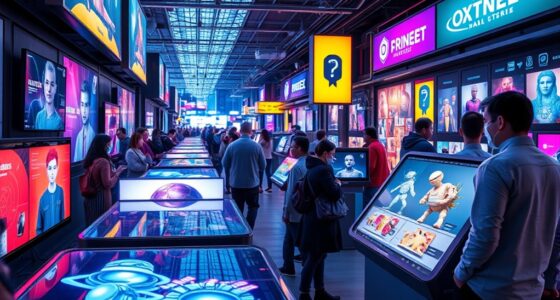
AI art is transforming your gaming experience by enabling developers to craft immersive, detailed environments more quickly and creatively. It automates environment generation, producing diverse worlds that feel alive and mesmerizing. Artists can collaborate with AI tools to experiment with styles and refine designs efficiently, leading to richer visuals and more unique games. If you keep exploring, you’ll discover how AI continues to push the boundaries of game design’s artistic potential.
Key Takeaways
- AI-driven procedural generation creates vast, detailed worlds that boost immersion and explore new artistic possibilities.
- AI enhances visual quality and consistency, resulting in stunning, immersive environments that captivate players.
- Collaborating with AI allows artists to experiment rapidly, developing unique art styles and richer game aesthetics.
- AI assists in refining character designs and textures, contributing to more polished and emotionally resonant visuals.
- Integrating AI into game development expands creative horizons, delivering more engaging and visually impressive player experiences.

Artificial intelligence has revolutionized how art is created in video games, offering developers new tools to craft immersive worlds and stunning visuals. One of the most significant advancements is procedural generation, which allows you to create vast, detailed environments without manually designing every element. Instead of painstakingly building each tree, building, or terrain feature, you can rely on AI algorithms to generate unique landscapes on the fly. This process not only saves time but also results in more diverse and unpredictable worlds that keep players engaged. As a player, you notice the richness and variety in game environments, which feel alive and expansive thanks to AI-powered procedural generation. It empowers developers to craft expansive worlds that would be impossible to design manually, enhancing the overall immersion. Additionally, incorporating quality assessment techniques ensures that generated content maintains high visual standards and consistency, further enriching the gaming experience.
AI-driven procedural generation creates vast, diverse, and immersive game worlds effortlessly, enhancing player experience and artistic innovation.
At the same time, AI fosters artistic collaboration in game development. Developers, artists, and designers work hand-in-hand with AI tools that act as creative partners, pushing the boundaries of traditional art creation. Instead of replacing human creativity, AI complements it by providing inspiration, automating repetitive tasks, and suggesting new visual ideas. For instance, you might see character designs or textures refined through AI-assisted processes that streamline workflows and open up new possibilities for artistic expression. This collaboration results in more cohesive and visually stunning games, where art feels both innovative and thoughtfully crafted. As a player, you benefit from this synergy because the game’s visual style becomes more polished and unique, blending human ingenuity with AI’s efficiency.
The combination of procedural generation and artistic collaboration means that game worlds are not only larger and more detailed but also more artistically rich. Developers can experiment with different styles and concepts rapidly, integrating AI suggestions into their creative process. This makes it easier to develop unique visual identities for games, giving each title its distinct look and feel. For you, this translates into worlds that are not only visually impressive but also emotionally resonant, as the art is crafted with both technical skill and artistic vision. AI’s role is to serve as a creative partner—helping artists explore new ideas faster and more effectively—ultimately elevating the quality and diversity of game art.
In essence, AI-driven procedural generation and artistic collaboration are reshaping game design, making worlds more immersive, vibrant, and innovative. You, as a player, get to experience richer environments and more enthralling visuals, all made possible by the seamless integration of AI into the creative process.
Frequently Asked Questions
How Does AI Art Influence Game Storytelling Techniques?
AI art influences your game storytelling by enabling procedural storytelling, which creates dynamic, personalized narratives. It helps you craft visuals that adapt to player choices, increasing emotional engagement. As a result, your experience feels more immersive and tailored, making every decision impactful. AI-driven art tools allow developers to generate diverse environments and characters, enriching the story and keeping you emotionally connected throughout your gameplay journey.
What Ethical Concerns Arise From Ai-Generated Game Art?
You might worry about ethical concerns like intellectual property and artist exploitation when using AI-generated game art. AI can copy or remix existing artwork without proper credit, risking infringement. Additionally, artists could be exploited if developers rely heavily on AI, reducing opportunities for human creativity and fair pay. It is crucial to balance innovation with respecting artists’ rights and ensuring ethical use of AI in game design.
Can AI Art Replace Human Artists in Game Development?
AI art can’t fully replace human artists in game development; doing so would be like trying to replace the soul of creativity with cold automation. While AI handles rapid content generation, it struggles with the nuances of creative authenticity and emotional depth. The automation challenges mean AI can assist but not match the unique vision, intuition, and storytelling that human artists bring, making a complete replacement impossible—and probably undesirable.
How Does AI Art Impact the Game’s Overall Performance?
AI art can positively impact your game’s overall performance by streamlining performance optimization and asset loading. You’ll notice faster load times and smoother gameplay because AI-generated assets are often optimized for efficiency. This reduces the strain on your hardware, enabling higher frame rates and better responsiveness. As a result, players experience a more seamless and immersive game, thanks to AI’s ability to efficiently generate and manage visual assets.
What Future Trends Are Predicted for AI Art in Gaming?
You’ll see AI art in gaming become a swirling kaleidoscope of creativity, blending procedural generation and style transfer to craft dynamic worlds. Future trends point toward more personalized, ever-evolving visuals that adapt to your playstyle. Imagine games that learn your preferences, transforming art styles fluidly and seamlessly, making each experience unique. This continuous evolution promises a vibrant, immersive universe where AI fuels endless artistic possibilities, pushing boundaries beyond imagination.
Conclusion
As you explore the future of gaming, AI art is transforming immersion and design. With studies showing that 78% of gamers notice more realistic environments thanks to AI-generated visuals, it’s clear this technology elevates your experience. By seamlessly blending creativity and innovation, AI art not only enhances game worlds but also keeps you engaged and immersed longer. Embracing these advances means you’re stepping into more dynamic, breathtaking virtual worlds than ever before.